
Ahoi Ashtami 2026: Why This Fast Ends at the Stars
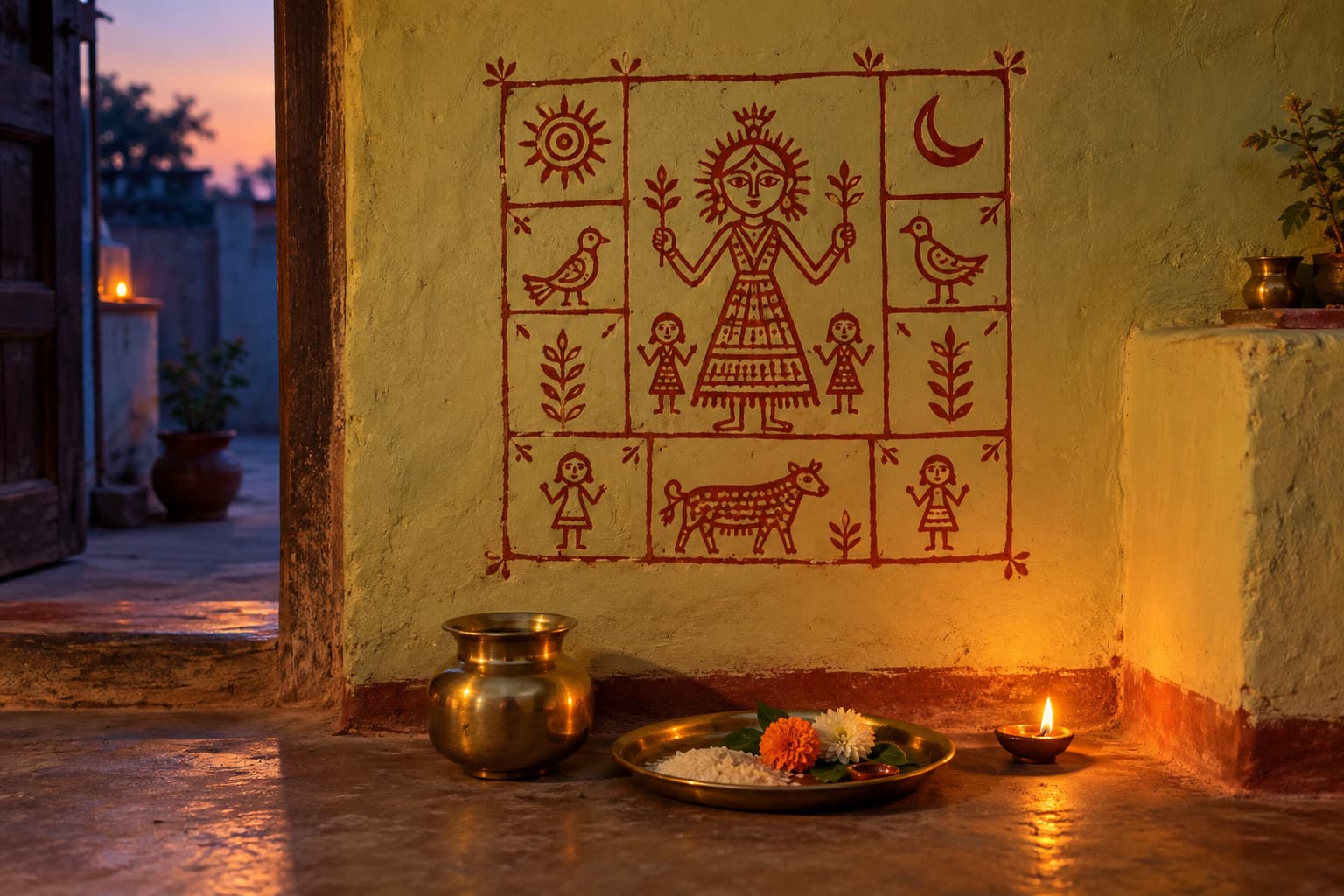
Ahoi Ashtami 2026 falls on Sunday 1 November, and the fast ends at the first stars — not at moonrise. Mothers keep it from dawn without food or water, for the long life and wellbeing of their children.
In Delhi the stars can be looked for from about 6:00 pm that evening. The moon does not rise until 11:40 pm. Those two numbers, nearly six hours apart, are the whole reason this day is not a second Karva Chauth.
Key takeaways
- Ahoi Ashtami 2026 is Sunday 1 November. The puja muhurat runs 5:36 pm to 6:54 pm, and the stars can be sighted from about 6:00 pm.
- It is Kartik Krishna Ashtami in the north Indian reckoning and Ashvin Krishna Ashtami in Gujarat and Maharashtra — one day wearing two calendar names, not two different festivals.
- The fast is usually nirjala: no food and no water from dawn. It is broken at the stars, though some families wait for the moon.
- The same date is Radha Kunda Snan in Braj: a midnight bath.
When is Ahoi Ashtami in 2026?
Sunday 1 November 2026. The timings below are calculated for New Delhi, and they are the ones worth checking against a panchang set for your own city rather than a forwarded screenshot.
| New Delhi, 2026 | |
|---|---|
| Ashtami tithi begins | 2:51 pm, Sunday 1 November |
| Puja muhurat | 5:36 pm to 6:54 pm |
| Evening time for sighting the stars | about 6:00 pm |
| Moonrise | 11:40 pm |
| Ashtami tithi ends | 1:10 pm, Monday 2 November |
Notice that the tithi does not begin until mid-afternoon. The fast still starts at dawn, as fasts do, but the puja and the breaking of it are pinned to that short evening window inside the tithi. This is an evening observance with a long morning attached to it.
Why does this fast end at the stars and not the moon?
Because the moon is not the marker here, and in Kartik it could not usefully be one.
The moon on the eighth night of a dark fortnight is thin and late — 11:40 pm in 2026. A household that waited for it would be holding a nirjala fast six hours past dusk, with children in the house and work the next morning. The stars, by contrast, are there as soon as the light goes.

So water is offered to the stars from the karva, and the fast closes. The written tradition is honest about the variation: it is broken after sighting the stars or the moon, according to a family's own practice. If your household has always waited for the moon, that is not an error to correct.
The confusion with Karva Chauth, three days earlier, is understandable — same month, same dark fortnight, same vessel of water held up to the sky. But Karva Chauth is pinned to a moonrise time that almanacs publish city by city, and the questions that come up when the moon is not visible are specific to that. Ahoi Ashtami simply does not depend on it.
Who keeps the fast, and for whom?
Mothers, for their children.
That is the plain answer, and it is worth sitting with rather than softening. The katha at the centre of this day is a story about a woman who loses all seven of her sons inside a year. The vrat she is given is not a wish for prosperity or a good match or a long marriage. It is a fast against the death of a child, kept in a world where that was not a remote possibility but an annual one.
The rite has outlasted the conditions that made it urgent, which is the ordinary fate of a good observance. Families keep it now in houses where the fear is milder and the attention is the same.
What is drawn on the wall?
Ahoi herself, in geru — red ochre — on a cleaned patch of wall. Households that would rather not redraw it every year embroider the same figure onto a piece of cloth and bring that out instead.
The picture carries the goddess and young children, set among eight compartments: the ashtha koshthak. The ashtami in the name of the day is sitting there in the drawing, counted out in panels.
There is also an animal with her young, and which animal it is depends on where you look. Hindi accounts of the vrat describe a porcupine — syahu, or sehi — and that is the creature in the katha as it is usually told. English-language descriptions often put a lion there instead. If the two do not match, the Hindi one is the older road.
What is the syau, and why does it gain beads?
In families that keep the custom, a small silver Ahoi is made. It is worshipped with the drawing and then worn at the neck on a thread, with two silver beads beside it. That silver figure is the syau.

Where the custom is kept closely, the necklace grows. Beads are added as the family does — accounts differ on exactly what earns each one, so this is a question for the oldest woman in your own house rather than for the internet.
It is a modest object and it does a great deal of work. A piece of silver that gains something each time the family does is a record of exactly the thing the fast was always about: that the line held. Nobody writes anything down. The silver counts.
What does the katha actually say?
A moneylender's wife goes out to dig clay. The earth is for the replastering that happens before Diwali, which places the story in the same week of the year as the fast itself. Her spade comes down on a young animal she had not seen — a porcupine's in the Hindi telling, a lion's in many English retellings — and it dies.
The curse that follows takes all seven of her sons within the year. She is eventually directed to worship Ahoi, keeps the fast on Kartik Krishna Ashtami, and the loss is undone.
What the story is careful about is intention. She is not cruel and she is not punished for cruelty. She is punished for harm she did not mean and did not notice, done while preparing her house for a festival. The remedy offered is not an apology but an annual act of attention. For the fuller telling, and the regional variants, the Wikipedia entry on Ahoi Ashtami collects them in one place.
Why do Gujarat and Maharashtra call it a different month?
Because they count months from a different end, and the day falls in the gap.
In the purnimanta reckoning used across most of north India, a month closes at the full moon, so the dark fortnight that follows belongs to the month ahead — Kartik. In the amanta reckoning used in Gujarat, Maharashtra and the south, a month closes at the new moon, so that same dark fortnight is still the tail of the month behind — Ashvin.
Nothing about the sunset changes. Two households in Somnath and in Lucknow keep the identical fast on the identical Sunday and name the month differently, and both are right. It is the same arithmetic that makes people argue about Chhath and Holi dates every year, and the same answer settles it: ask which reckoning, not which date.
Where the day sits in the week around it
Ahoi Ashtami opens the long run-in to Diwali rather than standing on its own. Karva Chauth has passed three days before. The clay has been dug and the walls are being made ready. Dhanteras is five days ahead on Friday 6 November, and Lakshmi Puja falls on Sunday 8 November — the shape of those five days is already being planned around this fast.
Panchangs mark Radha Kunda Snan on 1 November too — a bath in the tank at Radha Kund, near Govardhan hill in Braj, kept by couples who want a child, with a white pumpkin offered in red cloth. Both days are asking after children.
The hour is the strange part. The nishita window runs 11:39 pm to 12:31 am, so the bath opens a minute before the moonrise this fast pointedly ignores and ends on Monday 2 November by the clock, while belonging wholly to Sunday night. A night rite and a daylight rite do not want the same day.
So if the house feels like it is in the middle of something on 1 November, it is. The year's biggest week of cleaning, lamp-buying and visiting starts roughly here, and the first thing asked of it is an evening of attention paid to the children in it.
Look for the stars early. They come before you expect them in November.
Questions people ask
When is Ahoi Ashtami in 2026?
Sunday 1 November 2026. The Ashtami tithi opens at 2:51 pm that afternoon and closes at 1:10 pm on Monday 2 November, so the whole observance sits inside Sunday evening.
Is the Ahoi Ashtami fast broken at the stars or at the moon?
At the stars, in most households. Arghya is offered to the stars with water from the karva once they appear, around 6:00 pm in Delhi in 2026. Some families wait for moonrise instead, and both are long-attested — your own family's practice decides it.
Can you drink water during the Ahoi Ashtami fast?
In most households, no. It is usually kept nirjala, without food or water, from dawn until the stars are sighted. Families adapt this for age, pregnancy and illness, and that adaptation is ordinary rather than a lapse.
Is a lion or a porcupine drawn on the Ahoi Ashtami wall?
Hindi accounts of the vrat describe a porcupine, syahu or sehi, with her young, and that is the animal in the katha as it is usually told. English-language descriptions often put a lion there instead. The silver pendant, the syau, takes its name from the same word as the porcupine.
Is Ahoi Ashtami only for sons?
The katha names seven sons, and older descriptions of the vrat follow it. The observance as it is generally described now is kept for the wellbeing of children, without that restriction.


