Aripan vs Rangoli: What Mithila's Floor Art Really Is
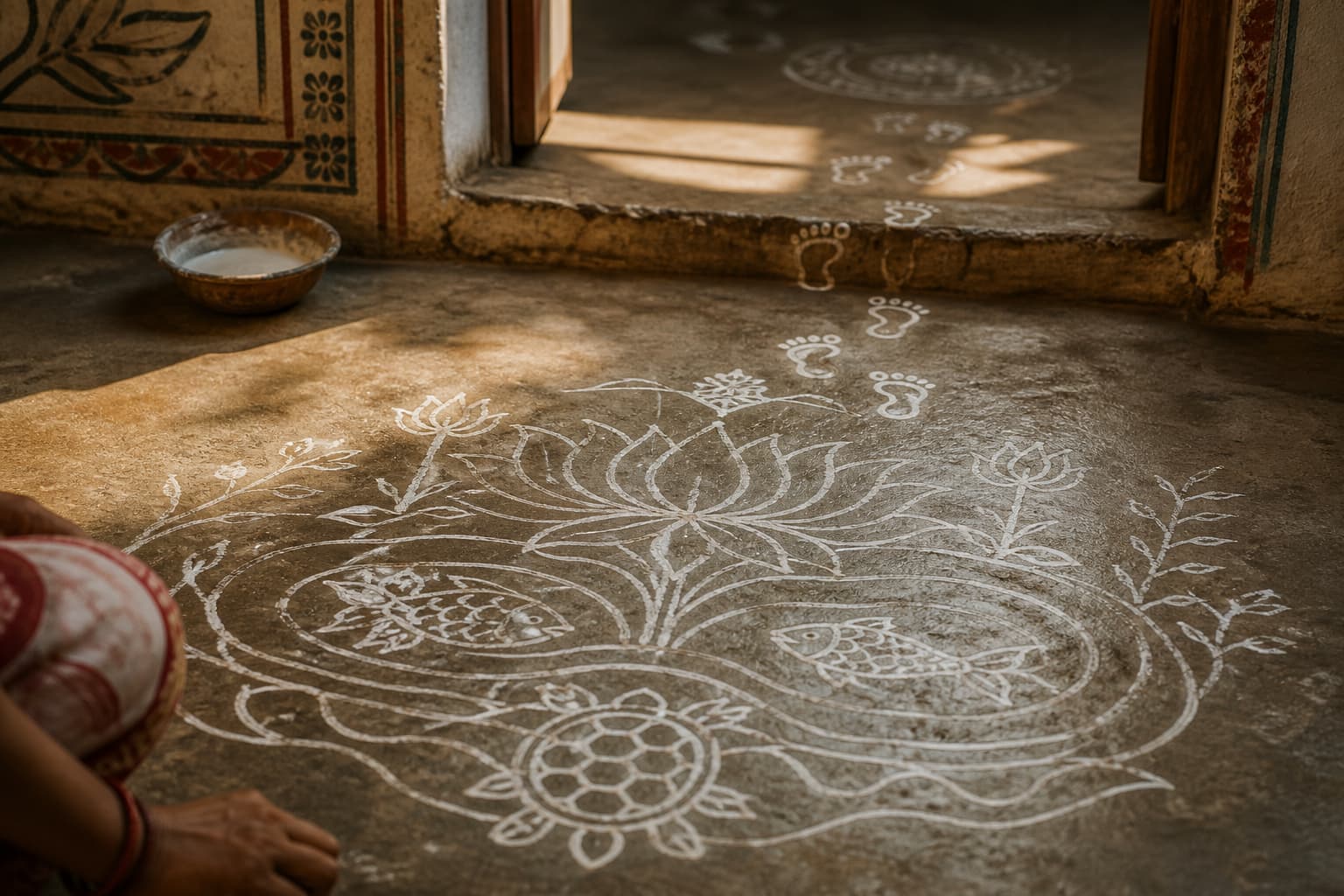
In my lane in Madhubani, you can tell a festival is close before anyone says so. The floors get swept twice. A bowl of soaked rice sits by the wall, going soft. And by afternoon the women of the house are down on their knees near the threshold, drawing — a lotus opening out of a pond, a tortoise, two fish, a run of small footprints walking in toward the room. White lines on a cleaned floor, made with nothing but ground rice and water and the tip of a finger.
Visitors photograph it and, almost always, call it rangoli. I have stopped correcting people in the moment, because it sounds like a small thing to fuss over. But it is not a small thing. When you call an aripan a rangoli, you have quietly decided it is decoration — something pretty to fill an empty patch of floor. And decoration is exactly what it is not. Every one of those lines is doing a job. Miss that, and you are looking at a language you have decided not to read.
I paint. My family has drawn on walls and floors and paper for as long as anyone remembers. So let me set down, plainly, the things people most often get wrong about aripan — not to scold anyone, but because the misunderstandings are so common that the real thing is disappearing behind them.
Mistake one: thinking it is decoration
A rangoli, in most of the country, can be drawn because a floor looked bare. It welcomes, it brightens, it can be as elaborate or as festive as you like, and if you skip it one day nothing is lost.
An aripan is drawn for something. There is no aripan floating free of a reason. It goes down for a particular vrat, a particular deity, a particular moment — Tusari, Kojagara, Sama-Chakeva, the Madhushravani fast a new bride keeps, the kohbar drawn in the marriage room. The design is not chosen because it is beautiful; it is chosen because this is the aripan that belongs to this rite. Ask a Mithila grandmother to draw "a nice aripan" with no occasion attached and she will look at you as if you asked her to sing a wedding song at a funeral. The occasion comes first. The drawing serves it.
So the first correction is the hardest, because it is a whole way of seeing: an aripan is not there to be looked at. It is there to be done.
Mistake two: reaching for coloured powder
Walk into a craft shop and you will find packets of bright synthetic rangoli powder in ten colours. People buy them, come home, and make what they think is an aripan in pinks and greens.
The medium of aripan is pithar — rice ground to a paste with a little water, applied white with the fingers, not poured from a pinch of dry colour. The white is not a limitation someone forgot to fix. Rice is the offering; it is the grain of the household, of the harvest, of survival, and to draw the sacred diagram in rice is part of the meaning. Where colour comes, it is usually a restrained touch — a line of vermilion, sometimes a wash of turmeric yellow — and it carries its own weight, not decoration for its own sake. Reach for the ten-colour packet and you have made something that looks festive and means nothing. The rice was never incidental.
Mistake three: treating the motifs as random pretty shapes
This is the one that hurts a painter to watch. People copy an aripan they saw, keep the lotus and the fish and the footprints because they liked how they looked, and rearrange them however fits the space.
But the motifs are a vocabulary, and the vocabulary is precise. The lotus — kamal — with its counted petals is the seat, the yoni, the generative centre; you do not add petals because there is room. The purain, the lotus leaf and pond, is the water of life the whole design grows out of. The bamboo — baans — stands for lineage, for the family continuing. The tortoise is stability, the ground the world rests on. The fish are fertility and plenty. The small footprints walking inward are Lakshmi's, coming into the house, and they always face in, never out; draw them leaving and you have, without meaning to, drawn prosperity walking away.
None of this was ever written in a book my grandmother read. It was drawn into her hands by watching her own mother, thousands of times, and it does not tolerate improvisation the way a rangoli does. A rangoli you can invent. An aripan you inherit.
Mistake four: skipping the floor itself
People will spend an hour on the drawing and give no thought to what it is drawn on. In the old way, the surface is prepared: the floor swept, washed, often smoothed with a wash of cow dung and left to dry, so the white rice line sits clean on a dark, even ground. The preparation is not a chore that comes before the ritual. It is the start of the ritual — the making of clean ground for the sacred to be invited onto.
Drawn on an unswept floor, over yesterday's dust, the finest lotus is only a picture. The cleaning is the first line of the aripan, even though it leaves no mark.
Mistake five: confusing aripan with Madhubani painting
Because both come from the same soil, people fold them together — they assume the bright Madhubani paintings sold on paper and the white floor aripan are the same art in two places. They are cousins, not twins, and the difference matters.
The paintings are, today, also an art you can frame, sell, and hang in a gallery in Delhi or Berlin. The aripan is not for sale and cannot be hung. It is drawn on the ground, for a rite, and then it is walked over — feet cross it, the puja happens on it, and within a day it is swept away or dissolved by the next washing of the floor. Its impermanence is not a flaw. A thing made for a single sacred hour is not meant to last; the meaning was in the making and the using, not in keeping it. To try to preserve an aripan is to misunderstand it as thoroughly as to sell one.
Why I keep insisting on the difference
None of this is about guarding a border for its own sake. It is about not losing a thing while we still have it. Every year fewer floors in Madhubani carry a full aripan, and more young people know the word rangoli from a phone than know the aripan their own great-grandmother drew for her wedding. When the name goes, the grammar goes with it, and then a lotus is just a flower and footprints are just a pattern.
If you keep a home far from Mithila and want to try, you do not need to get it perfect. Sweep and wash a patch of floor. Grind a little rice with water. Draw a lotus with the tip of your finger, and Lakshmi's footprints walking in toward your puja corner, on the morning of a fast or a festival you keep. Light a lamp beside it, and a stick of something clean and quiet — in our houses it was always a plain sandal note, still rolled by hand a district away in Samastipur, part of the temple and fragrance ranges that carry these places in their names. Then do your prayer on it, and let it be swept away after.
That is the whole thing. Not a picture to admire, but a clean floor, a counted lotus, a grain of rice, and a door drawn open for what you are asking to come in. Call it aripan, and read the lines. They were always saying something.