
The Bamboo Stick Inside Every Hand-Rolled Agarbatti
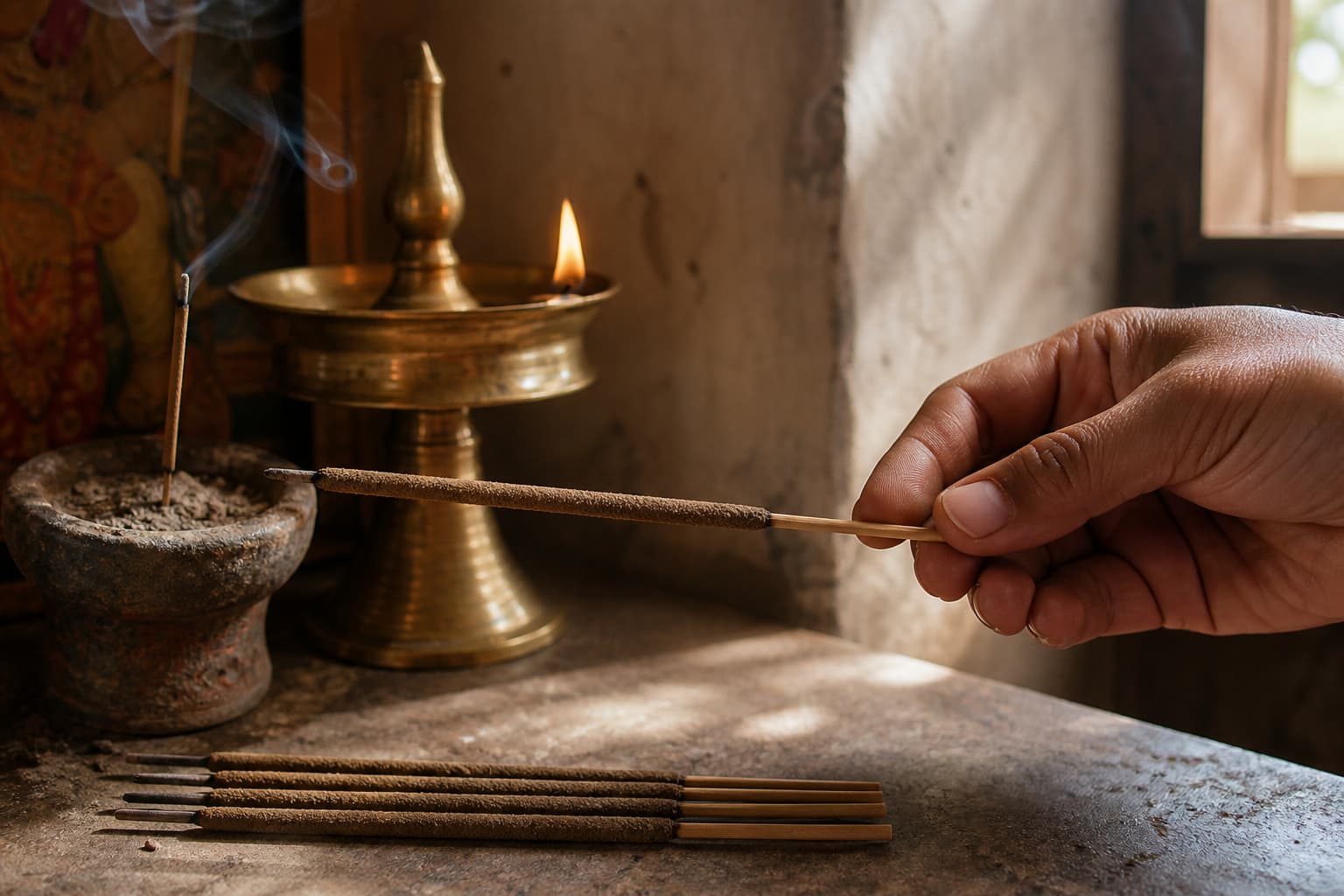
When we light a stick in front of the lamp at home in Thrissur, my mother still checks it the way her mother did — a small turn between the fingers, a glance down its length before it goes into the holder. She is not smelling it. She is looking at the stick. Is it straight. Does it sit true. Whether it will stand and burn down without leaning into the wall or dropping ash across the floor.
That habit is about the part of an agarbatti nobody thinks to praise: the thin bamboo splinter running down the middle of it. The fragrance gets the packaging and the poetry. The bamboo gets ignored until the moment it fails you.
The stick before the incense
Strip the paste away and what is left is a length of bamboo about the thickness of a broom bristle, usually eight or nine inches long, with an inch or so at the base left bare so you have somewhere to hold it. That bare tip is the handle. The rest is the skeleton the whole stick is built on.
Most of this bamboo does not come from Bihar at all. It comes down from the northeast — Assam, Tripura, the bamboo country where the plant grows thick and fast and straight. Poles are split lengthwise, again and again, until you have thin round splints. Round is the word that matters. A good agarbatti stick is round in cross-section, not flat, not square. A flat sliver burns unevenly, chars on one face and stays raw on the other, and tends to curl as it burns because one side loses heat faster than the other.
By the time these splints reach a rolling table in Samastipur, they have already been sorted — by length, by thickness, by whether they are true. It sounds like a small thing. It is not. A rolling worker can turn out a beautiful, even coat of masala and still hand you a stick that burns crooked, because the bamboo underneath it was crooked to begin with.
What the bamboo has to do
People assume the bamboo is just a stick to hold the fragrance. It does more work than that.
It is the wick. The bamboo carries the ember down the length of the stick at a steady pace, the way a candle wick draws the flame down the wax. A denser, better-seasoned splint burns slower and more evenly. A dry, pithy, or hollow one races ahead in some places and stalls in others, which is why a cheap stick sometimes burns in fits — a bright run, then a sulk, then a bright run again.
It is the spine. Incense paste is heavy when wet. A stick has to stay rigid enough to be rolled, to be laid out flat to dry without sagging in the middle, and later to stand upright in a holder through a twenty-minute burn without bowing toward the heat. That rigidity is the bamboo's job entirely. The masala does not hold anything up; it only rides along.
And it is the thing that decides whether the ash holds or falls. When the coat burns clean and the core is sound, the ash keeps the stick's shape and curls over gently before it drops. When the core is weak or damp, the ash breaks early and lands on the shelf, on the cloth, on the floor of the puja room — the small daily nuisance that makes people quietly stop buying a brand without ever knowing why.
What goes wrong
Ask anyone who has spent a monsoon around a workshop and they will tell you the bamboo's worst enemy is water — not the rain outside, but the damp that lives in the splints if they are stored badly.
Bamboo drinks moisture out of the air. A bundle left in a humid corner through July will feel dry to the hand and still carry enough water inside to ruin a batch. Roll fresh paste onto a damp core and the stick takes far longer to dry, and even then it can stay soft at the heart. Light it and you get that tell-tale hiss, a stick that will not hold its ember, smoke that turns sharp and grey instead of clean. The fragrance you blended so carefully is buried under the smell of the stick struggling to burn.
Then there are the flaws you can see if you look. A splint with a knot in it — the little raised node where the bamboo joint was — has a hard spot that the ember has to fight through, so the stick pauses there. A splint that was split off-centre is thicker on one edge, and it burns toward the thin side and curls. A hairline crack, invisible under the coat, snaps halfway down and drops the top half into the tray. None of this is exotic. It is the ordinary reason a stick misbehaves, and almost all of it is settled before a single drop of fragrance is added.
This is the unglamorous truth of the craft that our own Char Dham temple range rests on as much as any other stick we make: the perfume is the last thing to go on, and the first thing people notice, but the bamboo was chosen and sorted and kept dry long before, and it quietly decides whether that perfume ever gets a fair burn.
Why the old hands still check the stick
There is a reason my grandmother turned each stick before she lit it, and it was not superstition. She had grown up when incense was rolled at home or bought loose from someone she knew, and a bad stick was a small daily offence — ash on the swept floor, a lopsided burn in front of the deity, a fragrance that never quite arrived. She had learned to read the core through the coat: the weight of it, the straightness, the faint give when you pressed it.
You can do the same, and it takes two seconds. Roll the stick lightly between finger and thumb before you light it. It should feel firm and true, not soft, not warped. Hold it up and sight down its length the way you would sight down a pencil — a good one is dead straight. Set it in the holder and it should stand without leaning. A stick that passes those three small tests will almost always burn clean to the end, hold its ash, and let the fragrance come through the way it was meant to.
None of this is written on the box. The bamboo is the humblest part of the whole object, hidden the moment the paste goes on, gone entirely by the time the stick is ash. But it is doing the quiet structural work the whole ritual depends on — standing straight in front of the lamp, carrying the ember down at an even, unhurried pace, holding its shape until there is nothing left to hold. The fragrance is what you remember. The stick is what makes the fragrance possible.


