Bhasma Aarti at Mahakaleshwar: Why It Begins With Ash
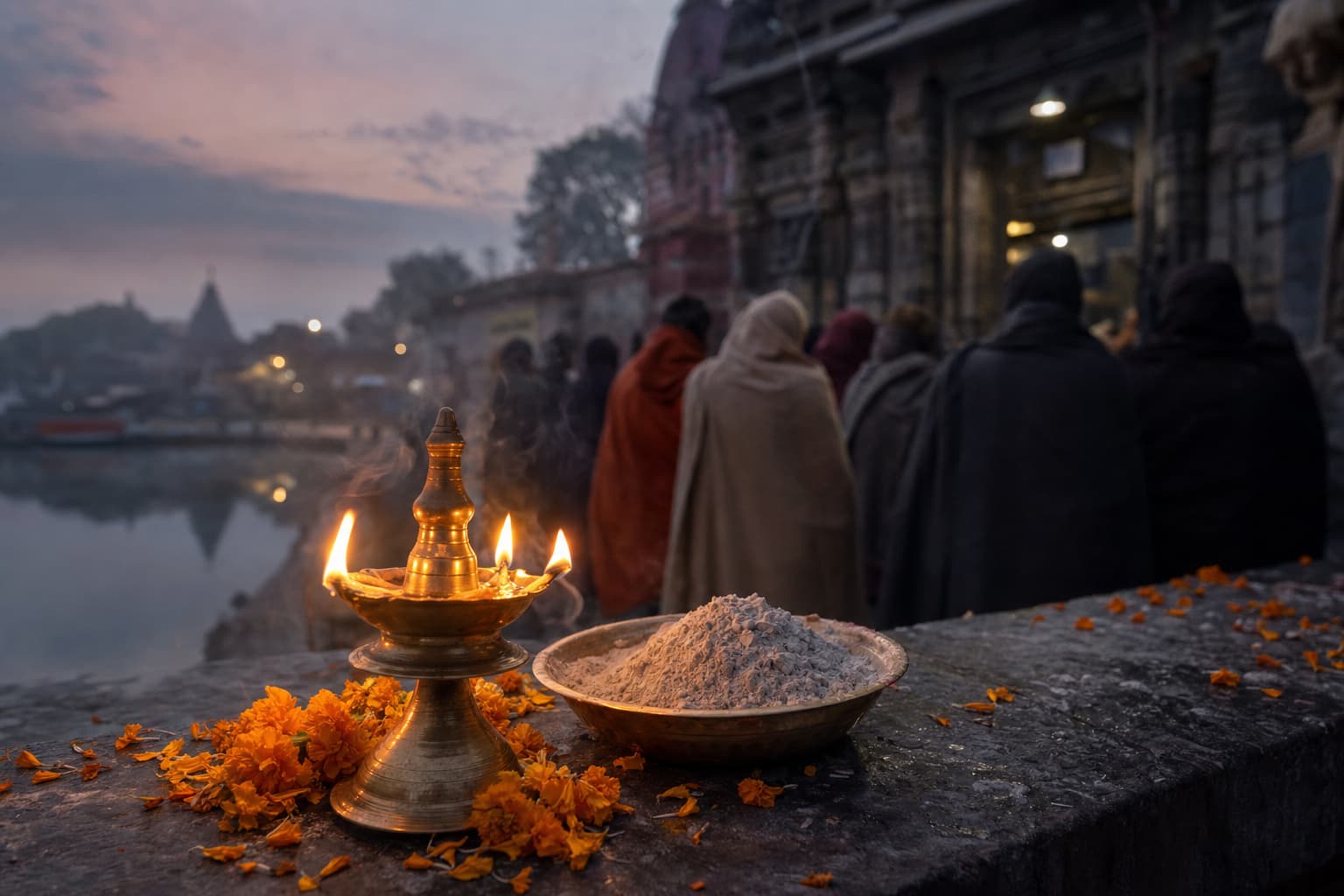
There is a moment, a little before four in the morning, when the old city of Ujjain is as quiet as it ever gets. The tea stalls near the Rudra Sagar are still shuttered. The Kshipra runs black and unhurried. And a line of people stands outside the Mahakaleshwar temple in the cold, having come — some of them across oceans — to watch a stone be covered in ash.
I want to make an argument that runs against the way the Bhasma Aarti is usually described. It is not a spectacle. The photographs make it look like one: the smoke, the drums, the priest moving in the half-dark. But if you go for the spectacle, you have already missed it. The Bhasma Aarti is the one aarti in the whole of the Shaiva world that begins by reminding you that you are going to die. Everything about how it is conducted exists to keep that reminder intact.
What the ash is, and what it is not
Bhasma means ash. That is the whole of it, and it is the difficulty of it.
The name most often attached to this shrine is Mahakal — the great time, or the lord of death. Time is the god here, and time is the one thing none of us negotiate with. So the central offering is not flowers, not milk, not gold. It is the residue that everything becomes when time is finished with it. When the priest lifts the ash and lays it over the lingam at the heart of the sanctum, the ritual is stating something plainly that the rest of our lives are arranged to help us forget: this, too, is what you are.
You will hear it said that the ash was once gathered from cremation grounds — that the Bhasma Aarti used fresh ash from a pyre. Whether that was ever the settled practice at Mahakaleshwar, I will not claim to know, and I would be careful of anyone who states it as fact. What I can tell you about the present is precise: the bhasma used today is prepared ritually, most commonly from the ash of dried cow-dung cakes and specified sacred materials, purified before it ever reaches the sanctum. The meaning does not depend on the source being grim. The meaning is in the substance itself. Ash is what does not burn again. It is the end state. To worship with it is to place the end of things at the very centre of the morning.
Why it happens before dawn
People assume the four o'clock timing is about beating the crowds, or about some idea that the early hours are "auspicious" in a vague, decorative way. It is more exact than that.
The Bhasma Aarti is held in the brahma muhurta, the stretch of roughly an hour and a half before sunrise. In practice, this is the only part of the day that belongs to no one. There is no commerce in it, no heat, no queue for darshan pressing at your back, no phone in your hand — phones and leather are left in the lockers, and rightly so. The hour is stripped of everything that usually fills our attention. And it is precisely then, in that emptied-out hour, that the temple performs the one rite designed to empty you out further.
The lingam at Mahakaleshwar is Dakshinamukhi — it faces south, the only Jyotirlinga said to do so. South is the direction of Yama, of death, in the traditional reckoning. None of this is arranged for atmosphere. It is arranged so that the confrontation cannot be softened. You have come, at the coldest and most defenceless hour, to face the deity of death, who is being dressed in ash, facing the direction of death. The consistency of it is the point.
The discipline is not bureaucracy
To attend the Bhasma Aarti from inside the sanctum, you must book a pass in advance through the official temple channel, and there are rules: modest dress, traditional attire for those participating closely, no photography during the rite itself, arrival well before it begins. Every year visitors grumble about this. It feels like officialdom wrapped around something sacred.
I want to defend the rules, because I think they are doing the real work. A ritual about impermanence is extraordinarily easy to convert into a performance about yourself — your pilgrimage, your photograph, your story to tell back home. The restrictions exist to prevent exactly that conversion. When you cannot film it, you have to be present for it. When you must arrive in the dark and wait, you arrive already stripped of the day's momentum. The discipline is not standing between you and the experience. The discipline is the experience. Remove it and you are left with tourism, which is a fine thing but is not this.
If you cannot get an inner pass — and many cannot, especially in Sawan when the whole of Malwa seems to be in that queue — do not treat it as a loss. You can stand for the aarti from the outer hall, or come for an ordinary morning darshan on a weekday, when the shrine is quieter and you can actually stay a while. Mahamaya makes an incense named for Mahakaleshwar in its Jyotirlinga range, and lighting it at home at four in the morning is not the Bhasma Aarti and does not pretend to be. But the hour is available to anyone, anywhere. The brahma muhurta is not ticketed.
What Sawan does to all of this
Through the month of Sawan, and on the Mondays especially, Ujjain fills past its seams. Kanwariyas arrive with water for the abhishek. The queues that take twenty minutes in winter take three or four hours. Every guesthouse near the temple is full.
It is worth understanding why the pressure lands here and not only at the more famous northern shrines. Mahakaleshwar is the Jyotirlinga of the heartland, the one that the pilgrim routes of central India have always turned around. For a Shaiva household, Sawan is Shiva's month, and to be in Ujjain for a Monday in Sawan is to be at the source. If you are planning a visit for the season, plan it the way you would plan for weather: assume the crowds, arrive on a weekday if the calendar allows, book what can be booked well ahead, and keep your expectations of comfort low and your patience high.
The argument, one more time
Watch people leave the Bhasma Aarti and the difference shows. The ones who came for the photograph look mildly cheated — it was dark, it was crowded, they could not get a clear shot. The ones who understood what they had come for look different. Quieter. As if something had been said to them directly.
Because something was. Strip away the drums and the smoke and the early hour, and the rite is one sentence, delivered in ash: you are time's, and time takes everything back. That is not a morbid thought when you actually sit with it before dawn. It is a clarifying one. It is why the temple guards the ritual so carefully, why the ash and not the flower is the offering, why the god faces south, why it must happen in the emptiest hour there is.
You do not need to go to Ujjain to receive the lesson. But if you do go, go for the ash — not the picture of it.