
Bhondla, Hadga and Bhulabai: Navratri in a Courtyard
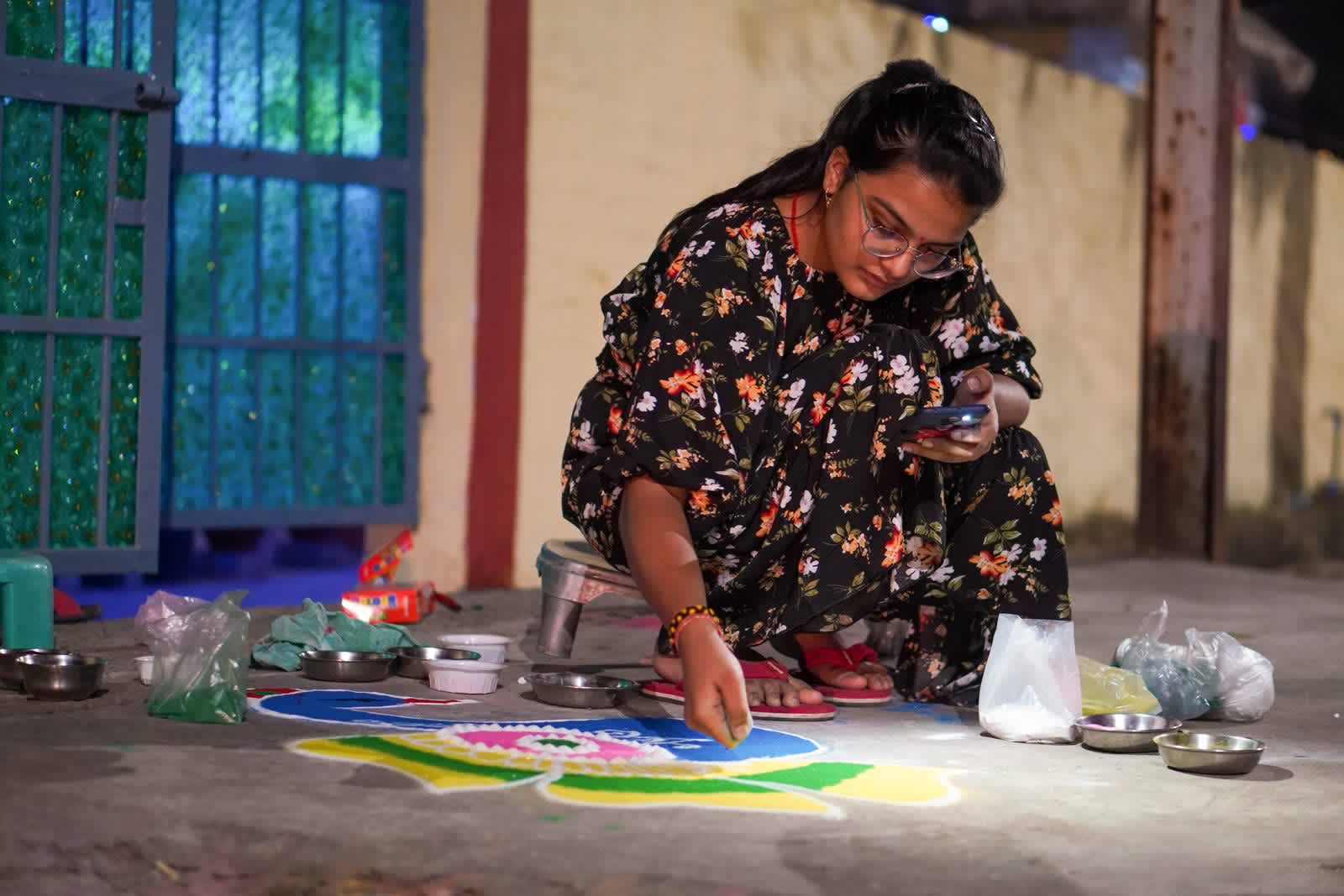
The courtyard gets swept twice on those evenings. Once in the morning, the way it always is, and again around five, properly, with water, because something is going to be drawn on it and the drawing will not sit on grit.
I grew up in Nashik, which is a useful place to grow up if you want to understand this custom. Pune and Mumbai are one way, Khandesh is the other, and what the women and girls do through Navratri evenings has a different name depending on which direction the family came from. Here are nine things about it that took me an embarrassingly long time to get straight.
1. It has three names, and the map of those names is not reliable
Bhondla, Hadga, Bhulabai. Ask what the difference is and you will be told, confidently, that Hadga is the western Maharashtra and Konkan word, Bhulabai is what Vidarbha and Khandesh say, and Bhondla is everywhere else. Ask somewhere else and you will be told, equally confidently, that Hadga belongs to Vidarbha and Marathwada and that Bhulabai is really a Madhya Pradesh thing.
Both versions are in print. I am not going to arbitrate between them. This is a household custom rather than a temple one, and household customs do not respect district boundaries. If you are joining one, ask the house what they call it. That answer is correct for that house.
2. The three names also keep three different calendars
This is the part that genuinely confuses people, because all three end on the same night but none of them start together.
- Bhondla runs the nine nights of Navratri, beginning at Ghatasthapana. In 2026 that is Sunday 11 October.
- Hadga is usually described as sixteen days, running past Dussehra to the full moon.
- Bhulabai is the long one. It begins at the Bhadrapada full moon and runs to the Ashwin full moon, a complete lunar month. In 2026 that means it starts on Saturday 26 September, a fortnight before anybody has done Ghatasthapana.
All three finish at Kojagiri Purnima, the night of Sunday 25 October 2026. So a Khandesh household and a Pune household can both tell you truthfully that it is "going on" and mean two quite different lengths of time.
3. The elephant in the middle is a constellation
An elephant is drawn or set in the centre of the circle, and this is not decoration. Navratri falls when the sun is in Hasta, the thirteenth nakshatra, whose name means hand and whose symbol is read as an elephant, or as an elephant's trunk. Rain during Hasta is the rain that finishes the crop, and an elephant pouring water from its trunk is about as direct an image of a raincloud as anyone has managed.
The fuller form is called bhondla mandne: two elephants facing each other, trunks up, holding a garland between them. It is worth saying plainly that this is a rain and harvest festival wearing a goddess festival's clothes, and that the two have been comfortably folded together for a very long time.
What the elephant is, though, is disputed. Some accounts call it Parvati's vehicle, some Lakshmi's — which is how you get the Gajalakshmi image — and some treat it as simply the shape of the nakshatra, leaving the deities out of it. I have not found a source that settles this.
4. It is drawn on the floor, and the floor is half the point
Rangoli powder on swept earth, rice flour, or plain chalk. In flats the elephant now gets drawn on a slate or a flat board and carried out, which works, and which loses something specific: you cannot walk around a slate. The circling is supposed to happen around the drawing, and a board on a coffee table turns a procession into an audience.
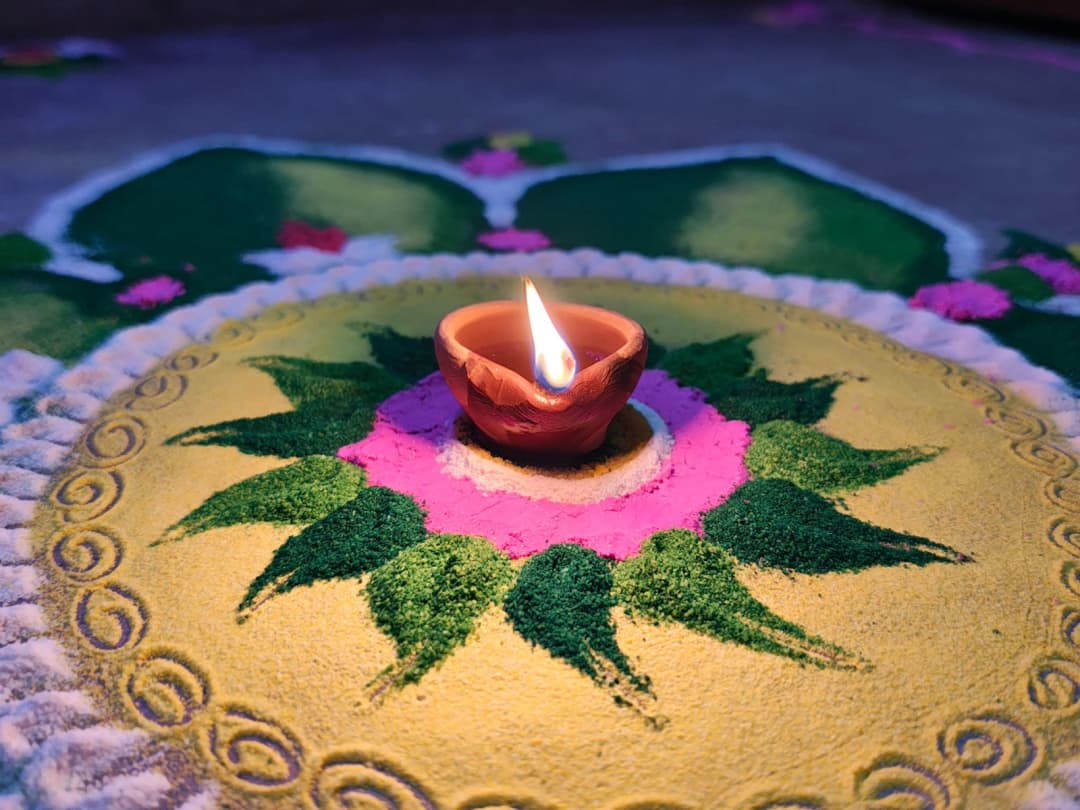
By five the floor is done, a lamp goes near the drawing, and in our house an agarbatti goes in before anyone arrives, usually the hand-rolled kind from Bihar my mother has bought for thirty years. Then you wait, because nobody comes on time to a Bhondla.
5. It is not garba, and confusing the two is how it gets lost
No sticks. No sound system. No choreography and nothing to learn. The women and girls hold hands, move around the drawing at walking pace, and sing unaccompanied.
I think this is precisely why it is fading. Garba and dandiya scale: you can put them on a ground, sell entry, hire a band. Bhondla scales to about fourteen people in a courtyard and then stops. It has no spectator position at all — nothing to watch, only something to be inside of. That is a real virtue and a commercial dead end, and the second has been beating the first for decades.
6. The songs have fixed ends and a very unfixed middle
By convention you open with Ailma pailma ganesh deva and you close with Aad bai aadoni. What happens between is enormous and local. The songs go after mothers-in-law, husbands, brothers, the gap between maher and sasar — the house you were born in and the house you were married into. Shivaji and Krishna both turn up. The structure is usually call-and-response, each verse adding one more object to a list.
A warning for anyone who goes looking for meaning: a good deal of the text is close to nonsense, and is meant to be. These are singing songs, not reading songs. But the grievance under the funny ones is real, and it was doing a job those households had no other vocabulary for.
7. Khirapat is the actual engine of the whole thing
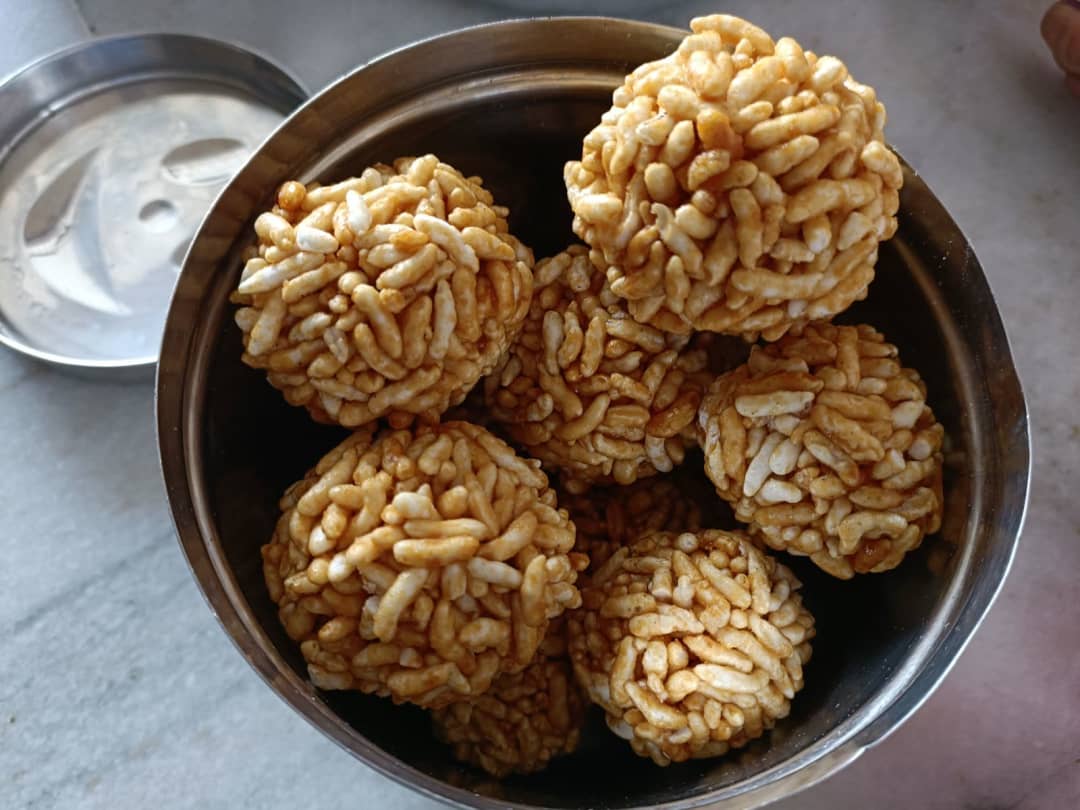
Everyone brings something to eat, made at home, carried covered. Before it can be distributed, the others have to guess what it is. Only then does it get handed round.
And the count escalates: one dish on the first day, two on the second, and upward, so the final night is a spread. This is the cleverest rule in the custom. The escalation forces variety — you cannot bring chivda nine times — and it makes attendance rise rather than drift, because the last night is worth showing up for. What a house brings becomes its signature. People remember for years whose mother made what.
8. Bhulabai has idols and a story the other two do not
In the Khandesh and Vidarbha form, small clay figures of Bhulabai and Bhuloba — Parvati and Shiva — are installed at home, and it is children, traditionally under sixteen, who set them up and sing to them.
The story behind the name is a dice game. Shiva and Parvati play, Shiva loses, and he goes off into the forest about it. Parvati takes the form of a bhillini, a tribal woman, and dances until he comes back. She is Bhulabai in that telling and he is Bhuloba. It is told lightly, as a family story rather than a sermon.
I should say plainly that I have never installed a Bhulabai. My household did Bhondla. What I have written here is what Khandesh families describe and what is published about the custom, not something I have kept.
9. It runs through Pitru Paksha, and I have never had a straight answer about that
Bhulabai starting at the Bhadrapada full moon means it begins on the same day Pitru Paksha does — 26 September in 2026 — and then runs right through the fortnight in which many households deliberately pause anything new or celebratory.
I have asked about this more than once and collected three answers: that the ancestors are family and would hardly object to children singing; that the fortnight's restrictions apply to particular acts rather than to a mood; and a flat "that is just how it is done here". None of those is a citation. I raise it because the tidy printed version of the Hindu calendar has no room for it, and the calendar people actually keep clearly does.
What it ends on
Kojagiri, the night of Sunday 25 October 2026, when the last khirapat and the milk on the terrace land on the same evening — a festival that needs no temple at all, and in most families no priest either.
If someone in your building is chalking an elephant onto a board this October and half a dozen women are gathering around it in slippers, that is what you are looking at. The correct response is not to photograph it. The correct response is to turn up with something covered, and let them work out what is in it.


