
Chausath Yogini Temple, Hirapur: Questions People Ask
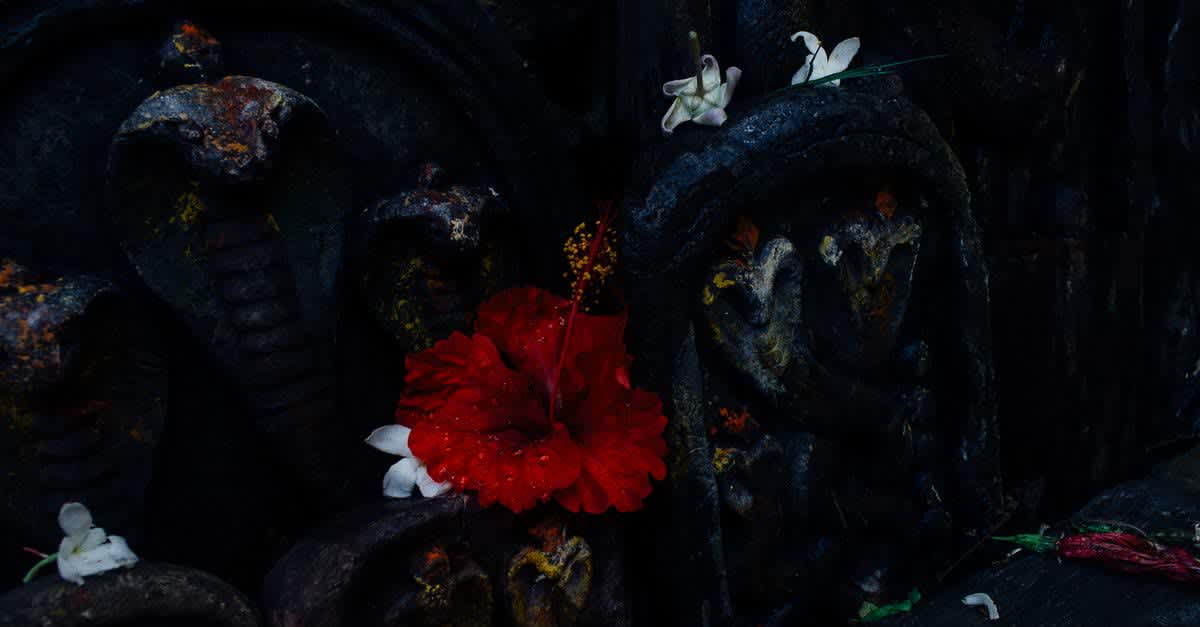
I grew up in Bhubaneswar, and for most of my childhood the Chausath Yogini temple at Hirapur was the place people mentioned in a slightly lowered voice and then changed the subject about. It deserves better than that. So here are the questions I have actually been asked about it, answered one at a time.
What is it, and where is it?
It is a small circular temple with no roof, standing in a village called Hirapur in Khordha district, somewhere between fifteen and twenty kilometres from Bhubaneswar depending on which road you take. Inside the circular wall, in niches cut into the stone, stand sixty-four carved goddesses called yoginis. In the middle of the open courtyard there is a small pillared pavilion.
That is the whole building. It is about twenty-five feet across. You can walk the full circle of it in under a minute.
The doorway is low and narrow, and this is not an accident of ruin — you have to bend to get in. Whatever else you think about the place, the architecture makes you enter it bowed.
How did nobody know it was there until 1953?
This is the part I find hardest to explain to visitors. Bhubaneswar has hundreds of old temples and has been studied for well over a century, and Hirapur is a short drive from the middle of it. The temple was brought to scholarly notice only in 1953, by Kedarnath Mahapatra, then curator of the Odisha State Museum. Vidya Dehejia, whose 1986 study is still the standard work on yogini temples, called that fact quite amazing, and she was right.
The villagers knew. They had been worshipping there the whole time. It was the record that had lost it, not the people.
Why has it no roof?
Because it was built that way. The word scholars use is hypaethral — open to the sky — and the surviving yogini temples across India share it. Nobody has produced a single explanation that everyone accepts. The most common suggestion is that the ritual required the open sky above the circle. Others point out that a circular plan of this size is awkward to roof in stone anyway.
I would rather give you the honest version: we know the roofless form was deliberate and consistent, and we do not know for certain why.
Who are the sixty-four yoginis?
Goddesses, usually understood as attendants or emanations of the Devi, each with her own name, her own weapon and her own mount. They stand on their vehicles — a rat, an owl, a peacock, a corpse, a human figure — and the carving is fine and small. None of the images is much longer than your forearm.
The sets are not fixed. The sixty-four named at Hirapur are not the same sixty-four named at every other yogini temple, and some sites count forty-two or eighty-one instead. If you go expecting a standard pantheon you will be confused; the variation is the actual state of things.
How many are still in their niches?
Fewer than sixty-four, and the sources disagree about the number. You will see fifty-six quoted most often. You will also see accounts that describe sixty still standing in the outer wall with four more in the central pavilion, which adds back up to the full count. I have never seen the two reconciled.
The damage is generally blamed on the sixteenth-century iconoclast Kalapahad, which is what a great deal of broken sculpture in Odisha is blamed on, sometimes correctly. Count them yourself when you go. It is a small building and it takes two minutes.
Who stands in the middle?
Here the disagreement is sharper, and worth knowing before someone tells you confidently at the gate. Some accounts say the central pavilion holds Kali, standing on a severed head. Others argue the original occupant was a form of Bhairava, with four yoginis and four Bhairavas arranged around him.
Both readings are in print. A circle of goddesses around a central Shiva-Bhairava is the standard description of the yogini mandala in the texts, which is why the second reading has weight. I am not in a position to settle it and neither is your guide.
Is this tantra? Is it something to keep away from?
It is associated with tantric Shaiva practice, yes — the yogini circle is described in texts belonging to that world, and the worship there was esoteric and not public in the way a village Shiva temple is public.
But I want to be plain, because the lowered-voice treatment does real harm. This is a protected ninth-century monument where ordinary people do ordinary puja. Women go. Families go. Kali Puja is observed. Nothing about walking into that circle in daylight is transgressive, and the whispered reputation says more about how we talk about goddess worship than about anything at Hirapur. I am not a practitioner of anything and I will not pretend to know what was done inside that circle eleven hundred years ago.
Can anyone go in?
Yes — and this is worth saying clearly, because the two most famous temples of this state do not allow it. Non-Hindus are not admitted inside the Lingaraj temple here in Bhubaneswar; there is a raised viewing platform near its north gate, put up for a viceroy's visit, from which everyone else looks in. Puri's Jagannath temple keeps the same restriction.
Hirapur does not. It is an Archaeological Survey of India monument and a living shrine at the same time, and the circle is open to whoever stoops through the door. In March 2025 thirteen chausath yogini temples across India, Hirapur among them, were entered together on the country's tentative list for UNESCO World Heritage status.
What should I do when I get there?
Go early. The enclosure is small, the stone holds the morning light, and by mid-morning in the warm months the open courtyard is genuinely hot underfoot.
Buy your flowers at the stall by the road rather than carrying them from the city — hibiscus for the goddess, and vermilion. One stick of incense is plenty inside that circle; the hand-rolled agarbatti still made in places like Samastipur burns low and long, and in a space that size a fistful of smoke is only unpleasant for whoever is standing behind you.
Then walk the circle slowly and look at the faces. That is the whole visit, and it is enough.
Is there anything like it inside the city?
There is, and almost nobody goes. The Vaital Deul stands in the old part of Bhubaneswar, dated to around the eighth century, and it is the clearest Shakta building in a city everyone reads as Shaiva. Its roof is a semi-cylindrical barrel rather than a tower, the khakhara shape; locally it is the tini-mundia deula, the three-headed temple, for the three small spires along the ridge.
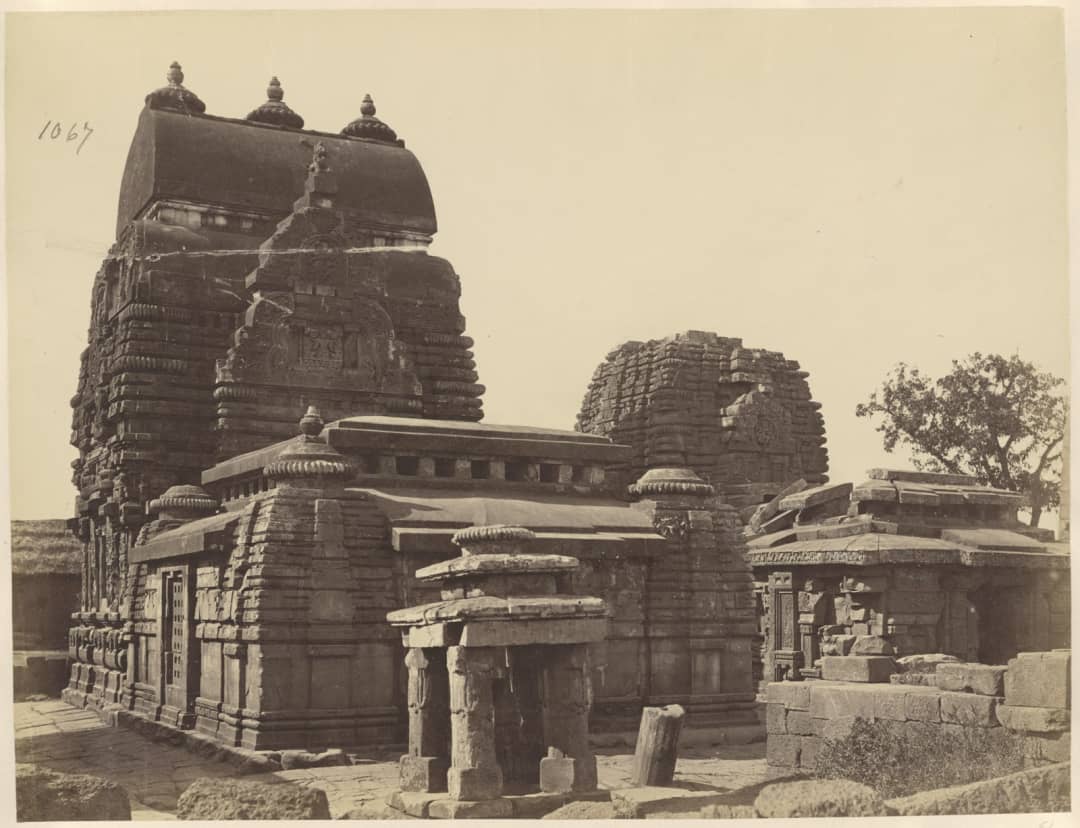
The deity inside is Chamunda, called Kapalini here — eight-armed, seated on a corpse, flanked by a jackal and an owl, garlanded with skulls. The sanctum is almost completely dark. Early morning sun reaches in through the door and that is the only time you see her properly without a torch. In front of the hall stands a stone post where offerings were once tethered.
Bhubaneswar is described in every guidebook as a city of Shiva temples, and it is. But the goddess is here too, in a black room off a busy lane and in a roofless circle twenty kilometres out, and she has been here the whole time.


