
Drying Agarbatti: Why Good Incense Can't Be Rushed
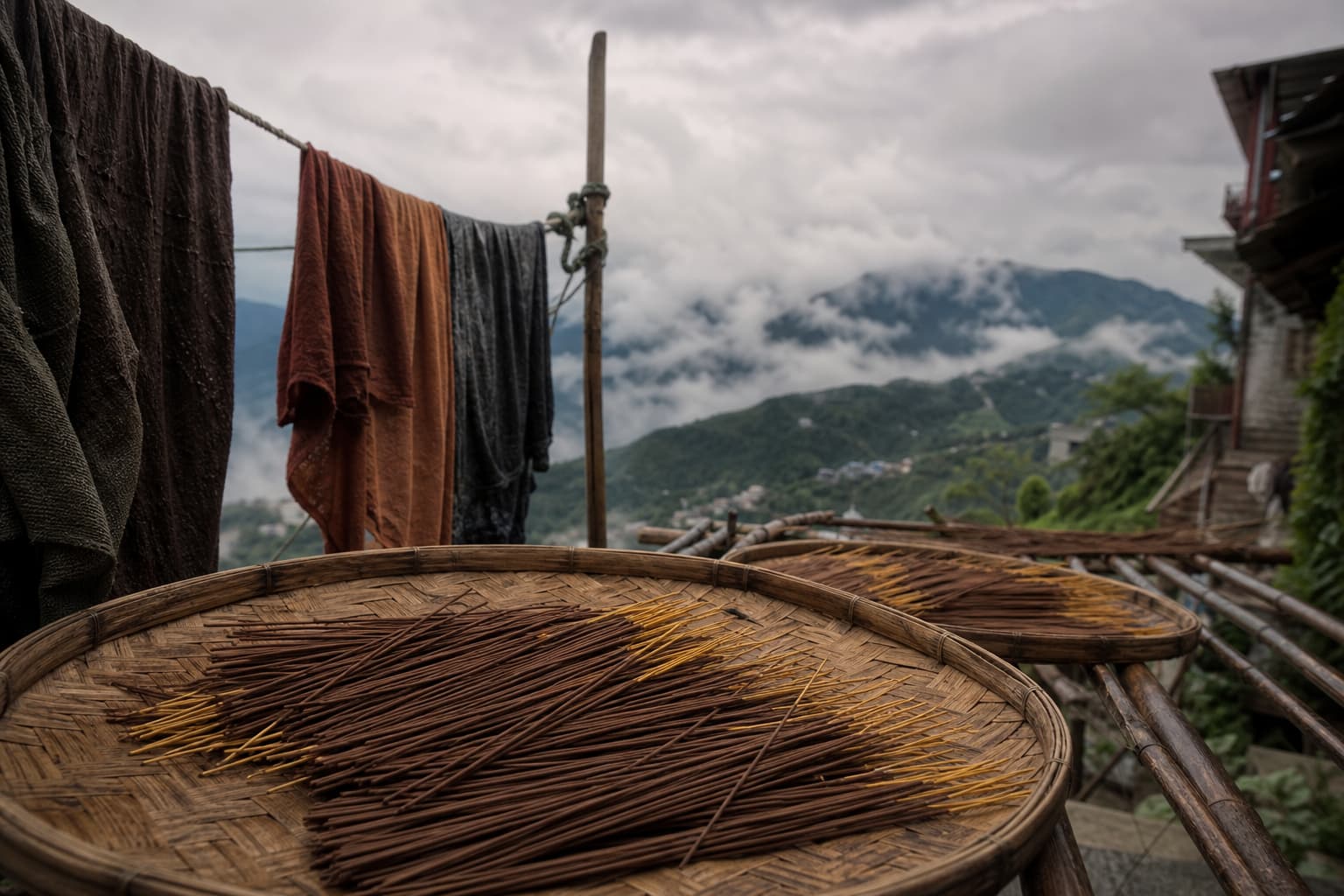
Up here in Dehradun, you learn to read the sky before you hang out the washing. In July the clouds come over the Mussoorie ridge by mid-morning, and if you have not brought the sheets in by noon they will still be damp at dusk. Weather governs drying. Anyone who lives close to the hills knows this in their hands, not their head.
I thought about that the first time someone explained to me how incense is actually made — because the part that decides whether a stick is any good is not the rolling. It is the drying. And drying, more than any other step, belongs to the weather.
The part nobody photographs
When people picture agarbatti being made, they picture the rolling: a thin bamboo stick, a dark paste, a quick practised turn of the palm that leaves the stick evenly coated. It is satisfying to watch, and it is the part that ends up in every video.
But a freshly rolled stick is a soft, wet thing. The paste on it — charcoal, wood powder, a natural binder, and the aromatic that gives it its smell — holds a lot of water. Left as it is, it will not burn. It has to lose that water slowly, from the outside in, until the coating is hard all the way through and grips the bamboo like bark.
Rush that, and everything you did before it is wasted.
Why slow, and not fast
The obvious question is why you cannot simply put the sticks somewhere hot and be done in an hour. People have tried. Ovens, hot rooms, fans on full. It does not work, and the reason is worth understanding.
When you dry the surface too fast, the outside of the coating hardens while the inside is still wet. The dry shell then traps the moisture underneath. Over the next day that trapped water does one of two things — neither of them good. It pushes its way out and cracks the shell, so the stick burns with little breaks in it and goes out halfway. Or it stays in, and the stick looks fine but burns unevenly, flaring and then sulking, because one part of the paste is denser than the next.
A stick that has dried slowly and evenly is a different object entirely. The coating is uniform right through. It takes the flame, settles into a steady ember, and burns at one pace from tip to base. That even burn — the thing you never think about when a stick is good and cannot ignore when it is bad — is made or lost on the drying rack, not in the rolling.
This is why the racks matter more than they look. The sticks are laid out with space between them, turned so the air reaches every side, and simply left. In fair weather it takes a day or two. There is no shortcut that does not show up later as a bad burn.
The monsoon is the enemy
Here is where the weather comes in, and here is why the rains are the hardest season of the year to make incense.
Drying needs the air around the stick to be drier than the stick itself — that difference is what pulls the water out. In the monsoon, the air is already full of water. On a heavy day in the plains the humidity sits so high that the sticks and the air reach a kind of standoff: the stick cannot give up its moisture because there is nowhere for it to go.
So drying slows to a crawl. What takes a day in April can take three or four in August. And the longer a wet stick sits, the more that can go wrong. In damp, still air, a batch left too long can start to spoil — a faint mustiness on the paste, spots where mould has taken. You cannot burn that away; it is in the stick. A whole rack can be lost this way.
The workshops that make incense in Samastipur, in Bihar, work through the monsoon because they have to — the demand does not pause for the weather, least of all in Shravan, when more lamps and more incense are lit than at almost any other time of year. So the drying gets managed rather than hurried. Racks go under cover before the afternoon rain. Air is kept moving. Batches are watched, not left. It is slow, careful, weather-anxious work, and it is the reason a good stick costs what it does.
If you have ever wondered why one packet of incense burns clean and steady while another crackles and dies, a fair amount of the answer is here, in how patiently it was allowed to dry. It is the same reason we let the sticks in our own Char Dham range take their time on the rack rather than pushing a batch out fast — the burn is only as good as the drying that came before it.
What good drying leaves behind
There is a plain way to tell whether a stick was dried properly, and you do not need a workshop to do it.
Roll a stick gently between your fingers. A well-dried one is firm and slightly rough, the coating hard and continuous, with no soft or tacky patches. Snap one, if you are willing to spare it: it should break cleanly, and the paste inside should look the same colour as the paste outside — dried all the way through, not darker and damp at the core.
Then light it and watch the first few minutes. A properly dried stick catches, glows, and settles into an even line of ash that holds its shape. A poorly dried one tells on itself quickly — it flares, or the ember shrinks and threatens to go out, or the ash falls away in wet-looking clumps.
None of this is mysterious once you know to look for it. It is the same instinct my grandmother used for everything from papads to pickles: you do not fight the weather, you work with it, and you never rush the drying.
The unglamorous truth
The romance of incense is in the smell and the ritual — the lamp lit at dawn, the thread of smoke rising in a still room. The reality behind it is a rack of plain sticks losing water slowly, under a watched sky, in air that some months helps and some months fights you every hour.
It is the least photogenic part of the whole craft, and the most decisive. The next time a stick burns steadily all the way down without a single stumble, you can thank the drying — and whoever had the patience to let it take as long as it needed.


