
Dwarka: Krishna's Sunken City and Its Great Temple
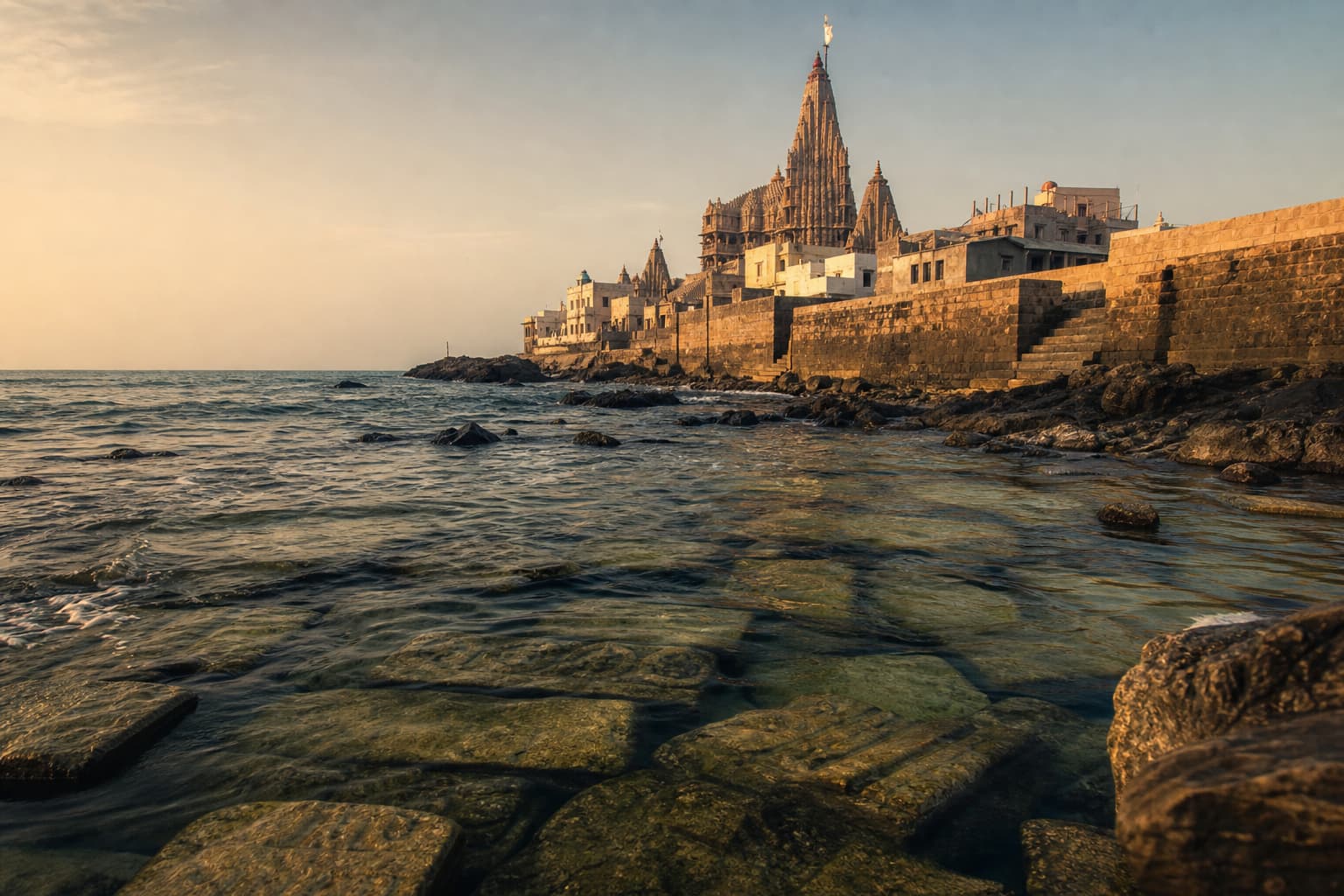
Let me start with the part most people skip. When you talk about the Char Dham, you talk about mountains. Badrinath up in the Garhwal cold. Kedarnath at the end of that long walk from Gaurikund. Puri on the Odisha coast, Rameswaram down at the tip. And then there is Dwarka, on the far west edge of Gujarat, where the land runs out into the Arabian Sea — and where the story, unlike anywhere else, ends underwater.
That is the thing about Dwarka I want you to sit with for a minute. It is the one great pilgrimage town whose founding legend is not "here a god appeared" but "here a god built a city, and then the sea took it back." Hold on to that. We will come back to it.
The city Krishna built
The story, the way it is told, goes like this. Krishna leaves Mathura — the town where he was born, the town of all those Janmashtami stories you already know — because it is no longer safe to stay. He travels west, right across the subcontinent, to the coast of Saurashtra. And there, on the shore, he founds a new capital. Dwarka. The name itself means gateway, or the place of many gates.
And this is not a small settlement in the telling. This is a planned city. Golden, sea-facing, laid out with quarters and gates and palaces — a working kingdom, not a shrine. Krishna is not a baby stealing butter here, and not the charioteer of the Gita either. Here he is a king, running a city by the sea. If you have only ever met Krishna as the flute-player, Dwarka is where you meet him with a crown on.
Now here is the part that gets me every time. In the Mahabharata, after Krishna's life ends, Dwarka does not become a museum. The sea rises and takes it. The city he built goes under the water. The gateway closes.
For most of history that was simply a beautiful, sad story. And then, in the 1980s, people went to look.
When the divers went down
Between roughly 1983 and 1990, marine archaeologists — a team led by Dr S. R. Rao, working with the Archaeological Survey of India and the National Institute of Oceanography — ran a series of dives in the waters off Dwarka and the little island of Bet Dwarka in the Gulf of Kutch.
I want to be careful and honest here, because this is exactly the sort of thing people exaggerate. What the divers found were submerged structures — stone walls, what looked like bastions, and a great many stone anchors, some of them large and old. The finds pointed to a substantial harbour town that had gone under the sea a very long time ago.
What they did not do — and what no honest person should claim they did — is pull Krishna's palace out of the water with his name on the door. That is not how archaeology works, and it is not what happened. What is fair to say is quieter and, to me, more moving: there really was an old, planned settlement here that the sea really did take. The legend and the seabed are, at the very least, pointing at the same coast. You can decide for yourself what to do with that. I just think it is remarkable that a story that old and a sonar reading that new end up in the same water.
The temple that stayed above the waterline
While the old city is under the sea, the temple is very much above it. The Dwarkadhish temple — the Jagat Mandir, the "temple of the world" — stands on the bank of the Gomti creek where it meets the sea. And it is a serious piece of building.
The shrine you see today largely dates to around the fifteenth and sixteenth centuries, though the tradition holds it was first raised far earlier, and it has been rebuilt and enlarged more than once. It rises five storeys, carried on seventy-two carved pillars, with a spire that climbs somewhere around seventy-eight metres into the coastal sky. Inside the sanctum is Dwarkadhish himself — the Lord of Dwarka, Krishna as king — carved in dark stone.
It has two famous doors, and I love that they tell you where you are going. The northern gate is the Moksha Dwara, the door of liberation, opening toward the town. The southern gate is the Swarga Dwara, the gate of heaven, and it opens onto fifty-six steps that go down to the Gomti ghat and the water. You climb up to the god and you climb down to the river. The whole building is a set of directions.
If you are the kind of person who keeps a small shrine at home, Dwarka is one of the four temples our own Char Dham range is named for — but honestly, you do not need to buy anything to be moved by this place. You just need to stand at the bottom of those fifty-six steps at the right hour.
The flag, five times a day
Here is the detail I would build a whole show around if I could. On top of that spire flies a flag — the dhwaja — and it is not small. It is fifty-two yards of cloth, and it carries the sun and the moon.
And they change it five times a day. Sunrise, mid-morning, noon, evening, night. Five fresh flags, every single day, hauled up by hand to the very top of a seventy-eight-metre tower by men who climb it. Think about that as a job. Think about the wind coming off the Arabian Sea and a person going up there five times between one dawn and the next.
Why fifty-two? The usual explanation is that it stands for the fifty-two gates, or the fifty-two royal households, of Krishna's old city — the Dwarka that is now under the water. So every time that enormous flag goes up over the temple, it is, in a small way, flying for the drowned city too. The gateway town remembers itself on the roof of the temple that outlived it. I did not know that the first time I stood there and watched it snap in the wind, and when someone told me, I had to sit down on the steps for a bit.
What to actually carry away
This ran long, the way the good stories do, so let me do the thing a good show does at the end and give you the three things worth remembering.
One. Dwarka is the Char Dham of Krishna as a king, not a child or a charioteer — the one great pilgrimage town whose founding city, by the oldest telling, was taken back by the sea. That is what makes it different from the other three.
Two. The sea part is not only poetry. Divers in the 1980s did find a real submerged settlement off this coast. Not a captioned palace — be suspicious of anyone who tells you that — but a genuine old town under the water, on the same shore as the legend.
Three. The living heart of Dwarka today is that fifty-two-yard flag going up five times a day, each raising a quiet nod to the fifty-two gates of the city that is gone. If you ever get there, do not just rush the darshan and leave. Wait for a flag change. Watch it go up.
That is Dwarka. A gateway that closed under the sea, and a flag that keeps opening it again, every few hours, in the wind.


