
Festivals of the Chotanagpur Plateau: A Local Guide
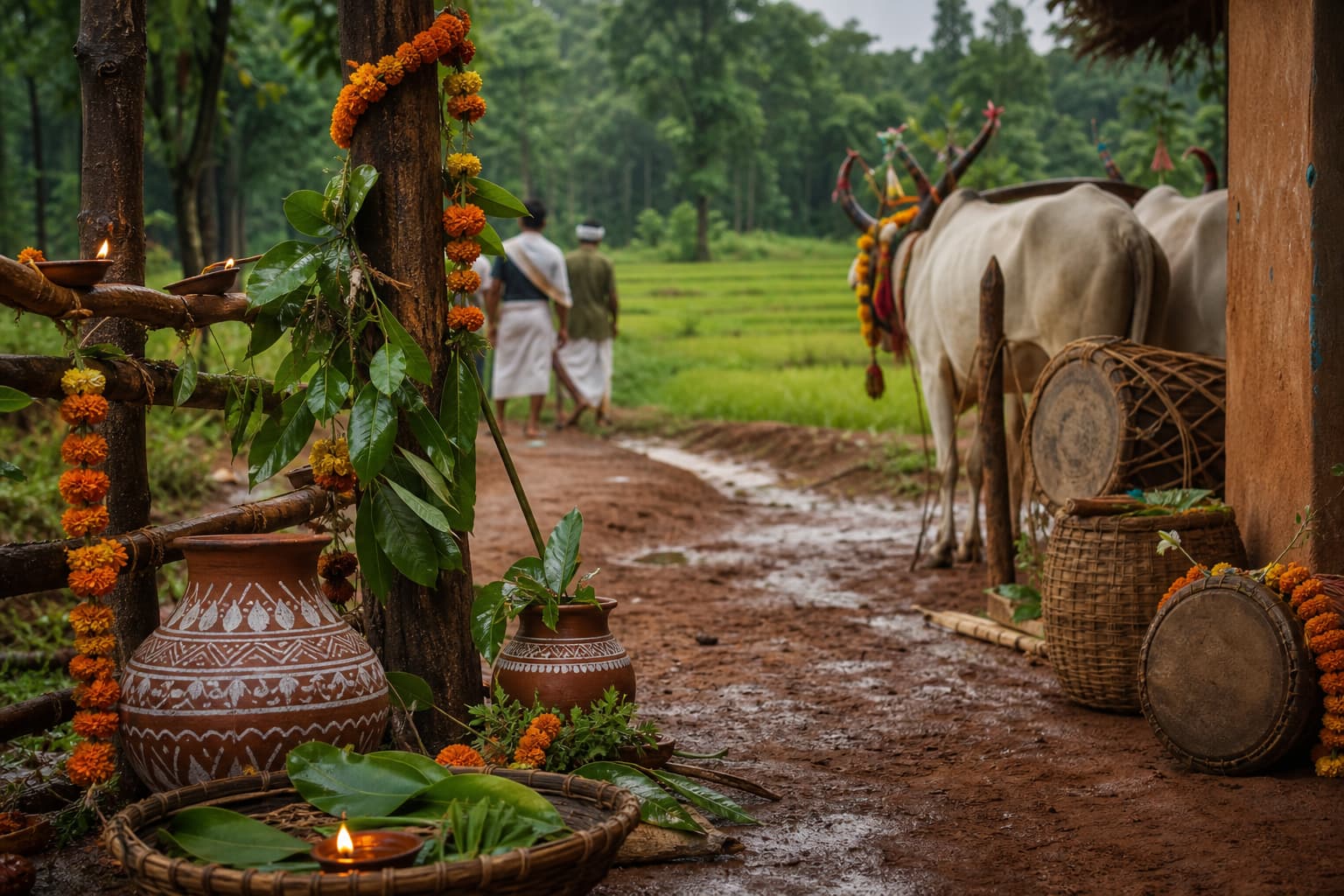
If you drive out of Ranchi in any direction, the calendar changes. In the city we keep the pan-Indian festivals — Diwali, Holi, Chhath by the tank in the evening. But the plateau underneath us keeps an older calendar, tied to the sal forest, the paddy, the cattle and the first rain. The Oraon, Munda, Ho, Santhal and the many communities who have farmed this red soil for centuries mark the year by these, not by the Gregorian months.
People from outside the region often hear "tribal festival" and picture one thing. In fact each of these is doing a very specific job — thanking, asking, protecting, marrying off a season. Here are the six that shape the year on the Chotanagpur plateau, in the order the year actually brings them, and what each one is really for.
1. Sarhul — the year begins with the sal tree
Sarhul is the new year for much of the plateau, and it is the one I would send an outsider to first. It falls in Chaitra, around the turn of March into April, when the sal trees put out their pale flowers. Sar is the sal flower; the festival is, quite literally, its worship.
The heart of it is the sarna — the sacred grove left standing when the forest around it was cleared. The village pahan (priest) reads the coming monsoon from pots of water set out overnight: if the water has dropped, the rains will be poor. Then the sal blossoms are offered, and only after that will people eat the new fruit or sow. What I find honest about Sarhul is its order — you do not take from the land until you have acknowledged it. Nothing about it is decorative.
2. Karam — the branch in the courtyard
Karam is the one on the horizon as I write this. It falls on the eleventh day of the bright fortnight of Bhadra — in 2026 that lands on 22 September — and it is the great late-monsoon festival of the region.
A branch of the karam tree is cut and planted in the akhra, the village dancing ground, and worshipped through the night. Young unmarried women keep a fast for the wellbeing of their brothers and for a good harvest, tending small baskets of sprouted grain called jawa. The pahan tells the Karam story, and then the drumming and the round dance go until light. If you have only ever seen festivals as something watched, Karam will surprise you — nobody is an audience. The whole village is inside the circle. That, more than the ritual, is the point of it: the plateau reminding itself that it is one body.
3. Sohrai — the cattle get their day
Sohrai comes right after Diwali, on the new moon of Kartik, and it is a cattle festival before it is anything else. For a farming people the bullock and the cow are not livestock, they are the reason there is a harvest at all, and Sohrai is the day that debt is paid. The animals are washed, their horns oiled and painted, garlanded, fed the good rice.
Sohrai is also when the mud walls of the houses are painted — the famous Sohrai art, drawn with fingers and twigs and coloured earth, animals and forests and the pregnant cow, redone fresh each year. It is some of the oldest living wall-painting in India, and it is not made for a gallery; it is made on the house you live in and left to weather. A home shrine is quietly cared for in the same season — the earthen lamp trimmed, the incense set out at dusk — the same instinct to make the ordinary house fit for the year to come.
4. Bandna — Sohrai's other name, and its longer week
In much of the plateau Sohrai and Bandna are the same festival, and you will hear both words used for it. Where people separate them, Bandna is the fuller, seven-day version, strongest among the Kurmi and the eastern communities. The most striking moment in it is the garea puja and the bull-taunting — a bull is tied and roused and the young men test their nerve against it, less a sport than a public showing of the year's courage.
I list Bandna as its own entry because outsiders reading a single-line calendar often see two names and assume two festivals on two dates, then arrive on the wrong day. They are one season, told slightly differently from valley to valley. If someone tells you Bandna is nothing like the Sohrai you know, believe them — the plateau is not uniform, and that is its character, not a contradiction.
5. Tusu — the winter festival that belongs to the girls
Tusu falls at the end of Poush, at Makar Sankranti in the middle of January, and it is the one festival on this list that is almost entirely the young women's own. Through the month the girls sing Tusu songs — sharp, funny, sometimes openly about the hardships of a woman's life — and build the chaudal, a bamboo-and-coloured-paper frame, sometimes carrying a small clay image.
On the last day the whole thing is carried down to the river and given to the water. There is nothing solemn about it; it is loud and bright and a little defiant, and then it is let go. Of all six I would tell a visitor Tusu is the one to hear rather than to watch — the songs are the festival, and they carry more of the real life of the plateau than any ritual manual will.
6. Jani Shikar — the hunt that comes once in twelve years
The last is the rarest. Jani Shikar means "the women's hunt," and it comes only once every twelve years. It remembers a day, kept in the region's memory, when the women of the plateau took up the men's weapons and drove off attackers — the Rohtasgarh story is the one usually told. On Jani Shikar the women go out to hunt as the men normally would, and for that one turning of the cycle the ordinary order is reversed.
I include it precisely because it is not annual. It is a reminder built into the calendar itself — that the arrangement of a normal year is a choice, not a law, and that the plateau has, within living memory, chosen otherwise. You are unlikely to catch it. But knowing it is there changes how you read all the others.
Reading the plateau's year
Put together, these six are not a folklore checklist. They are a working calendar: Sarhul opens the year and asks the land's permission; Karam holds the village together at the monsoon's tail; Sohrai and Bandna repay the cattle and dress the house for winter; Tusu gives the girls the cold months as their own; and Jani Shikar, once a generation, turns the whole thing over to remember it could be turned.
If you come to Jharkhand for one of them, come for Karam or Sarhul and stand inside the circle rather than at the edge of it. The plateau does not perform its festivals. It lives inside them, and it will make room for you if you step in.


