
Ganesh Chaturthi in Hyderabad: How the City Keeps the Ten Days

If you have never lived through it, the easiest thing to get wrong about Ganesh Chaturthi is the scale of time. People outside the tradition imagine a single festival day — a puja, some sweets, a photograph of an elephant-headed god. In Hyderabad, where I have watched it my whole life, it is closer to a season. It begins months before the calendar date, in the smell of wet clay drifting out of a few narrow lanes, and it does not end until an entire city has walked, together, down to the water.
This year the season has its dates. Ganesh Chaturthi falls on 14 September 2026, and the great immersion day, Anant Chaturdashi, is 24 September — so the festival runs across those ten days. What happens in between is worth understanding whether or not you keep it yourself.
What the festival actually marks
Ganesh Chaturthi welcomes Ganesha — the elephant-headed son of Shiva and Parvati — into the home and the neighbourhood as a guest. He is the god people turn to first, the remover of obstacles, the one invoked before any new venture, any journey, any exam. The idea at the centre of the festival is simple and human: you invite the deity in, you look after him as you would an honoured visitor for a set number of days, and then you walk him back to the water and let him go. The welcome and the farewell matter equally.
The date follows the Hindu lunar calendar — the fourth day (chaturthi) of the bright fortnight in the month of Bhadrapada — which is why it moves each year against the Western calendar. In 2026 that lands in mid-September, at the tail of the monsoon, when Hyderabad's air is still washed and green.
The season begins in the clay
Long before any household lights its first lamp, the festival is already underway in the idol-makers' quarters. In Hyderabad the most famous of these is Dhoolpet, an old neighbourhood where families have shaped Ganesha figures for generations. Walk through it in the weeks before the festival and you find idols in every state of becoming — armatures of straw and wood, forms roughed out in clay, rows of finished figures waiting for paint, and the finest details, the curl of the trunk and the fold of the shawl, done last by hand.
There is a quiet debate inside all this work, and it is one worth knowing about. For decades many idols were made with plaster of Paris and bright chemical paints, because plaster is light, cheap and holds fine detail. But plaster does not dissolve, and the paints carry heavy metals into the lakes at immersion time. So a slow shift is happening back toward what the tradition originally used: river clay, natural mineral colours, sometimes seeds pressed into the base so the idol can be dissolved at home in a bucket and the mud returned to a plant. If you are choosing an idol, this is the one question worth asking the maker — what is it made of — and a growing number of them are glad to be asked.
The giant, and the neighbourhood
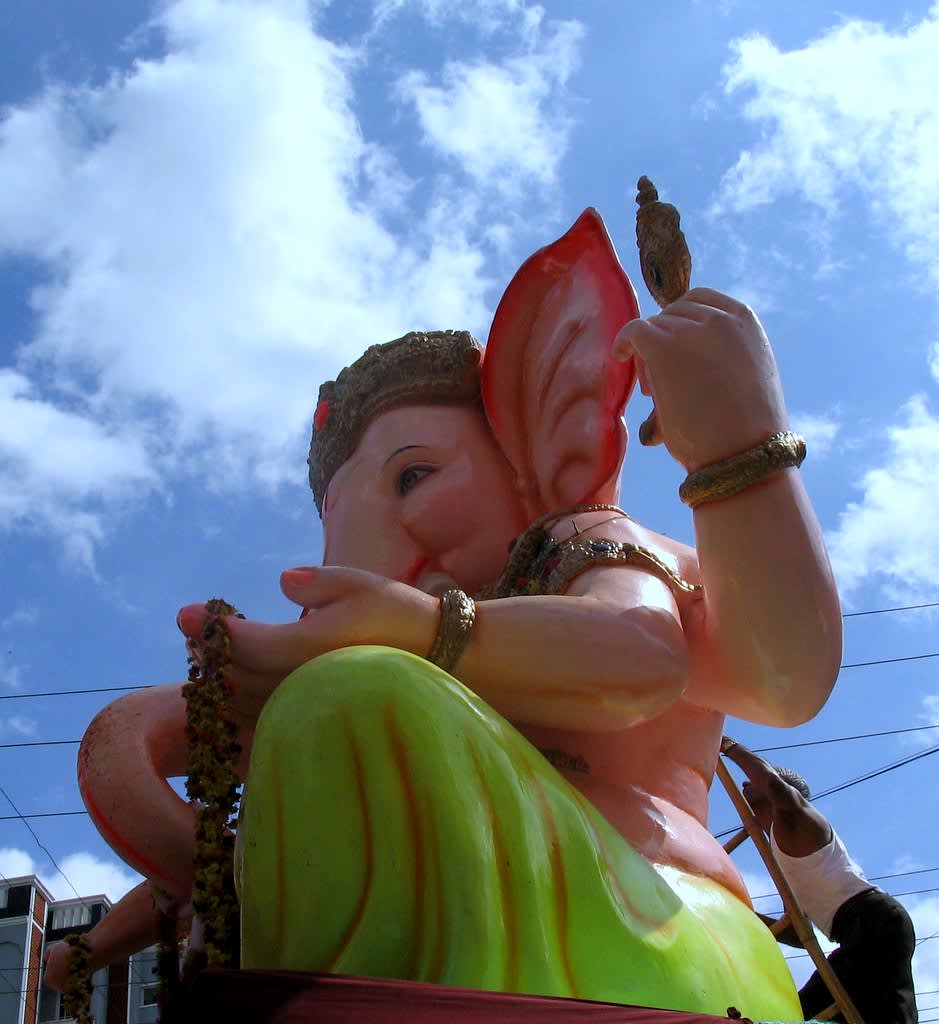
Hyderabad is also known for going very large. The Khairatabad Ganesh, raised by a committee in the heart of the city, is among the tallest idols made anywhere in India, rising many storeys over a temporary pavilion, drawing queues that run down the road late into the night. It is a spectacle, and it is meant to be — but it is only the loudest note in a much wider sound. For every giant there are thousands of ordinary pandals, the neighbourhood tents where a local committee installs a modest idol, and lakhs of small clay figures carried home to a shelf in the corner of a living room.
That range is the real character of the festival here. The same ten days hold a five-storey idol under floodlights and a six-inch one beside a family's kitchen, and both are kept with the same care.
How a home keeps the days
Inside a house the rhythm is gentle and repetitive, which is much of its point. On the first morning the idol is installed on a clean, raised place — the pranapratishtha, the moment the figure is treated as a living guest rather than a statue. Around it the family builds a small world: fresh flowers, especially the red hibiscus Ganesha is fond of; durva grass, the tender blades offered in little bundles; fruit; and the sweet that belongs to him above all others, the modak, a steamed dumpling of rice flour filled with jaggery and coconut.
Then, for as many days as the household has chosen to keep him — some keep the idol a day and a half, some three, five, seven, or the full stretch to the eleventh day — there is a daily aarti, morning and evening. Lamps are lit, a plate of light is circled before the idol, and the room fills with the smell of camphor and incense. This is where the festival slows a busy family down: twice a day, everything stops for a few minutes of song and light and scent. It is not incidental that fragrance carries so much of the mood — the nose remembers a festival long after the eyes have forgotten it, and a particular incense can put a grown adult straight back in their grandmother's front room. If you are drawn to that side of it, our own signature fragrances grew out of exactly these household rituals, though a stick of sandalwood from any honest maker will do the same work.
The farewell at the water
The part visitors remember is the end. Over the ten days, on the day each household or committee has chosen, the idol is carried out for immersion — visarjan, or as it is called here, nimajjanam. It builds toward Anant Chaturdashi on 24 September, when the largest processions move through the city, drums ahead of them, colour thrown in the air, the crowd chanting the line every Hyderabadi knows — Ganpati Bappa Morya, pudhchya varshi laukar ya: come again next year, and come soon.
In Hyderabad most of the immersions converge on Hussain Sagar, the great lake at the centre of the city, with the processions streaming along Tank Bund. Smaller idols go into neighbourhood ponds or, increasingly, into the household bucket at home. The emotional shape of the day is particular and slightly surprising the first time you feel it: you have looked after this guest for days, and now you are letting him dissolve back into the water on purpose. It is a festival that builds something beautiful and then, deliberately, lets it go — a rehearsal, some say, for every larger letting-go a life asks of you.
If you are watching from outside the tradition
You do not have to keep the festival to understand what it offers, and there is no need to borrow its rituals to feel their logic. Strip it back and Ganesh Chaturthi is a clear, portable idea: invite something in with full attention, tend it daily for a fixed stretch of days, and release it without clinging. The clay returns to the lake. The flowers wilt. The house smells, for a week, of camphor and jaggery and smoke, and then it doesn't.
If Hyderabad in mid-September is anywhere near your path, the thing to do is walk out in the evening. Follow the drums. Stand in a queue you don't fully understand, in front of an idol taller than a building, among people who have done this every year of their lives — and then, on the last day, go down to the water and watch a whole city say goodbye to a guest, already planning next year's welcome.


