
An Ordinary Sawan Monday at the Gorakhnath Temple
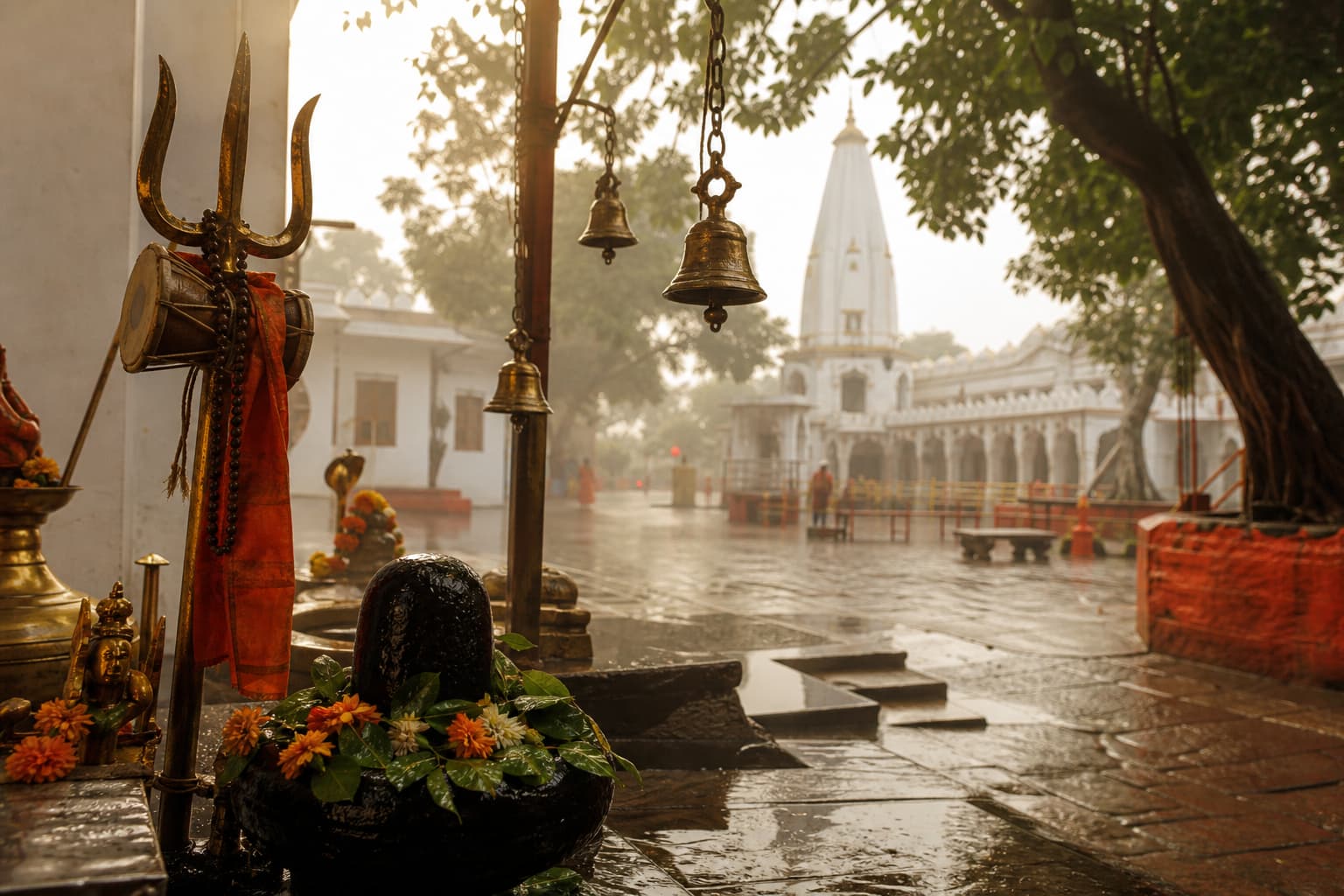
The temple gives the city its name, not the other way round, and people here forget that the way you forget the source of your own drinking water. Gorakhpur is Gorakh's town — Guru Gorakhnath, the yogi who sat in penance on the banks of the Rapti some nine hundred years ago and never really left. Ask a rickshaw-wallah on Bank Road to take you to "the mandir" and he does not ask which one. There is one mandir in Gorakhpur the way there is one river. You go to the others by name. This one you just go to.
On a Sawan Monday it fills early. Sawan — Shravan, the month of Shiva — began at the end of July this year, and the Mondays inside it belong to him. Gorakhnath was a Shaivite yogi, a Nath, so the shrine that carries his name draws the Shravan crowd even though the deity in the sanctum is the guru, not the god. The distinction does not trouble anyone on the queue. A man who has taken the day off from a cloth shop in Golghar, who has bathed and put on a clean kurta and is carrying a small brass lota of milk, is not sorting his theology on the walk up. He is going to pour milk. That is the whole of it.
The gate, the shoes, the lota
Come at six and the fifty-two acres are already awake. The Gorakhnath Math is not a single spire but a walled compound the size of a small university — gardens, a pond, a Sanskrit school, a hospital, cow sheds, guest quarters, and at the centre the white temple with its gold finials. You leave your shoes with a boy who hands you a numbered token torn from an old exercise book, and you walk the last stretch barefoot over stone that Sawan rain has left cool and slightly slick.
The milk queue forms to one side. In Sawan the offering is milk, and the men and women carrying it — more men, this early — hold their lotas carefully against being jostled, the way you carry a full cup across a moving bus. Nobody hurries them. A temple that has run for centuries has learned that a queue moves best when no one shoves it.
Inside, the first thing is not sight but smell: wet stone, marigold going soft in the heat, and under it the low sweet weight of loban and sandal smoke that never quite clears from the pillars. That smoke is older than anyone in the queue. In a town that grew up around a shrine, the smell of a puja thali — camphor, a stick of agarbatti, the particular sandal note families in this part of Bihar and eastern UP have burned at their home altars for generations, the kind we still hand-roll a day north of here in Samastipur — is not incense the way a shop sells it. It is the smell of Monday.
The fire that is not allowed to go out
Deep in the sanctum burns the dhuni, the yogis' hearth, and above it the Akhand Jyoti — the flame the Naths hold has never been let die. Devotees will tell you it has burned since the Treta Yuga, an age of the world ago; the historian in you may keep his own counsel on that, but the fact on the ground is plainer and harder to argue with. Someone has fed this fire every single day for as long as the math has kept its records. Through Mughal demolitions — the temple was pulled down more than once and built again — through floods off the Rapti, through the long quiet centuries, a yogi has risen before light and put wood on the coals. That is not a miracle. It is something steadier and rarer: an unbroken habit, kept by men who took a vow and then simply did not stop.
You can stand near it a moment before the queue carries you on. The heat is real, the ash is grey and deep, and a Nath in ochre feeds it without looking up. He has done this ten thousand mornings. He will do it tomorrow.
The kitchen, and who eats there
One thing the guidebooks underplay: this is a working monastery, and monasteries feed people. Off the main courtyard the bhandara kitchen runs on a scale that has nothing to do with tourism. Vats of khichdi and dal, tin plates stacked to the ceiling, a queue for prasad that on a Monday can be longer than the queue for darshan. The Nath order has never held with caste the way orthodoxy does — its own tradition allows non-Brahmins to serve as priests — and its kitchen has always fed whoever came. A labourer, a schoolteacher, a family down from a village near Maharajganj, all sit in the same rows on the same floor and eat the same khichdi off the same tin.
It is worth remembering, on a plain Monday, that the temple's biggest day is built entirely around this pot. Every Makar Sankranti in January the math holds the month-long Khichdi Mela, when hundreds of thousands come to offer rice and lentils to Gorakhnath — a fair that goes back to a story of the guru lighting a hearth to boil water and sending for grain, and a hermitage pot that would not fill however much was cooked. Sawan is quieter. But the pot is the same pot, and it is on the fire this morning too.
What the place is, when nothing is happening
By eight the sun is up properly and the compound has taken on the flat, busy ordinariness of any large institution at the start of a working day. Sweepers with long brooms. A queue at the temple hospital's window. Schoolboys in white cutting across the garden. Cows being moved. The milk-carriers coming back out through the gate with empty lotas and wet feet, collecting their shoes against a torn paper number, folding themselves back into the city — a shop to open, a bus to catch, an ordinary Monday to get on with, the darshan taken and the week begun.
That is the thing about Gorakhpur's temple that a festival day hides. On Makar Sankranti it is a spectacle. On the first Monday of Sawan it is simply the machinery the city runs on — a fire kept alight, a pot kept full, a fifty-two-acre habit that has outlasted empires by refusing to be interesting. You do not have to believe the flame is from the Treta Yuga to feel the weight of that. You only have to stand in the smoke a while, at six in the morning, and watch a very old thing do exactly what it did yesterday.


