
Hemkund Sahib vs Valley of Flowers: Two Walks, One Base
Every August the same conversation happens outside the taxi stand in Joshimath. A family comes off a night bus, bags too heavy, someone's mother in a saree and sports shoes, and they say they are going to Hemkund Sahib and the Valley of Flowers. Someone asks how many days they have kept, and they say two. The driver looks at the mother's knees and says nothing, because it is not his business — and then says it anyway.
They are not the same walk. They are not even the same kind of thing. One is a shrine and one is a national park. They share a road head, a base village and a great deal of confusion, and almost every year somebody turns back halfway up the wrong one having spent their strength on the other.
So let me separate them properly, because if you are travelling in the next six weeks the difference decides your whole trip.
What they actually share
Both begin at Govindghat, on the Alaknanda, on the road that runs up to Badrinath. From Govindghat you go to Ghangaria — about thirteen kilometres, of which the first four are now motorable up to Pulna, leaving nine on foot along the Lakshman Ganga. Ponies and porters work this stretch, and there is a helicopter service when the weather permits, booked out well ahead in season.
Ghangaria is the base for both — a strip of guest houses and dhabas at around 3,000 metres with a gurdwara langar, no proper road, and electricity that comes and goes. There is nothing else up there. Whichever of the two you came for, you sleep here and walk out from here in the morning.
From Ghangaria the trail forks, and the two branches ask completely different things of you.
Hemkund Sahib: six kilometres, and all of them upward
Take the right fork and you climb to Hemkund — about six kilometres to a lake at 4,632 metres, in a bowl of seven peaks, with the highest gurdwara in the world standing on its shore.
Six kilometres sounds like an afternoon. It is not. It is a stone staircase for most of its length and it gains well over a thousand metres, and people who walk it comfortably still take four to five hours up. The langar at the top gives hot tea and khichdi to everyone who arrives, which on a cold day is the most welcome thing in Garhwal.
The shrine is Sikh. In the Bachitra Natak, Guru Gobind Singh describes a place of meditation in a previous birth, by a lake among seven peaks. The site was identified here in the 1930s, and the gurdwara was built up over the decades that followed — carried up in pieces, on backs, along the path you are walking.
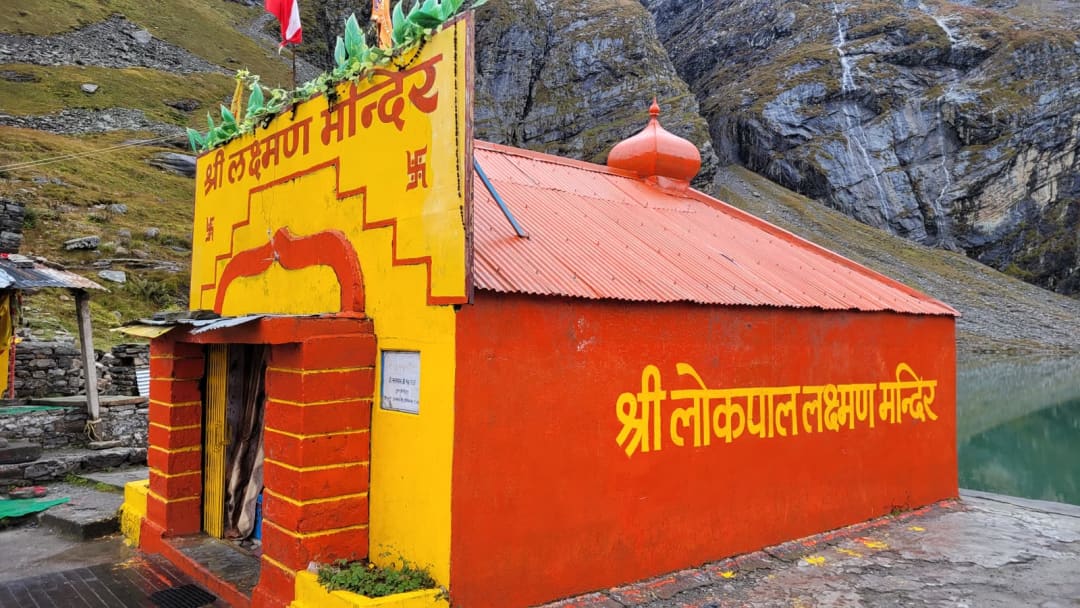
A few steps away stands a small temple, and this is the part most visitors miss entirely. The lake's older name is Lokpal, and Hindu tradition holds it as the place where Lakshman meditated and recovered his strength. The Lokpal Lakshman Mandir sits right at the water. Pilgrims of both traditions have been coming here for a long time, up the same stones, and nobody at the top makes a distinction about it.
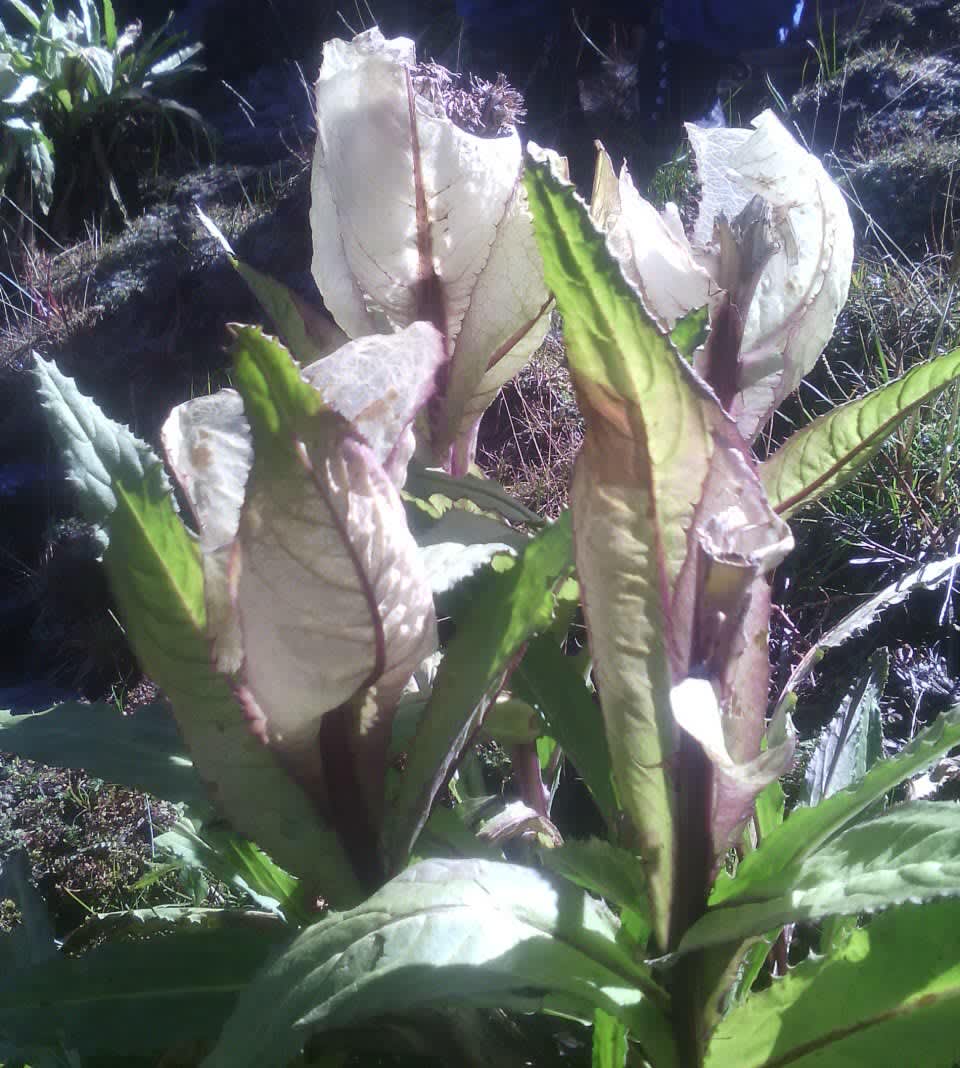
Around the lake in these weeks you may see the Brahma Kamal — the real one, Saussurea obvallata, papery and pale, closed in on itself like a lamp with a hood. It is Uttarakhand's state flower and it is offered at shrines here. Do not confuse it with the night-blooming plant sold as Brahma Kamal in the plains, which is a different species altogether and grows nowhere near this altitude.
The Valley of Flowers: shorter, gentler, closed at night
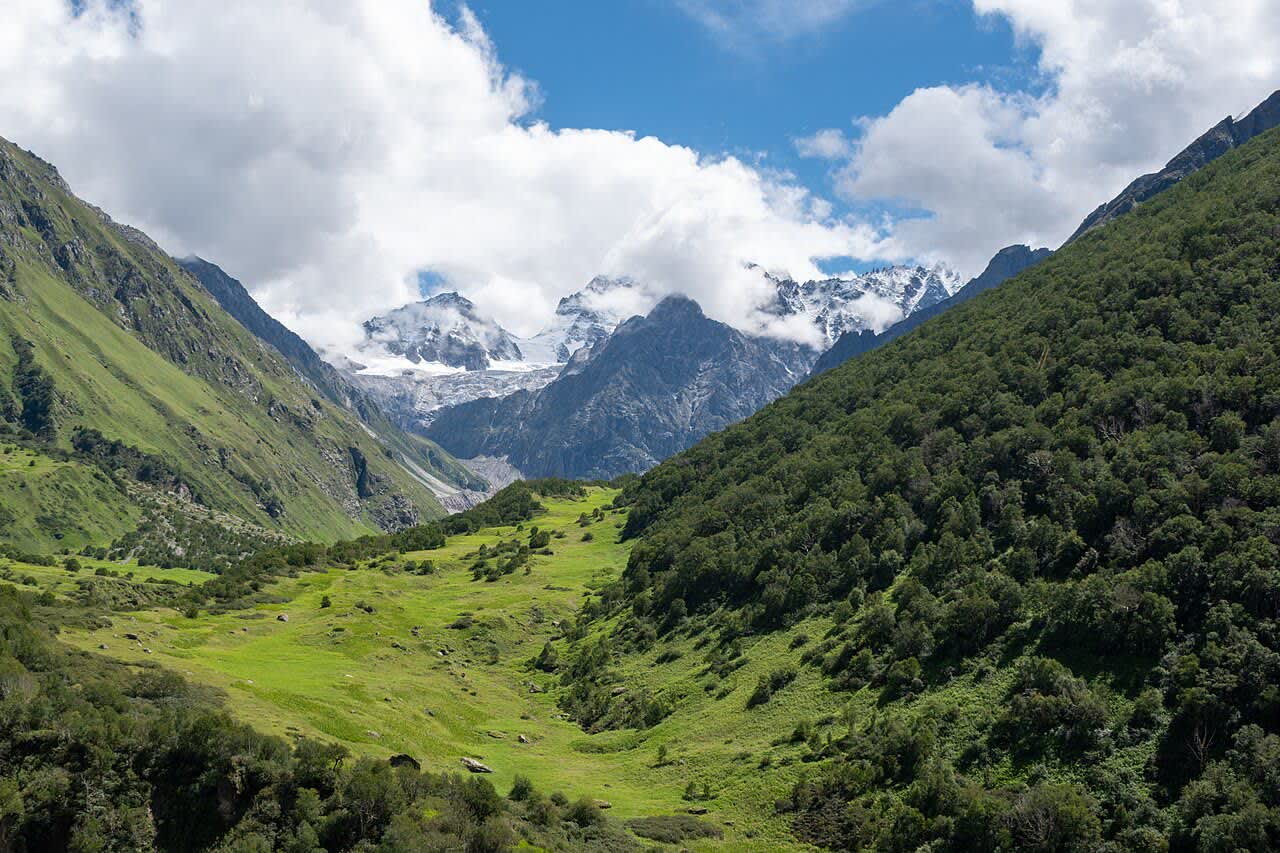
Take the left fork and you enter a national park. It is about four kilometres from Ghangaria to the valley floor, a gradual climb through birch and over a bridge, and then the ground opens out into a hanging valley some eight kilometres long with a glacier at its head.
You need a permit from the forest check post at Ghangaria. You are counted in and counted out. You cannot stay the night — no camping, no huts, nothing. Whatever hour you go in, you walk back down to Ghangaria before the gate closes. That rule is what people fail to plan around, and it is why the valley is a full day, not a morning.
It has been a protected park since 1982 and part of a UNESCO World Heritage site, together with Nanda Devi. The name people know it by comes from the British climber Frank Smythe, who came down into it by accident in 1931 while returning from Kamet. The shepherds here had known it far longer.
Right now — mid-August — it is at its best. Late July into August is when the valley carries the most colour. By the second half of September it is going over, and the meadow turns the colour of straw.
The head-to-head
| Hemkund Sahib | Valley of Flowers | |
|---|---|---|
| From Ghangaria | ~6 km | ~4 km |
| Altitude | 4,632 m | roughly 3,300–3,650 m |
| Gradient | relentless stone stairs | gradual, a real walk |
| Time from Ghangaria | 8–10 hrs return | 6–8 hrs return |
| What it is | a living shrine, langar, darshan | a protected meadow, no stay |
| 2026 season | closes 10 October | 1 June to 31 October |
| Best in | June and September | late July and August |
Note the last two rows. Their good seasons do not coincide. If you come for peak bloom you are in the valley in the monsoon, when the ridge above Hemkund is often in cloud all day. If you come in late September for clear skies at the lake, the flowers have already gone. Anybody promising you both at their best in the same trip is selling you something.
Being honest about the risk
I live below this stretch of the Alaknanda, so let me say the unglamorous part plainly.
Hemkund is high enough that altitude sickness is a normal, ordinary occurrence, not a rare one. Headache, nausea, breathlessness that does not settle after resting — these mean go down, that day, not tomorrow. Sleeping a night at Ghangaria before you climb is not a luxury, it is the whole precaution.
Start at first light. The weather here turns in the afternoon with no discussion, and the stone steps become genuinely dangerous wet. There is no accommodation at the lake; every person who goes up must come down the same day, and the descent breaks more knees than the climb breaks anything.
And the road itself is not a settled thing. In June 2013 this valley was cut apart — the bridge at Govindghat went, and thousands were stranded at Ghangaria for days before they could be lifted out. None of that is a reason to stay away. It is a reason to keep a spare day, to carry your medicines on your person and not in the bag on the pony, and to accept a closed road as an answer instead of arguing with it.
So which one
If you have one day at Ghangaria and you have come as a pilgrim, go to Hemkund. The valley will be a beautiful thing you missed. The lake is the thing you came for.
If you have one day and you have come for the mountains, go to the valley. Hemkund at 4,632 metres, attempted tired and unacclimatised on the wrong day, is not a consolation prize — it is a bad idea.
If you have three days at Ghangaria, which is what I would tell anyone to keep: valley on the first day to loosen the legs and let the body sit at altitude, Hemkund on the second, and the third kept back for weather. You will use the third day more often than not.
Govindghat is on the Badrinath road, so most families roll the two together and go up to the dham afterwards, which is sensible and is also why the shrine names of this valley travel so far from it — Badrinath is on the boxes of the Char Dham incense Mahamaya rolls in Bihar, a thousand kilometres from the river it is named for.
Whichever fork you take, the walk back to Ghangaria in the evening is the same for everyone: amber light on the far ridge, wet socks, the langar's steel tumblers ringing somewhere ahead. Reach that and you have had the trip. What you do with it at home — a lamp lit, a few minutes kept quiet before the day starts again — usually lasts longer than the photographs.


