
Is Your Chandan Real Sandalwood? What Actually Counts
Chandan and sandalwood are the same word in two languages. Most of what is sold under either name is not the thing itself.
True sandalwood is the heartwood of one slow tree, Santalum album. Almost everything that confuses a buyer comes from not knowing that sentence, and the confusion starts earlier than people expect — not at the question of pure or adulterated, but at the question of which tree is being discussed at all.
Key takeaways
- Chandan is sandalwood; the two words are not a grade or a quality tier.
- Raktachandan is a different tree entirely — a legume, unrelated to sandalwood, and not aromatic.
- Only the heartwood carries scent. The outer sapwood of a genuine sandalwood tree is unscented.
- The on-the-spot tests are weak. What separates sandalwood from its substitutes is how it behaves over months, not over a minute at the counter.
What is chandan, botanically?
Santalum album belongs to the family Santalaceae. The fragrance is not in the tree generally; it is in the heartwood, the dense core. The sapwood around it — the newer, outer wood — is unscented.
This single fact disposes of a great deal. A pale block sold cheaply as sandalwood may be perfectly genuine Santalum album and still be worthless for the purpose, because it is sapwood. Colour will not settle it, and a surprising amount of buying advice rests on colour.
The wait explains the price without anyone needing to quote one. The trunk begins to develop its fragrance after roughly ten years of growth, and the tree is not ready to harvest until after twenty. Two decades is not a supply chain anyone can hurry, and Santalum album is listed as Vulnerable on the IUCN Red List.

Why is red chandan a completely different tree?
Raktachandan — red sanders, red sandalwood, Pterocarpus santalinus — is not a red variety of sandalwood. It is a legume, family Fabaceae, as distant from Santalum as a bean plant is from a mango. Reference works go out of their way to say so, listing it among the false sandalwoods and warning directly against confusing it with the aromatic Santalum trees of southern India.
The practical consequence is the one people trip on. Red sanders is valued for its colour and its density — for furniture, for instruments, for traditional medicine — not for its smell. If you have bought red chandan expecting the scent of chandan, nothing has gone wrong with your purchase. You have bought a different material that happens to share half a name.
It is also a protected species in its own right, listed as Endangered and carried on CITES Appendix II, which is why so much of its trade history is a smuggling history rather than a fragrance one.
What else gets sold as sandalwood?
A surprising number of unrelated trees carry the word, in several families, on three continents.
| Sold as | Species | Family | A true sandalwood? |
|---|---|---|---|
| Indian sandalwood, chandan | Santalum album | Santalaceae | Yes |
| Australian sandalwood | Santalum spicatum | Santalaceae | Yes, a different species |
| West Indian sandalwood | Amyris balsamifera | Rutaceae (citrus) | No |
| Red sandalwood, raktachandan | Pterocarpus santalinus | Fabaceae | No |
| African sandalwood | Osyris lanceolata | Santalaceae | No — same family, different genus |
West Indian sandalwood is the one worth pausing on, because it appears in fragrance listings constantly and reads as a regional variant. Amyris balsamifera sits in Rutaceae — the citrus family.
Australian sandalwood is the honest case: Santalum spicatum is a genuine Santalum, simply a different species, and the distinction is one of degree. Santalum album carries santalol — the compound responsible for the smell — at around 90 per cent, against roughly 39 per cent for the other main commercial source. That is why the two do not smell interchangeable even though both are real.
Do the home tests for real chandan work?
This is where I would ask for some discipline, because the honest answer is unsatisfying.
You will find a standard set of tests offered: rub the powder and feel for oil, drop it in water and watch whether it disperses, smell it and judge whether the scent is natural. The difficulty is that the most common substitutes are perfumed woods. A scented stand-in passes a smell test on the day it is sold, which is precisely the day you are performing the test.
What actually separates them is time. Most woods from the alternative sources lose their aroma within a few months or a few years; sandalwood does not. That is a real and usable test, but it is a retrospective one — it tells you about the packet you bought last year, not the packet in your hand. The useful move is to treat last year's purchase as the evidence and the seller as the hypothesis.
So the questions worth asking at the counter are not sensory. Ask which species. Ask whether it is heartwood. A seller who deals in the real material will answer Santalum album without hesitating, because it is the thing they are proud of; a seller who deals in whatever arrived will talk about quality in adjectives. It is the same discipline a musician uses in tuning — the ear that will accept anything close enough is the ear that never settles the note. Chandan rewards the same refusal to round off.
None of this makes the cheaper material dishonest to use. A chandan-character incense is a blend built to a profile, not a slab of heartwood set alight, and the sandalwood and frankincense comparison is about how two scents behave in a room rather than what a log costs; our own chandan sits in the signature fragrances on those terms. The problem is never that a blend exists. It is a label implying heartwood where there is none.
Is buying sandalwood at all defensible?
This is the question devotional buyers ask most and get the least help with, because the honest answer has changed.
For a long time the assumption in Indian households was that sandalwood was effectively a state monopoly and a private tree was a liability. That is no longer the position. Karnataka permitted private cultivation through a 2001 amendment, and further changes in 2008 and 2022 widened the set of buyers permitted to purchase privately grown wood. A 2024 review put sandalwood plantations in India at roughly 23,100 hectares.
The species remains Vulnerable, and governments in India, Pakistan and Nepal still regulate harvesting against a steady background of illegal felling. But cultivated sandalwood is now a real category rather than a loophole, and the ordinary buyer's contribution is not abstinence. It is refusing to pay sandalwood attention to wood that is not sandalwood.
There is a reason the Mysuru association runs so deep. The famous oil works were set up during the First World War, when large reserves of sandalwood piled up in the kingdom because the war had closed the export routes — a glut and a government with a chemist's instinct turning a raw log trade into a distilling one.
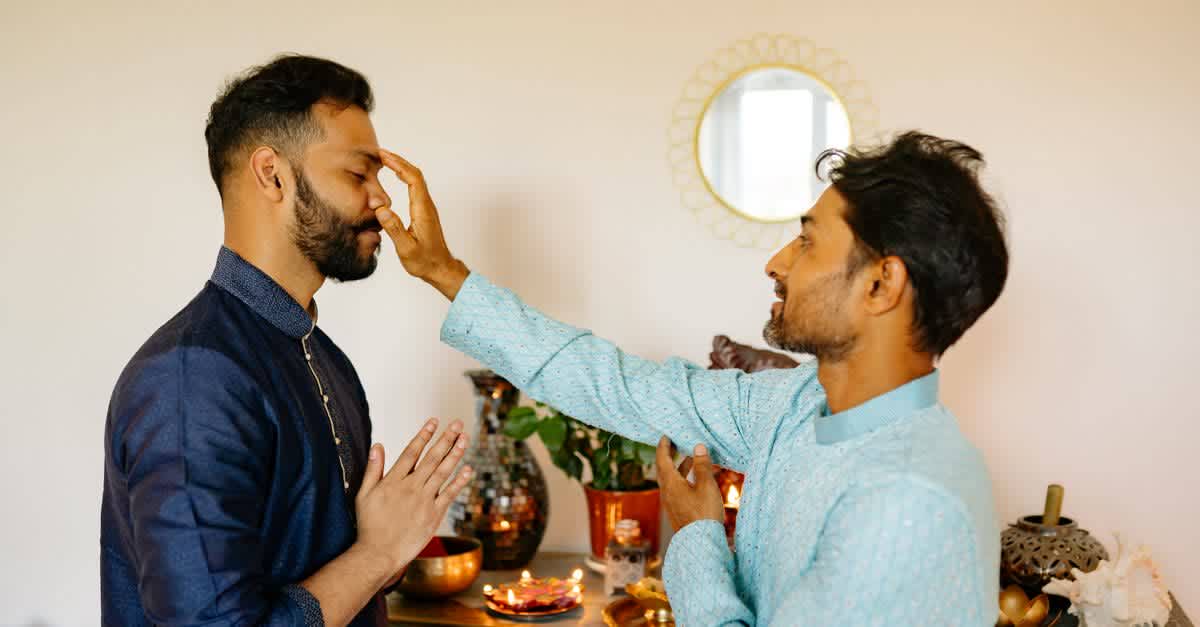
What survives all of this is the use itself. Sandalwood paste is applied in Hindu, Jain, Buddhist and Sufi practice, and in a Zoroastrian fire temple the wood itself is offered to the fire, and the gesture is older than any of the botany above. The point of knowing the species is not connoisseurship. It is that when you put chandan on a forehead, it is worth knowing whether it is chandan.
Questions people ask
Is red chandan the same as chandan?
No. Red chandan, or raktachandan, is Pterocarpus santalinus, a legume in the family Fabaceae. True sandalwood is Santalum album, family Santalaceae. They are not related, and red sanders wood is not aromatic in the way sandalwood is.
Why is real sandalwood so expensive?
The tree only begins to develop fragrance in its trunk after about ten years, and is not ready to harvest until after twenty. That wait, plus restrictions on cutting, is most of the cost.
Does the smell test tell you if chandan is genuine?
Not reliably on the day you buy it. Many substitute woods are perfumed and smell convincing at first; what separates them is that their aroma fades over months or a few years, while sandalwood holds.
Is it legal to own sandalwood in India?
Yes, and private cultivation is now permitted too. Karnataka allowed private growing through a 2001 amendment, with later changes in 2008 and 2022 widening who may buy privately grown wood.
What is the difference between Indian and Australian sandalwood?
Both are true Santalum species. Santalum album, the Indian one, carries a much higher proportion of santalol, the compound that gives the wood its characteristic smell, than the other main commercial source.


