
Jhulan Yatra: The Monsoon Swing Festival of Krishna
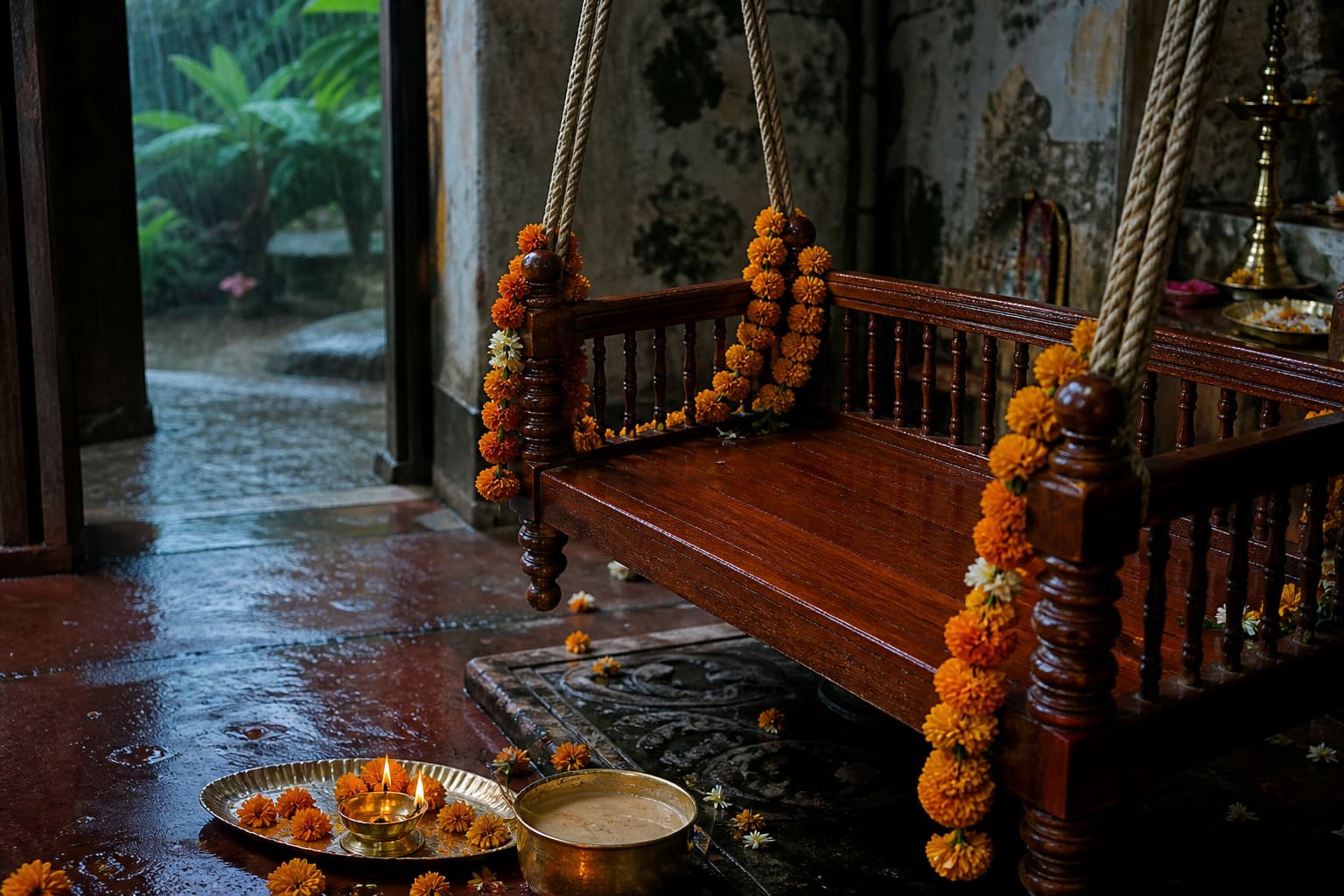
The first sign of it in our part of Bengal is not an announcement but a smell: wet marigold, damp sandal paste, and the particular mustiness of a swing that has been in storage since last Shravan. Someone in the para has brought the jhula down from the loft. By evening it is hung in the thakurghar or the local temple, cleaned, repainted if it needed it, and waiting. For the next five nights, small hands and old hands will take turns rocking it — not hard, never hard — while someone sings. This is Jhulan Yatra, the swing festival, and of all the things Shravan asks of a Bengali household it is the gentlest.
When it falls, and what closes it
Jhulan Yatra is not a single day. It is a short season inside a season — five evenings in the bright fortnight of Shravan, running up to the full moon. In 2026 the swinging is kept from 23 August to 28 August, and the last night, the Shravan Purnima, is also Balarama Purnima and the day the rest of India ties rakhi. So the festival ends exactly where Raksha Bandhan begins, which is a nice accident of the calendar and, if you grew up with both, not an accident at all: the same full moon, two ways of saying I am holding you.
The dates move every year because they follow the moon, not the Gregorian month, so it is worth checking the panchang rather than trusting last year's memory. What does not move is the shape of it — five ascending nights, the swing dressed a little more elaborately each evening, and the Purnima as the crescendo.
What is actually observed
The heart of Jhulan is small and physical. A swing — sometimes a jewelled silver one in the big temples, sometimes two ropes and a painted plank in a village — is hung, and the images of Radha and Krishna are placed on it and rocked. That is the whole rite. Everything else is decoration around that single tender act.
But the decoration is where the festival breathes. The swing is banked with flowers — marigold, tuberose, whatever the monsoon garden is giving. Fruit is offered; in Bengal the season's taal, the sugar-palm fruit, turns up in the bhog as taaler bora. Lamps are lit against the early dark that the rain-heavy sky brings on. And there is singing — kirtan, the swing-songs of Vrindavan, sometimes just a grandmother's thin voice keeping time with the rope. Children are given the job of pushing the swing gently, which is really the job of being made to sit still and be tender for an hour, and it works about half the time.
Somewhere in most Bengali homes, incense is going the whole while — the smoke standing almost straight in the wet, unmoving air of a monsoon evening. It is a small thing, but it is the thing I remember most clearly: the way a stick of good agarbatti behaves differently in Shravan, burning slow and hanging low because the air itself is heavy with water.
Why a swing, and why now
Here the comparative habit is hard to resist, because Jhulan sits inside a whole family of Indian swing rites and only makes full sense against them. Teej, a few days earlier, hangs swings from the trees for women and girls. Dol and Holi, in spring, swing the deities too. Odisha keeps its own Jhulana; Puri's Jagannath is rocked in the Jhulana Mandapa through these same evenings — the reason our own Jagannath incense, named for that temple, gets lit a little more often this fortnight. The satras of Assam keep their own versions, and the Braj towns of Mathura, Vrindavan and Barsana are the heartland of it. Wherever Krishna is loved, the monsoon seems to want him on a swing.
The stories give reasons — the swings of Vrindavan, Radha and Krishna in the rain-fresh groves of Nidhivan, the raas mood of the wet season. But the plainer reason is seasonal, and it is the one a wellness-minded reader will feel without any theology at all. Shravan is the low, enclosed heart of the monsoon. The sky is shut, the fields are working on their own, travel is hard, and the festivals of this month are quiet, interior, domestic — vrats kept at home, the swing hung in your own room. It is India's introverted season. The swing is the perfect object for it: motion that goes nowhere, a back-and-forth that is not travel but rest, a way of moving that calms rather than covers ground. You are not going anywhere in the rain. You are staying put, and rocking.
How a house prepares for it
If you want to keep even a small Jhulan at home this year, almost nothing is required and that is the point. You need a swing — a proper jhula if you have one, or improvised: a small hanging seat, a decorated tray on cords, even a cloth cradle for the images. You need flowers, and Shravan is generous with them. You need a lamp and something to burn, because the monsoon dark comes early and the evening wants marking. And you need five nights of a few unhurried minutes each — the difficulty of the festival is not effort but patience, the willingness to do a small tender thing five evenings running when there is no audience and nothing measurable comes of it.
That, honestly, is the whole discipline of it, and it is closer to a contemplative practice than to a public festival. Light the lamp. Let the incense go. Rock the swing a little. Sing if you can, sit quietly if you cannot. Let the rain do the rest of the sound. On the fifth night, the full moon closes it, the rakhis come out, and Shravan begins to loosen its grip toward the drier, brighter festivals of autumn.
I have come to think of Jhulan as the monsoon teaching a lesson the wellness magazines charge money for: that stillness and gentle motion are not opposites, that you can be held and be moving at once, and that some of the deepest rest is not lying down but being rocked. The season built a whole festival around that, and hung it from two ropes, and left the pushing to children. There are worse ways to spend five wet evenings.


