
Kamakhya Temple: The Climb Up to the Mother in Guwahati
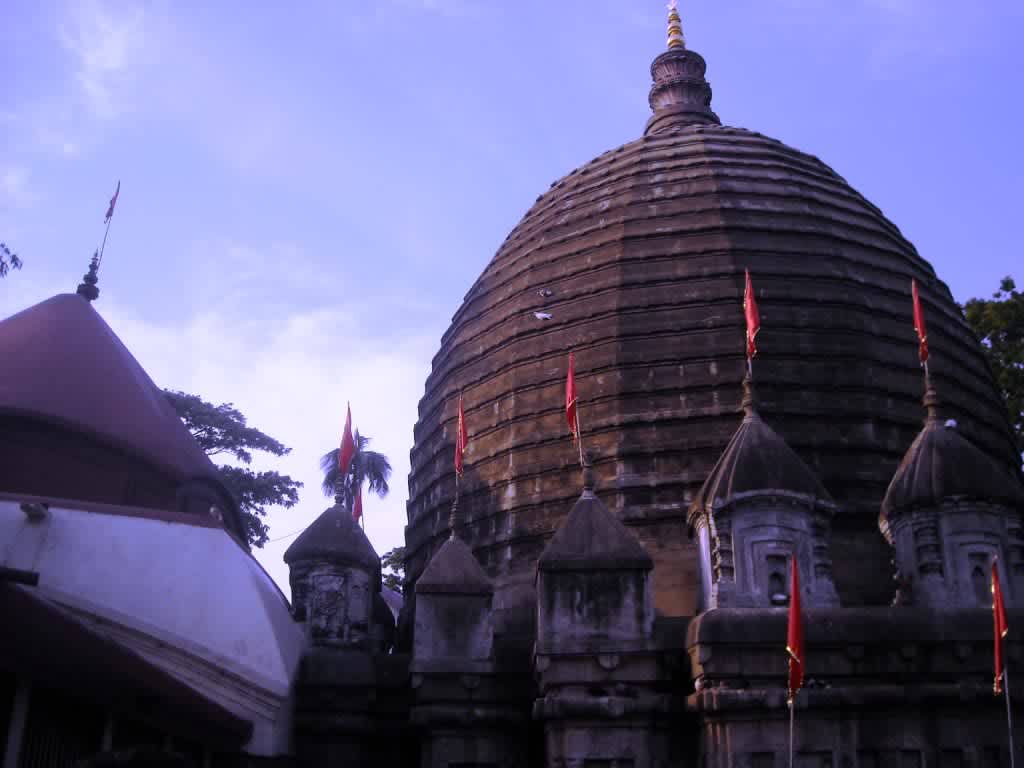
If you grow up in Guwahati, you learn early that the low green hill on the western edge of the city is not just a hill. People point at it from the ferry ghats, from the Saraighat bridge, from the roof of a bus stuck in traffic on the way to Adabari — there, that is Nilachal, that is Kamakhya — and they say it the way you would name a grandmother. Not a landmark. A presence you were born beneath.
I want to write down what the climb to Kamakhya is really like, because most of what you read about it goes straight to the tantra and the mystery and skips the ordinary morning — the queue, the heat coming off the stone, the smell of sindoor and wet flowers, the sound of the Brahmaputra moving somewhere below you that you cannot quite see but always feel.
The hill you have to go up
Kamakhya sits on Nilachal Hill, also called Nilshaila, the "blue hill", on the western side of Guwahati, looking down over the Brahmaputra. You can drive most of the way up now — the road winds and doubles back on itself past small shrines and shops selling red cloth, brass bells, coconuts, and garlands that are already wilting a little in the heat. Shared vehicles run from the bottom. But there is also the old way, a long flight of stone steps that pilgrims have climbed on foot for centuries, and if your knees allow it, the walk up is the better way to arrive.
Either way, you come up out of the noise of the city into something quieter and older. There are langurs on the walls. There are sadhus with ash on their foreheads sitting where the shade is. There is the particular Kamakhya sound — bells, a conch somewhere, the low collective murmur of a lot of people all waiting for the same thing.
The queue is long, and the queue is the point
Do not come to Kamakhya expecting to walk straight in. On an ordinary day the line moves slowly; on a Tuesday, or a Saturday, or any day near a festival, it can take hours. There is a general queue and there are paid faster-darshan passes, and I will not pretend the fast line does not exist — but the ordinary queue, the long one, is where the temple does its quiet work on you.
You stand in it pressed close to strangers, families from all over Assam and Bengal and beyond, an old woman counting something under her breath, children who have long since stopped being patient. The heat builds. Somewhere ahead the line bunches and stops and you cannot see why. This is the part nobody photographs, and it is the part that matters. By the time you reach the sanctum you have already given up your hurry at the door, because there was nothing else to do with it.
Down into the dark
The thing that surprises people who come to Kamakhya from other temples is that there is no idol. No face, no arms, no painted eyes looking back at you. You descend a few worn stone steps into a dim cave-like chamber below the main hall, and it is dark, and it is close, and the air is wet.
What is worshipped here is a cleft in the rock — a natural stone shaped like a yoni, the womb, kept permanently moist by a spring that seeps up through the hill. It is draped in red cloth and heaped with flowers and sindoor and offerings until you can barely see the stone itself. The priests move fast in that narrow space; there is water underfoot; the smell is flowers and vermilion and the loban and sandalwood smoke that hangs in every corner of the place. Households that keep a lamp and a stick of incense from the Jyotirlinga range burning through the week recognise that smell instantly — it is the smell of a shrine that has never once gone cold.
You get a moment, maybe two, with your hands wet from touching the stone, and then the line behind you moves you gently on. Most people come up the steps blinking, a little dazed, not quite able to say what just happened.
Why here, of all the hills in India
The old story is the one told of every Shakti Peetha, and it is worth telling plainly. When Sati gave up her life at her father Daksha's sacrifice, Shiva carried her body across the world in his grief, and Vishnu's discus cut it into pieces so that the world might be spared his mourning. Wherever a part of her fell, a Peetha rose. There are fifty-one of them across the subcontinent, and Kamakhya is where her yoni is said to have fallen. That is why the goddess here is worshipped as the source — Kamakhya, the giver of desire, of fertility, of life itself.
It is also why Kamakhya is unlike the tidy, marble, well-lit temples of the tourist circuit. This is a Shakti Peetha and a centre of tantra, and it does not soften itself for visitors. Once a year, in the monsoon month of Ahaar, the temple observes Ambubachi — the days when the goddess is believed to menstruate, when the spring in the sanctum is said to run red, and the temple closes its doors for three days. When it reopens, thousands of sadhus, tantriks and pilgrims who have gathered from across the country receive the raktabastra, a piece of the red cloth from the sanctum, as the most powerful prasad Kamakhya gives. It is one of the few places on earth where a woman's body is not treated as something to be hidden but as the very thing that is holy.
The temple that was rebuilt
Look up when you are outside again and you will see the shape that makes Kamakhya instantly recognisable — the beehive dome, a rounded, ribbed shikhara clustered with smaller domes, sitting on a base shaped like a cross. This is the Nilachal style, and it is not ancient in the way the site is. The present temple was rebuilt in 1565 by the Koch king Nara Narayan and his brother Chilarai, after an earlier structure on the hill had been destroyed. The site is far older than that; the building you stand in front of is a few centuries of Assam's own kings deciding this place would not be allowed to disappear.
Around the main temple, scattered across Nilachal, are the smaller shrines of the Dasha Mahavidya — the ten aspects of the Divine Mother, Kali and Tara and Bhuvaneshwari and the rest. Pilgrims with time and strong legs go from one to the next through the day. Most first-time visitors do the main darshan and Tara and leave the rest for a life that brings them back.
What you carry down
Coming down Nilachal, the city returns slowly — the horns, the heat, the river brown and enormous below you, the same Brahmaputra you have watched your whole life without ever quite taking in how big it is.
I would not dress up what the visit does. It is not a solution to anything. But there is a specific quiet that comes from having stood in a dark wet chamber and touched a stone that people have touched for longer than anyone can date, and having asked the Mother for the ordinary things people always ask her for — a child, a marriage, a parent's health, a way through a hard year. You do not need to believe every line of the story to feel the weight of all the asking that has gone before yours in that room.
You come back down to Guwahati, and the hill is a hill again from street level, green and unremarkable in the afternoon light. But you have been up there now. And the next time someone on a crowded bus points and says there, that is Kamakhya, you will understand why they say it the way they do.


