Karam Parab: A Jharkhand Harvest Festival Remembered
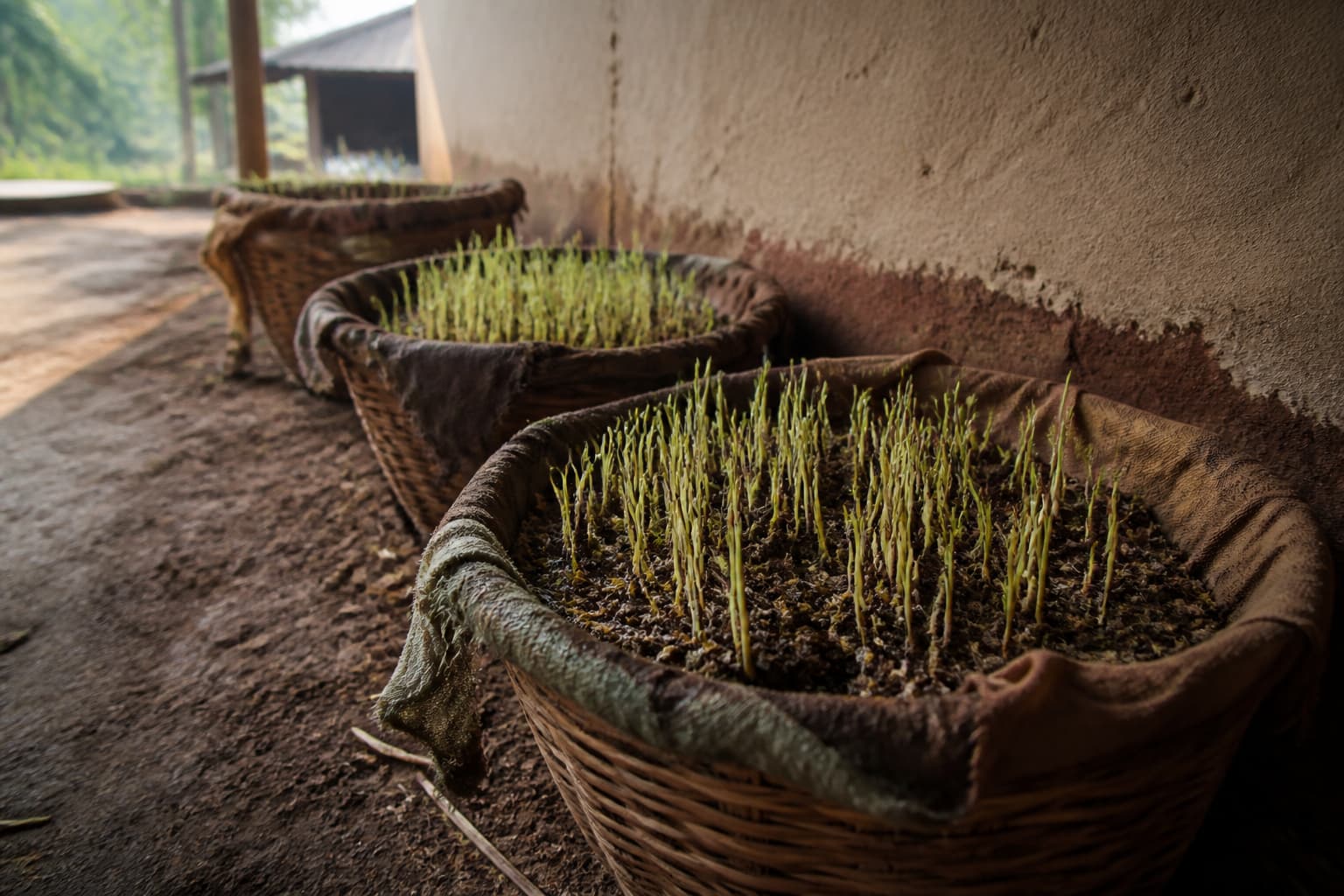
The first sign of Karam was never a date on a calendar. It was a row of small baskets sitting in the shade behind the house, and the smell of wet earth and sprouting grain coming off them every time you walked past. My cousins would be crouched over those baskets before school, lifting the cloth, checking whether the pale yellow shoots had come up overnight. In the plateau where I grew up, on the red-soil edge of Ranchi, that quiet daily tending was how you knew the festival was close.
The baskets are called jawa. Seven to nine days before Karam Parab, the unmarried girls of a house — the karamaiti — sow nine kinds of seed in them: rice, wheat, maize, and whatever else the season allows. They keep the baskets in shade, water them gently, turn them, guard them from goats and careless feet. By the time the festival arrives, the shoots stand a few inches high, pale for want of full sun, and the girls carry them the way you would carry something alive that you had personally raised. Which, of course, they had.
When the whole village is one household
Karam falls on the eleventh day of the bright fortnight of Bhado — the month that straddles late August and September. In 2026 the main day is the 22nd of September. It is a harvest festival, and in Jharkhand it is not a small thing. It is a gazetted state holiday, and it belongs to a long list of communities of the Chotanagpur belt and beyond — Oraon, Munda, Ho, Kudmi, Bhumij, Kharia, and many more. You do not have to trace one clean religious line through it. It is older and broader than that. What it worships, plainly, is the tree, the harvest, and the young — the Karam Devta, spoken of as the god of strength and of youth.
I say "the whole village" because that is how it felt. A festival like Diwali, you keep inside your own doorway. Karam happens in the akhra — the open dancing ground at the centre of the village — and there is no version of it you observe alone. The whole point is the crowd.
The branch
On the day, a group goes to the forest to bring the Karam branch. Drummers go with them. There is a specific tree — people will point to it and name it — and the branch is not simply broken off; it is cut with some ceremony, a young man with a flower tucked behind his ear, the drums keeping everyone together on the walk back. The branch is carried into the akhra and planted upright in the middle of the ground.
Then it is washed — with milk, and with the rice beer that is inseparable from these festivals, what people call tapan or handia. The pahan — the village priest; in some places he is called dehuri — does the honours. And this is the part I would wait for as a child, because it was the one quiet moment in a loud day: the pahan sits by the branch and tells the story.
Two brothers, Karma and Dharma
The story he tells is about two brothers, Karma and Dharma. In the version I grew up hearing, the brothers offend the Karam tree — one of them, careless and full of himself, tears it out or throws it away — and afterwards everything goes wrong. The crops fail, the household falls into ruin, fortune turns its back. Only when the tree is found again, brought back, and honoured properly does the family's luck return.
You can hear it as a simple morality tale — respect the thing that feeds you and it will keep feeding you. On the plateau, where the forest genuinely is the difference between a good year and a hungry one, it is not a metaphor. The tree in the story is the tree in front of you. That was the lesson underneath all the noise: what keeps you alive is owed something back.
The night belongs to the akhra
After the story, the fast the karamaiti have kept all day is broken, and the dancing starts. This is Karam Naach, and it does not stop until morning.
The dance is a long line or a ring, arms linked at the shoulder or the waist, feet moving together, the whole line swaying as one body around the branch. The women sing the siring — the Karam songs — and the drums answer. If you have never stood next to a mandar drum being played hard for hours, you cannot quite imagine how the sound gets into your chest and stays there. The men drink handia. The old people sit at the edge and watch and remember their own akhra nights. Children like me were supposed to be asleep and mostly were not; we watched from the dark edge of the ground until we could not keep our eyes open, and someone carried us home.
Smell is what I kept. The green, sap smell of the fresh branch. Woodsmoke from the fires. Sal-resin dhuna thrown on the coals, the dense grey smoke that people across this whole region — the same Bihar-Jharkhand belt where, in Samastipur, we now hand-roll our own incense — have burned at gatherings for as long as anyone can say. Scent is a stubborn kind of memory. Decades later a lungful of resin smoke will put me straight back at the edge of that dancing ground, half asleep, the drums going.
Morning, and letting the branch go
By first light the singing thins out. The next morning the branch is honoured a last time and carried to the river or a pond and immersed there. That closes the cycle. The jawa shoots the girls raised are given out too — tucked behind ears, floated on the water, shared around — small green blessings for a good harvest and for the young people of the house.
There is a neatness to it that I only understood much later. A living thing is raised in a basket for a week; a living branch is brought in, honoured for a night, and returned to the water. Nothing is meant to be kept. The festival is a loan from the forest, paid back the next morning.
Why I still think about it
I have lived in cities long enough now to have watched Karam shrink to a holiday on the office calendar, a day people take without always knowing what the baskets in their grandmother's yard were for. That is the ordinary way of things and I am not going to be sentimental about it.
But I would say this to anyone whose family kept Karam, or Chhath, or any festival built around a plant and a river and a shared ground: the small tending is the whole festival. Not the big night — the week of quietly watering a basket of grain, of raising something you will give away. If you have moved far from the plateau, you can still do the small part. Sprout a little grain in a bowl on the windowsill in Bhado. Light something that smells the way home smelled. Tell a child the story of the two brothers.
The branch goes back to the river. What stays is what you took the trouble to remember.