Karkidakam: The Ramayana Month in a Kerala Childhood
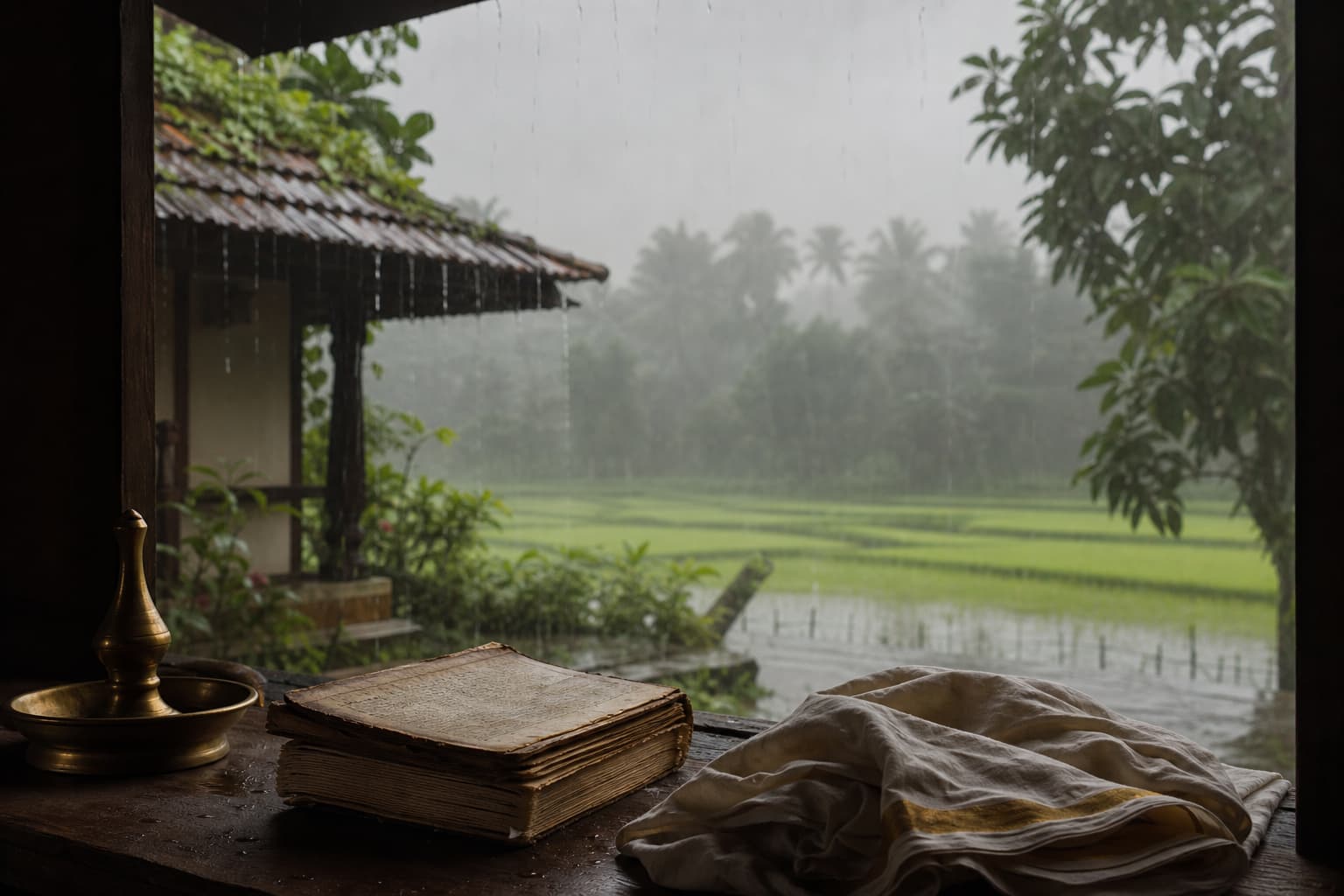
The rain in Karkidakam does not fall so much as settle in. It comes down thick and grey over the paddy behind the house, and it stays — for days, sometimes, without a break wide enough to dry a single mundu on the line. This is the last month of the Malayalam year, the twelfth month of the Kollavarsham calendar, and in Thrissur where I grew up it arrived the way an old relative arrives: quietly, expecting to be looked after, and staying longer than anyone plans for.
We called it many things. The lean month. The empty month. My grandmother, who measured a year not in dates but in what the kitchen could offer, called it panja Karkidakam — the month of want. The granaries were low, the fields were flooded and unworkable, and the sea was too rough for the boats to go far. In an older Kerala this was a genuinely hard stretch, weeks of making a little rice go a long way. And yet it is this same hungry, waterlogged month that Malayalis have turned, over centuries, into the most sacred one of all.
Ramayana Masam
Karkidakam is Ramayana Masam — the month of the Ramayana. On the first morning of the month, in Hindu homes across Kerala, someone opens the Adhyatma Ramayanam, the sixteenth-century Malayalam retelling by Thunchaththu Ezhuthachan, and begins to read it aloud. A little is read each evening, and the aim is to finish the whole epic on the last day of the month, so that the reading and the month end together.
In my grandmother's house that someone was, of course, my grandmother. After the evening lamp was lit she would sit on the low wooden palaka with the book open on a cloth, and read in the sing-song kilippattu metre the way it is meant to be read — the poem is framed as a story told by a parrot, and there is a particular lilt to it that I could pick out from the next room before I understood a word. She did not read fast. She was not trying to get through it. If a verse moved her she would stop and tell us what it meant, and half the time the telling was longer than the verse.
I understood almost nothing then and I remember almost everything now: the specific dark of that room, the rain on the tiles, the exact pitch of her voice going up at the end of a line. That is the strange gift of Karkidakam. It teaches you things you only collect the meaning of decades later.
The lamp and the smell of the month
Every Kerala house has a particular smell, and Karkidakam has its own within that. The windows stay shut against the rain, so nothing airs out; the whole house holds the day inside it. There is woodsmoke from the kitchen hearth, the green bitterness of medicinal herbs, damp earth, wet coir. And over all of it, at dusk, the nilavilakku — the tall brass lamp — lit with a cotton wick and a little oil, and beside it a curl of incense smoke.
That evening lamp is the still point of the whole month. The Ramayanam is placed before it; the family gathers around it; the reading happens in its light. When I try to picture Karkidakam I do not first see the rain or the epic — I see the small warm circle the lamp made, and I smell the sandalwood that went with it. In our house the fragrance for the prayer corner was always chandan, sandalwood, because it was my grandmother's; even now a thread of good sandalwood incense will put me straight back on that floor beside her, seven years old, not understanding a word and perfectly content.
Karkidaka kanji — medicine you could eat
The other half of Karkidakam is the body. Because the month is damp and the monsoon leaves people run-down, Kerala treats it as a season of repair. This is when families make Karkidaka kanji — a thin, warm rice gruel cooked with a fistful of medicinal herbs, jaggery, coconut milk and roasted spices. It is bitter and sweet at once, and you are meant to take it in the early morning for the length of the month.
My grandmother made hers with the herbs she gathered herself, and with dashapushpam, the ten sacred plants of Kerala — small, ordinary-looking weeds that grow in every wet corner of the state and that women once knew by sight the way they knew their own children. Half of them I could not name today, and that loss is its own small grief. The kanji tasted of the rain. It is the reason Karkidakam is now sold, in wellness circles, as a month of Ayurvedic "monsoon rejuvenation" — but in the house it was never a spa treatment. It was simply what you ate when the year had worn you thin.
Karkidaka Vavu
There is a darker, tenderer note in the month too. The new-moon day of Karkidakam — Karkidaka Vavu — is the day Malayalis remember their dead. Before dawn, on riverbanks and temple tanks and the long grey beaches, thousands sit to offer bali, water and rice and sesame, to parents and grandparents who have gone. You do not need to be able to see the sea to know, on that morning, that half of Kerala is at the water's edge with their ancestors.
It fits the month exactly. Karkidakam is inward-turning by nature — the fields resting, the sea closed, the family drawn indoors around a lamp and a book. Of course it is also the month you turn to the ones no longer at the table.
Why it stays with you
People outside Kerala sometimes find it strange that the wettest, poorest, most difficult month became the holy one. I think it is the opposite of strange. When there is nothing to harvest and nowhere to go, what is left is the inside of the house and the inside of yourself. Karkidakam took a hard season and filled it with the two things that carry people through hard seasons anywhere — a long story about a god who also lost his home and walked a very long way, and a warm bowl in the morning.
The month ends on the eve of Chingam, the first month of the new year, when Kerala turns bright again and Onam begins to gather on the horizon. But before the marigold and the feasting there is this: a grey month, a shut house, a brass lamp, and an old voice reading a parrot's song into the rain. If you have somewhere quiet this month, light a lamp in the evening and read a little of something that matters slowly. That is the whole practice. Karkidakam has never asked for more than that.