
Kumartuli: How a Durga Idol Is Actually Built in Clay
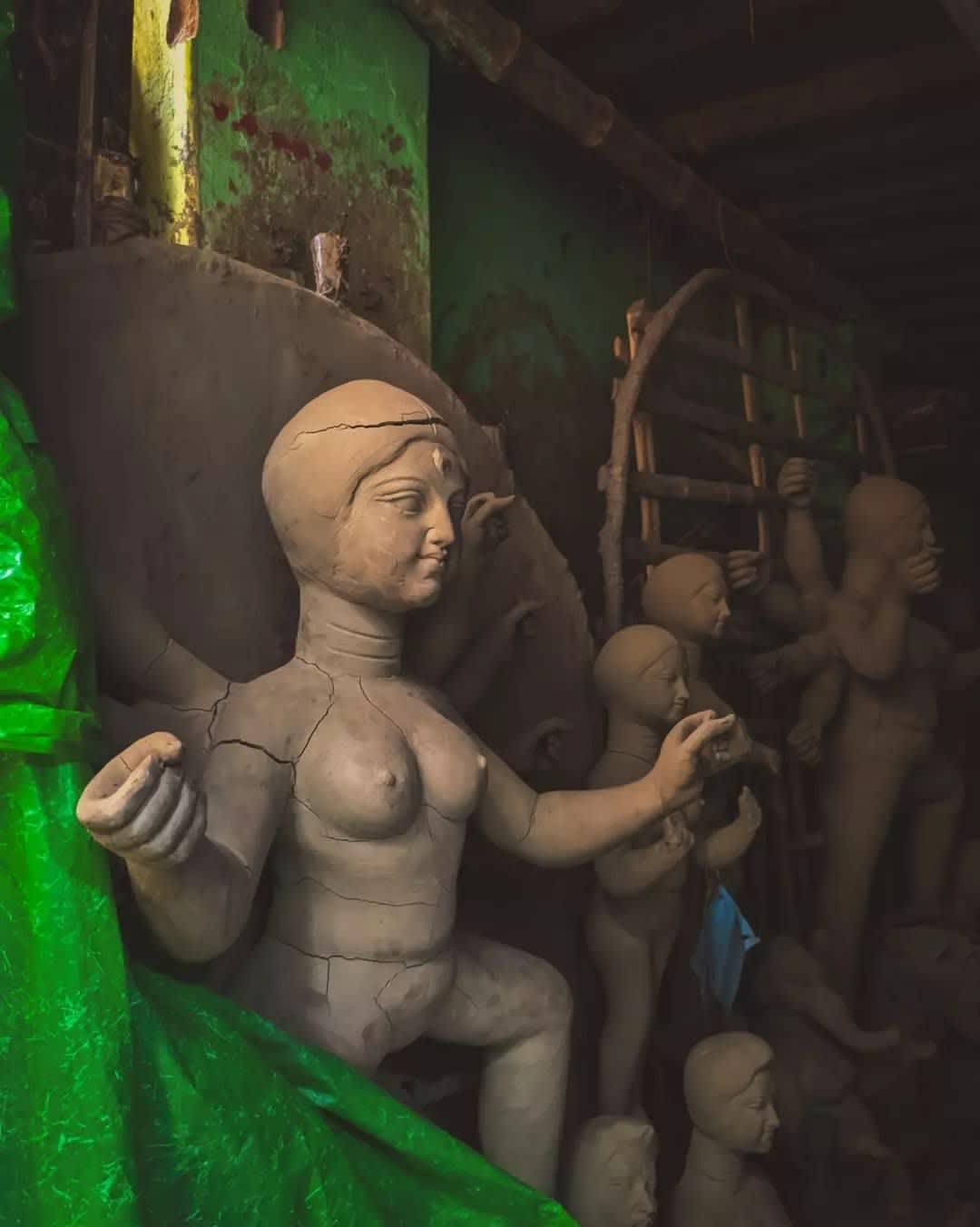
Here is the thing nobody tells you about Kumartuli. If you go there today — Thursday, the fifteenth of October, the day before Shashthi — you will mostly find empty floors. The lanes that every photographer shoots in September are swept and quiet. The idols have gone. They went out on handcarts and lorries over the last few nights, and what is left behind is straw ends, broken armature wood, and a lot of men sleeping.
So let us go backwards instead. Because the interesting part of a Durga idol is not the finished thing under the lights at a pandal. It is the eight months of construction underneath it, which is a genuinely technical business, and almost none of it is sculpting in the way you are picturing.
I want to walk you through the actual sequence. Stay with me on the materials — that is where the whole thing lives.
The quarter is named after the job
Kumartuli — you will also see it spelt Kumortuli — is the potters' quarter of north Kolkata, a wedge of lanes sitting between Rabindra Sarani, which used to be Chitpur Road, and the Hooghly river.
The name is a colonial filing system that stuck. After the Battle of Plassey in 1757 the East India Company built its new Fort William on the site of Gobindapur village, and the people living there were moved up to Sutanuti. Holwell, acting on orders from the Company's directors, allotted "separate districts to the Company's workmen" — and those districts got named after the trade in them. Suriparah for the wine sellers. Collotollah for the oil men. Chuttarparah for the carpenters. Aheeritollah for the cowherds. And Coomartolly, the potters' quarters.
What the potters actually made, at first, was pots. River clay from the bank beside their own houses, thrown and fired and sold at Sutanuti Bazar, which later became Burrabazar. The image-making came afterwards, as a sideline for the big mansions all around them that needed a goddess once a year, and then — once Durga Puja became a public, subscription-funded, community affair — as the main business. The same quarter now ships idols abroad.
An aside, because it matters to how you read the place: most of north Kolkata's other trade quarters thinned out or vanished in the late nineteenth century. The potters stayed. They stayed because the river was right there and the clay was free.
It begins in July, with a frame and a prayer
The festival is a post-monsoon event, but the work starts in high summer.
The opening day is Rath Yatra, usually in July, with Paata Puja — paata being the wooden frame that forms the base of the idol. That is the formal start of the season: you worship the structure before you build on it. The process begins with prayers to Ganesha, and to the divinity understood to be present in the materials themselves, including the bamboo frames the figures are cast around.
Think about what that implies. The bamboo is not scaffolding to be thrown away. It is part of the thing.
On top of that frame goes hay, bound into the rough mass and volume of a body. The limbs are mostly shaped from bundles of straw — not carved, bundled, tied tighter where an ankle needs to be thin and looser where a thigh needs to be full. By the time the clay arrives, the figure already has its posture, its scale and its gesture. The clay is a skin.
This is the part that separates Kumartuli from the other great idol towns. In Pen, in Maharashtra, where the Ganpati workshops cast from two-part moulds, a large idol is replicated. Here it is constructed, once, around a skeleton, and no two come out identical because no two bundles of straw are tied the same way.
Straw, then clay, then jute
The clay is alluvial soil, and the tradition is that it comes from many different places rather than one pit — the reasoning being that Durga is the creative material of the universe and is therefore present everywhere, so the body should be made of everywhere.
In certain Kolkata traditions that principle is pushed to its sharpest point: soil is included from the nishiddho pallis, the "forbidden" neighbourhoods, meaning the brothel districts. The logic is uncomfortable and deliberate. If the goddess is in everything, she is in the ground there too, and a body built without it is incomplete.
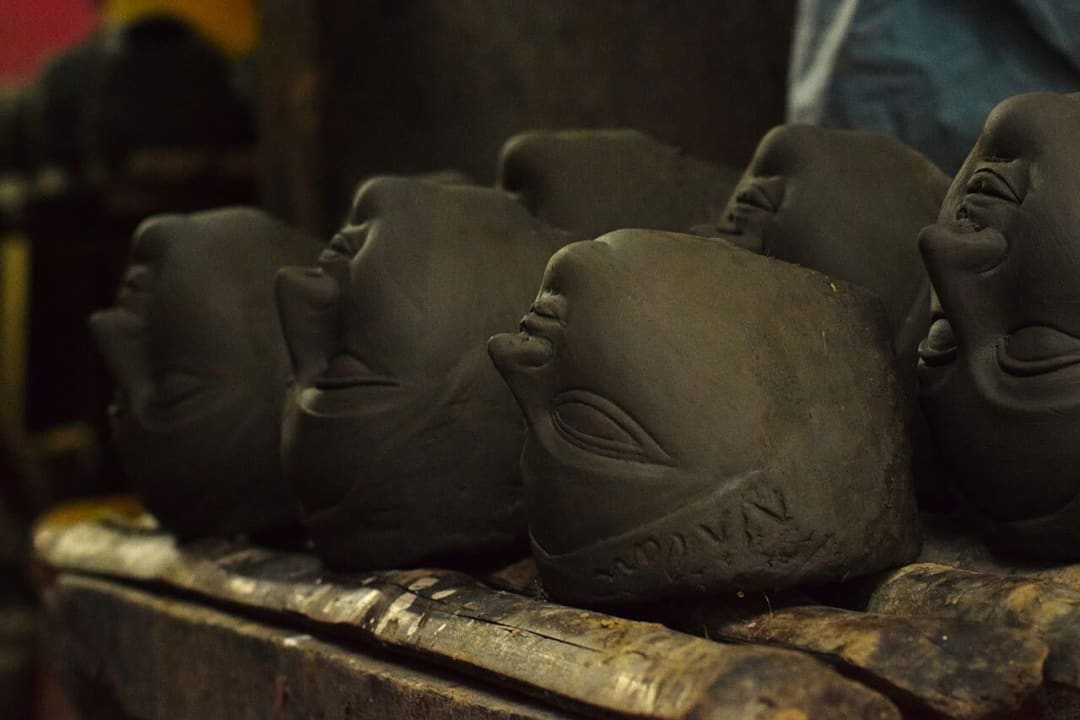
The clay is combined with straw, kneaded, and packed onto that hay-and-bamboo cast. Then it is layered up to a fine final shape, cleaned, and eventually painted and polished. The heads are the complicated part and are usually made separately — which is why a workshop in August has a plank of faces drying in a row, looking like that photograph, before any of them belong to a body.
And then the step that tells you these people are engineers as much as artists: a layer of jute fibre, mixed into clay, is applied over the top specifically to stop the figure cracking in the months it still has to survive. The idol is going to sit through the tail of a Bengal monsoon and then dry out. Clay shrinks as it dries. Jute holds it together, the way hair holds lime plaster together, and it is doing exactly the job rebar does in concrete.
It does not always work. Look at the cracks on the figures at the top of this page — that is a real workshop, not a failure of one. Cracking is the default state of the material and the whole craft is a running argument with it.
From about August the painting begins, and after painting comes the clothing, the ornament and the jewellery.
The eyes are not a finishing touch
Now the part I actually wanted to tell you about.
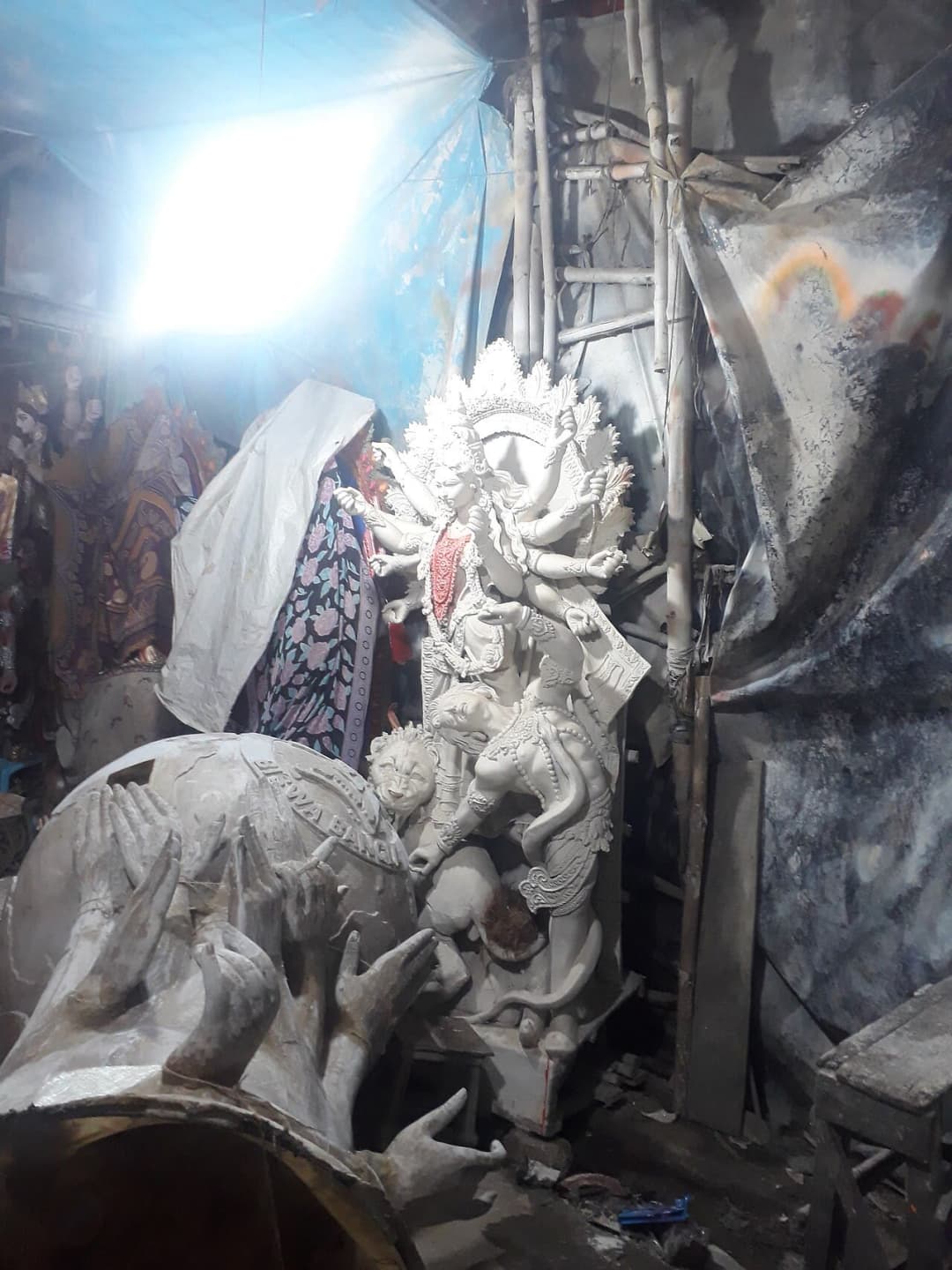
The eyes are painted in a rite of their own — Chokkhu Daan, the giving of the eyes — and it is traditionally done around Mahalaya, which this year fell on Saturday 10 October. Not when the artisan happens to reach the face in his queue. On the day.
Mahalaya is the hinge between Pitru Paksha, the ancestors' fortnight, and Devi Paksha, the goddess's. It is the morning all of Bengal is awake at four for the Mahishasuramardini broadcast. And in Kumartuli it is the morning the eyes go on.
Here is the bit most people get wrong, and it is worth being precise about. Chokkhu Daan is an awakening. It is not the installation of life. That belongs to a separate rite, prana pratishtha, which comes with the puja proper — and the puja proper does not start until Shashthi, which in 2026 is tomorrow, Friday 16 October.
Manuals differ on exactly which morning carries it, and I am not going to pretend they agree. Some count the pratima's prana pratishtha within the akal bodhon, the out-of-season waking performed on Shashthi; others place it on Saptami morning, after the navapatrika has been taken to the water and bathed. Either way it is seven or eight days after the eyes.
So there is a stretch of about a week where several thousand figures across north Kolkata are standing in the dark with open, finished, looking eyes and no breath in them yet. The artisans will tell you it changes how the workshop feels. I believe them, and I do not think that is superstition — it is what anyone who makes things by hand will say about the moment an object starts to look back.
Three things worth remembering
If you take nothing else from this:
- It is built, not sculpted. Bamboo frame, straw body, clay skin. The shape is decided by a man tying bundles in July, long before anybody touches the surface.
- The jute is the clever part. A fibre layer mixed into the clay, applied specifically against cracking, on an object engineered to last about four months and then dissolve. Most things are built to resist their ending. This one is built to meet it on schedule.
- The eyes come before the life. Chokkhu Daan at Mahalaya; prana pratishtha with the opening of the puja. Seven or eight days this year, and the gap is not an accident.
Then Ashtami on Monday 19 October, and Navami on Tuesday the 20th — which is the morning most of the country is already keeping Vijayadashami. In Bengal Bijoya Dashami waits for Wednesday the 21st; it is not a second holiday, just Dashami kept on a different morning, because the Dashami tithi does not begin in Kolkata until ten to one on the Tuesday afternoon and runs until past two on Wednesday. And then the clay goes into the river it came out of, the straw and bamboo with it, and in Kumartuli somebody starts thinking about next July.


