
An Ordinary Morning at the Meenakshi Temple, Madurai
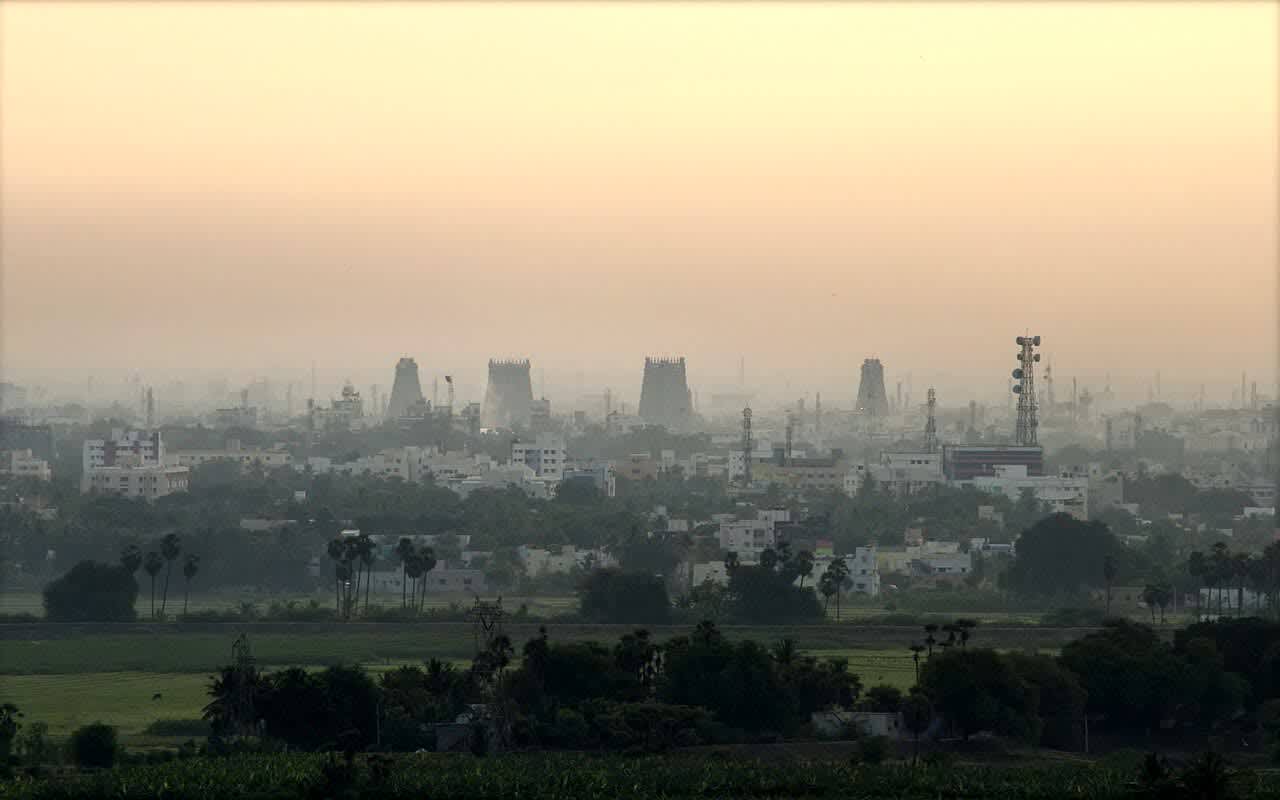
The gopurams are the first thing Madurai gives you, long before you reach the temple itself. You see them from a bus window, from a rooftop, from the far end of a lane selling steel vessels — great tapering towers rising over the low roofs of the old town, every inch of them crowded with painted figures. Gods, guardians, dancers, horses, demons mid-lunge. From a distance they read as colour and mass. Up close, on an ordinary morning with no festival to justify the looking, you can stand at the base of the southern tower and simply count the storeys until your neck aches.
This is the Meenakshi Amman Temple, and Madurai grew up around it the way rings grow around the heart of a tree. The streets are laid out in concentric squares, the innermost ones still named for the Tamil months — Chithirai, Avani Moola, Masi — so that walking toward the temple you are, in a sense, walking through a calendar. The whole city is oriented to the shrine at its centre. Even now, when a flyover carries traffic past the outer wall and a coffee chain has opened where a cloth merchant used to be, the geometry holds.
Before the crowds
Come early. Not for the light, though the light is good — for the quiet. A little after five the temple opens, and for an hour or two it belongs to the people who are there for reasons of their own rather than the itinerary.
The first sound is not a bell. It is the nadaswaram, the long reed horn, and the thavil drum beside it, waking the deity the way you would wake an honoured guest — with music, before speech. The notes carry down the stone corridors, bending around pillars, so you hear the temple before you have properly entered it.
Then the smell. Madurai is a jasmine town — Madurai malli, the small tight-budded jasmine that carries a name and a reputation of its own, sold not by weight but by the muzham, the length of a forearm. By six the flower sellers are threading it into garlands outside the east gate, and the scent gets into everything: the damp stone, the wet feet of the tank, the smoke of the first camphor. A working morning at Meenakshi is a morning you can navigate with your eyes closed.
Inside, the scale rearranges you. The temple is not one shrine but a walled town of them — fourteen gopurams, thousands of pillars, two great sanctums under gold-topped towers, and a warren of corridors connecting them. The impulse is to hurry toward the main shrine. Resist it. On an unhurried morning the corridors are the thing.
The stone that was meant to last
Walk the pillared halls and you understand what the builders were after. Much of what stands today was raised and expanded under the Nayak kings who ruled Madurai from the sixteenth century, on the site of a far older shrine, and they built for permanence and for wonder in equal measure. Pillars are carved into yalis — the mythical lion-elephant — rearing on their hind legs. Others are cut so that a tap sends a clear musical note down the shaft. In the hall once counted at close to a thousand columns, no two capitals are quite the same; the guides call it the Thousand Pillar Hall, and part of it now holds a museum of temple bronzes and old photographs, so the stone keeps working for its living.
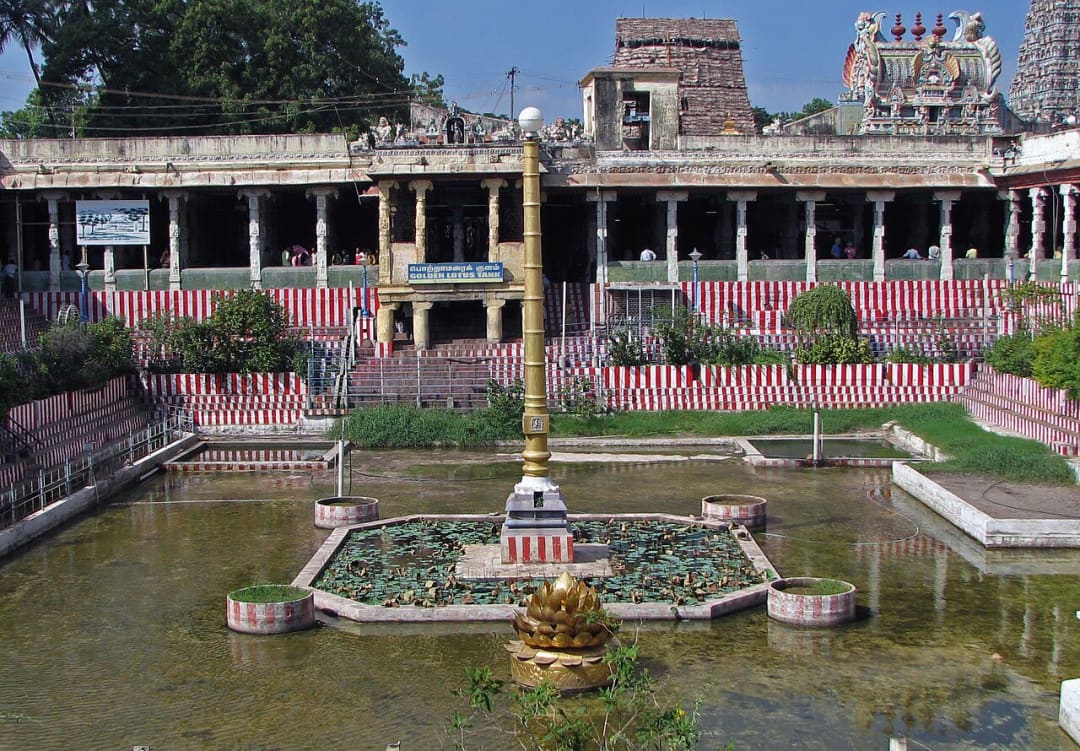
At the centre, open to the sky, is the Potramarai Kulam — the golden lotus tank. Green water, a low colonnade around it, steps worn smooth by centuries of feet. People sit on those steps in the early morning without any particular purpose, and that permission to simply sit is one of the things a great temple offers that a monument does not. There is an old story that poets of the ancient Tamil academy tested their verses here — a manuscript worth keeping would float, a poor one would sink. Whether or not that ever happened, it tells you how the town has always thought of this water: as a place that judges what is genuine.
The two sanctums face each other across the complex — Meenakshi, the fish-eyed goddess whom the town regards as its own daughter and queen, and Sundareswarar, her consort, a form of Shiva. Madurai does not treat them as distant. The temple's daily life runs on the rhythm of a household: the deities are woken, bathed, dressed, offered food, and each night Sundareswarar is carried in procession to Meenakshi's chamber and returned again at dawn. It is why the town is sometimes called the city that never sleeps — the shrine keeps hours the way a family does. Incense has a plain place in that routine; the shrine-named agarbatti we make for temples like Ramanathaswamy, further south on the coast, belongs to exactly this kind of morning ritual, and you can find the Jyotirlinga range if that is what you keep at home. But the point of an ordinary morning here is not to buy anything. It is to notice how a very large sacred place stays intimate.
What the day does with it
By nine the character changes. The tour groups arrive, the queue for the main sanctum lengthens, the guides raise their voices to be heard, and the shoe-stall outside the wall does brisk business. This is the temple most visitors meet, and there is nothing wrong with it — a living shrine is supposed to be crowded. But it is a different building from the one that exists at six.
If you have only an afternoon in Madurai, you will still be glad you came; the gopurams do not need good timing to impress. But the temple keeps its best hour for the people who show up before it is convenient. Nothing is staged for them. A priest crosses a corridor carrying a brass lamp. A woman presses her palm flat to a cool pillar and rests her forehead against the back of her hand. Two old men argue quietly about a bus. The jasmine sellers count out garlands by the forearm. None of it is for show, which is exactly why it is worth seeing.
That is the thing an ordinary Tuesday teaches that a festival cannot. A festival shows you what a temple can rise to. A plain morning shows you what it is the rest of the time — which is to say, what it actually is: a working house of the divine that the town has never stopped living inside. Stand under the southern tower once more on your way out, look up until you lose count of the figures, and then go and get your coffee. Madurai has been doing exactly this for a very long time, and it will do it again tomorrow, festival or no festival.


