
Mahaprasad: A Morning in the Puri Temple Kitchen
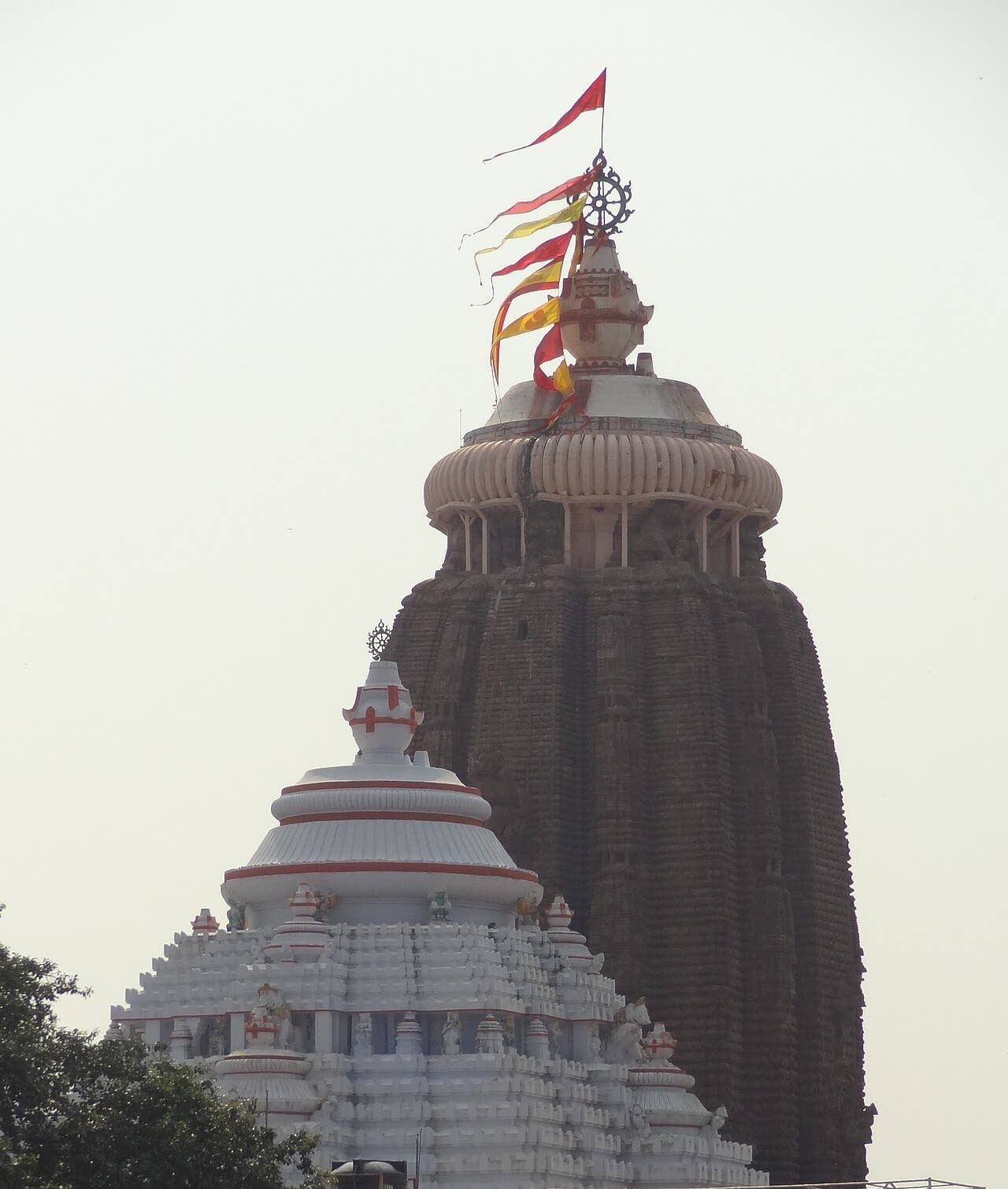
By six in the morning the wind off the Bay of Bengal has already turned the corner of the Grand Road and is pushing salt up the lanes of Puri. You can taste it before you see the temple — the sea is only two streets away — and then the great tower is there above the rooftops, the flag on top of it turning slowly in that same wind. Most people come to Puri for the god. I keep coming back for the kitchen behind him.
It has no signboard. From the eastern side of the complex you notice it as smoke first, a low grey haze that never quite lifts, and then as sound: the flat knock of firewood being split, the scrape of iron ladles the length of a man's arm, hundreds of voices that are not shouting but are not quiet either. This is the Rosaghara, the temple kitchen, and on an ordinary Tuesday — no festival, no procession, no crowd from out of state — it will still cook enough to feed several thousand people. Nobody in there is thinking about that number. They are thinking about the next pot.
The pots that cook from the top down
The first thing that undoes your sense of how a kitchen should work is the fire. There is no gas here, no steel range, no thermostat. Food is cooked over firewood, in unglazed earthen pots made fresh — a potter's colony nearby turns them out by the cartload, and each pot is used once and then broken. A single dish for the god may pass through a stack of these pots set one on top of another over the same flame, seven or nine high.
And here is the thing everyone in Puri will tell you, and which I have watched with my own eyes and still cannot fully explain: the pot at the top of the stack is done first. The one sitting directly on the fire finishes last. People offer you reasons — the clay, the steam, the way the heat climbs — and the cooks themselves mostly shrug, because to them it is not a marvel, it is Tuesday. They have been doing it this way for longer than any record we have.
The cooks are called suaras, and they belong to families who have held this work for generations. There are hundreds of them on an ordinary day, moving in a choreography no one is directing out loud. Rice, dal, a dozen vegetable preparations, sweet things, all of it sattvic — no onion, no garlic, nothing that would not be offered to a deity. Nobody tastes the food as they cook. You do not sample what is meant for the god before the god has had it.
What makes it maha
Cooked food, however carefully made, is not yet Mahaprasad. It becomes that only after it is offered — first inside the sanctum to Jagannath, and then, crucially, carried to the shrine of the goddess Bimala in the same complex and offered again there. Bimala's shrine is counted among the Shakti Peethas, and it is that second offering, people here will tell you, that turns prasad into maha-prasad, the great prasad. Until then it is only very good food cooked with enormous care.
That distinction matters to the people who eat it, and it is worth sitting with rather than rushing past. The devotion at Puri is not only in the tower and the darshan; a great deal of it is in the cooking and the eating. It is the same instinct that makes a household light a lamp and a stick of incense before the family eats on a festival morning — the sense that food touched by the sacred is different from food that is merely food. It is the reasoning behind our own Jagannath incense in the Char Dham range, named for exactly this dham; but a stick of incense is a small domestic echo of what happens here at industrial scale, every single day, in clay and firewood.
Ananda Bazaar, where nobody eats alone
Follow the pots out of the kitchen and you arrive at Ananda Bazaar — the "market of bliss," an open expanse inside the temple grounds that is, on any given day, one of the largest places on earth where cooked food changes hands. It does not look grand. It looks like a floor, sellers seated behind mounds of rice and vegetables in stitched-leaf bowls, and pilgrims sitting down wherever there is room.
That last part is the whole point. At Puri the Mahaprasad is eaten without the divisions people otherwise carry. The old rule of the place is that anyone who has been offered this food sits and eats it beside anyone else — the wealthy pilgrim and the day labourer, the family from Cuttack and the family from Canada, on the same floor, from the same clay. There is a phrase for the idea that the food is never refused and never runs short, and on an ordinary morning you see why the idea holds: the pots keep coming, the leaf bowls keep filling, and the sea wind keeps carrying the smell of rice and ghee out over the wall.
You buy your portion, you find a patch of floor, you eat with your hand. The rice is soft and faintly smoky from the wood. The dal is plain in the way that only long, unhurried cooking makes plain. It is not restaurant food and does not want to be. It tastes like something made in bulk by people who are not in a hurry and are not, in the ordinary sense, cooking for you at all — they are cooking for the god, and you are eating what he has finished with. That is not an insult here. It is the highest thing food can be.
The ordinary day is the point
There will be days at Puri that are not ordinary — the Ratha Yatra when the deities come out onto the Grand Road and the whole town becomes a single moving crowd, the festival days when the offering swells to fifty-six items and the kitchen works past what seems possible. Those days get the photographs.
But the kitchen I keep returning for is the Tuesday kitchen. The one with no crowd from out of state, where the smoke still rises and the top pot still cooks first and a few thousand strangers still sit down together on a stone floor to eat rice cooked over a wood fire by families who have cooked it that way for centuries. Grand festivals are easy to be moved by. It is harder, and somehow more, to be moved by a place that does the extraordinary thing every single day and does not consider it extraordinary at all.
Walk back out toward the sea afterward and the wind is still there, still salted, still turning the flag on the tower. The kitchen behind the god does not stop. Tomorrow it will do all of this again.


