Mangalnath Temple, Ujjain: A Tuesday for Mars
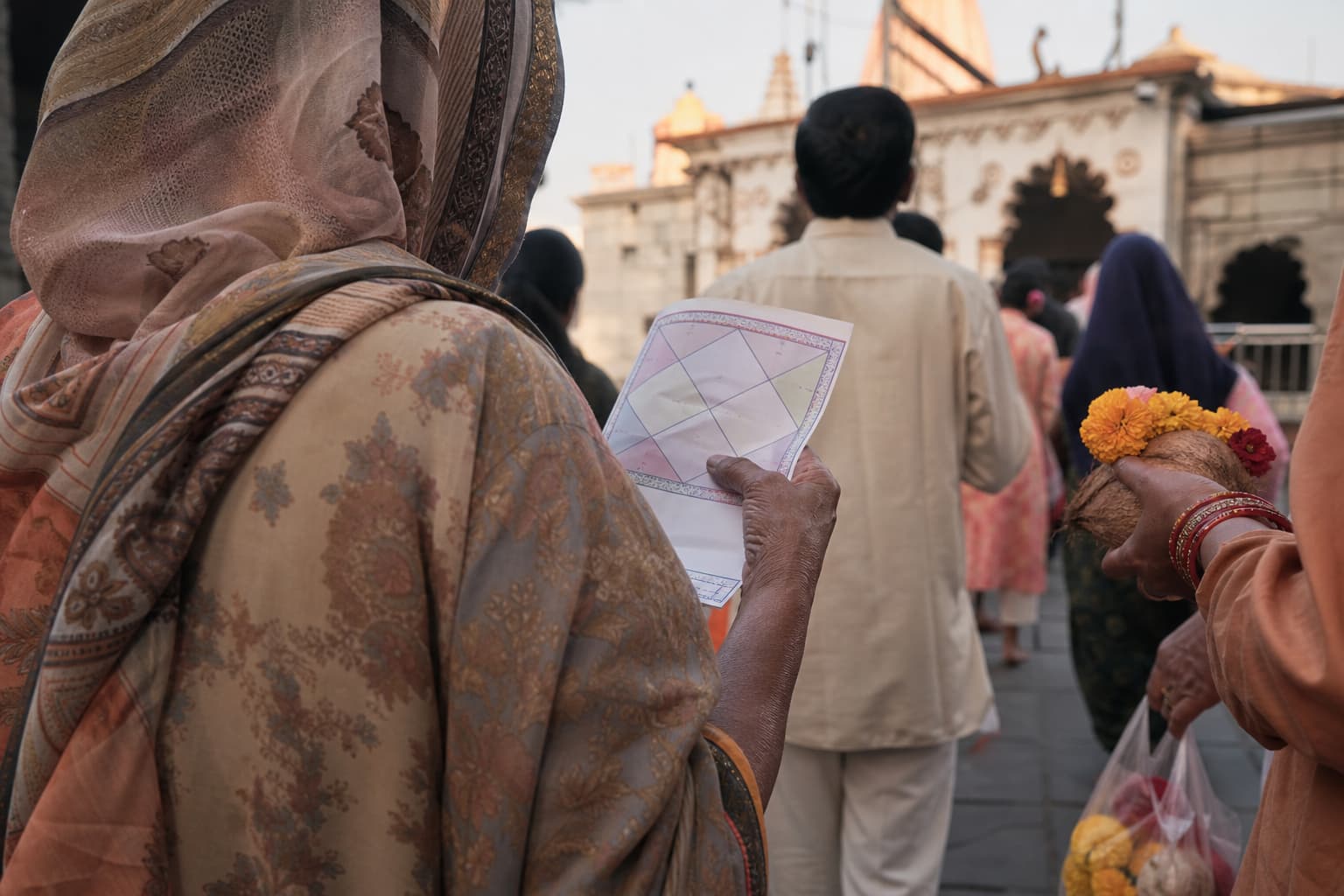
By seven on a Tuesday morning the lane up to Mangalnath is already lined with families who arrived the night before. You can tell them apart from the regular darshan crowd. They are not carrying flowers and coconuts alone; they are carrying folded sheets of paper, and the paper has a horoscope printed on it. A grandmother holds one against her chest the way you would hold a train ticket you are afraid to lose. A young couple stands slightly apart from their parents, the way people do on the morning of something that is about to be decided for them.
Mangalnath is a small temple. If you have come to Ujjain for Mahakaleshwar — the great Jyotirlinga in the heart of the old city, with its four-o'clock Bhasma Aarti and its river of pilgrims — this place will seem almost plain by comparison. It sits a few kilometres out, on a low rise above the Shipra, painted the deep coral-red that temples to Mars and Hanuman tend to wear. There is no towering gopuram, no marble expanse. There is a courtyard, a shrine, a view of the river, and on the right day, a queue that does not stop moving from before dawn until the afternoon heat empties it.
The right day is Tuesday. Mangalvar — Mars's day, Hanuman's day — and this is Mars's own house.
Why the horoscopes
To understand why a family will travel two days by train to spend a Tuesday morning here, you have to understand what they are carrying in those folded papers.
In the grammar of Indian astrology, the position of Mars in a birth chart matters enormously for marriage. When Mars sits in certain houses — the first, fourth, seventh, eighth or twelfth, by the common reckoning — a person is said to carry Mangal dosha, and is called Manglik. Families read this as a warning about the marriage: friction, delay, a match that will not settle. Whether you hold this belief closely or not, in a great many households it is checked before a wedding is fixed, the way you might check a medical report.
And Mangalnath is where you come to answer it. By tradition this is the very birthplace of Mars — the janmasthan of the planet itself. The old story ties it to Shiva: in the long fight with the demon Andhakasura, a drop of sweat fell from Shiva to the earth at this spot, and from it rose a form that became Mangal, the red planet. If Mars was born anywhere, the tradition says, it was born here on the Shipra. So this is the address you go to when Mars is the problem — to make peace with the planet in the one place it is understood to belong.
The bhaat puja
The ritual most families come for is the bhaat puja — the rice offering — and watching it done is the clearest window into what this temple actually is.
A puja here is not a two-minute darshan. Families sit down on the temple floor with a pandit, the printed horoscope is read, and the working begins. There is red cloth, because red is Mars's colour. There is masoor dal and jaggery and rice, cooked and offered — bhaat is the rice — and there is a set of steps that has to be followed in order, mantra by mantra, for it to count. The Manglik person is at the centre of it, often the one whose marriage is being arranged, sometimes newly married and here to settle the chart before the household truly begins.
It is unhurried and it is exact. If you have grown up around Bihari kitchens and courtyards, as I did, you will recognise the temperament immediately: the sense that a thing done for the family must be done fully or not at all, that there is a correct order and you do not skip a step to save twenty minutes. The pandits here do it all day on a Tuesday, family after family, and the courtyard fills with the low overlapping sound of a dozen recitations at once, the smell of incense and cooked rice and river damp all folded together in the morning air. The incense is the same grammar as everything else in that courtyard — a fixed part of the working, not decoration — which is the spirit in which we make our own Jyotirlinga range, named for shrines like the Mahakaleshwar just down the road.
Nobody promises anybody anything. The families do not talk as though they are buying a guarantee. They talk the way people talk when they have done the thing that was theirs to do — a little lighter on the walk back down to the river.
The city that measured the sky
There is a second reason Ujjain, of all places, became the address for a planet, and it is older than any of the marriages being arranged upstairs.
For centuries, Ujjain was where India measured the heavens. Sitting close to the Tropic of Cancer — the Karka Rekha — the city was treated by classical Indian astronomers as the reference meridian, the line from which longitude and time were reckoned across the subcontinent. The great astronomer Varahamihira worked here. Later, the observatory known as the Vedh Shala was built a short way from this very temple, its stone instruments still standing, still readable by anyone who knows how to look. In the older cosmology the day itself began at Ujjain.
So it is not an accident that the birthplace of a planet is fixed in the city that fixed the sky. Mangalnath sits inside that inheritance. The temple to the red planet stands a few minutes from the observatory that once told the country what time it was — the ritual answer and the mathematical one, both grown from the same soil above the same river.
An ordinary Tuesday, once the crowd thins
By late morning the queue loosens. The families who came for the bhaat puja drift back down toward the ghat, horoscopes now folded away, and the temple returns to its plainer self.
This is my favourite hour to be here. The Shipra runs low and brown below the temple, and there are the small permanent fixtures of any river shrine — the flower-seller with marigolds going soft in the heat, the man selling red thread and small packets of sindoor, a boatman waiting without much hope for an afternoon fare. A few older devotees sit on the steps with nowhere they need to be. The red walls hold the heat. Somewhere a bell.
You do not need a Manglik chart to come here. A great many people who climb up on a Tuesday are simply Ujjain locals paying their respects to Mars on his day, the way you would greet a neighbour whose house you happen to be passing. That, in the end, is what the temple is on an ordinary Tuesday — not a place of grand spectacle, but a working shrine that a city has kept in use for a very long time, for a very specific need, on one particular day of the week.
If you are ever in Ujjain, give it the Tuesday. Go early, before the heat, and stand for a while at the edge above the Shipra where the families sit after their puja. You will not see the great aarti you would see at Mahakaleshwar. You will see something quieter and, in its way, more revealing — an entire tradition of reading the sky, brought down to a red temple by a river, one folded horoscope at a time.