
Moolavar vs Utsavar: Two Forms of the Same God
The first time it confused me I was small, standing on Beach Road in Visakhapatnam during a temple procession. The god was coming down the street on a decorated platform, garlanded, lit by rows of little lamps, rocking gently as the bearers walked. The sea was to my left, the evening wind coming off it warm and salt-heavy, and I remember tugging my grandfather's hand and asking why the god had left the temple.
He laughed and said the god had not gone anywhere. The god was still inside, exactly where he always was. What was passing us on the street was the same god in a form that could walk.
It took me years to understand what he meant. Most people who grow up around South Indian temples carry the same small confusion without ever putting words to it. There are, in a sense, two deities in a large temple — one that never moves and one that goes out to meet you. They have names. Getting them straight changes how you see every festival you will ever stand at the edge of.
The one who stays: the Moolavar
Walk into the sanctum — the garbhagriha, the innermost dark chamber — of an old temple, and the figure you see fixed there is the Moolavar. The word comes from mula, root or origin. This is the root image, the principal deity, and the whole temple is built outward from it like a body around a heart.
The Moolavar is usually carved from stone, sometimes very ancient stone, and it does not move. It was consecrated once, in a long ceremony that is understood to have settled the divine presence into it, and from that day it stays in the sanctum. It is not carried in processions. It is not taken to the sea. During the fiercest festival, when the whole town is awake and the streets are full, the Moolavar remains exactly where it has stood for centuries, in the cool dark, receiving those who come inside to it.
That stillness is the point. The Moolavar is the anchor. When people say a temple is a thousand years old, it is really the Moolavar and its sanctum they are dating; the halls and towers around it may have been rebuilt many times.
The one who walks: the Utsavar
The Utsavar — from utsava, festival — is the deity of celebrations. It is a second, smaller image of the same god, and it is made to move. Where the Moolavar is fixed stone, the Utsavar is almost always cast in metal, traditionally panchaloha, an alloy of five metals, which is why these bronzes have that particular warm dark sheen under lamplight.
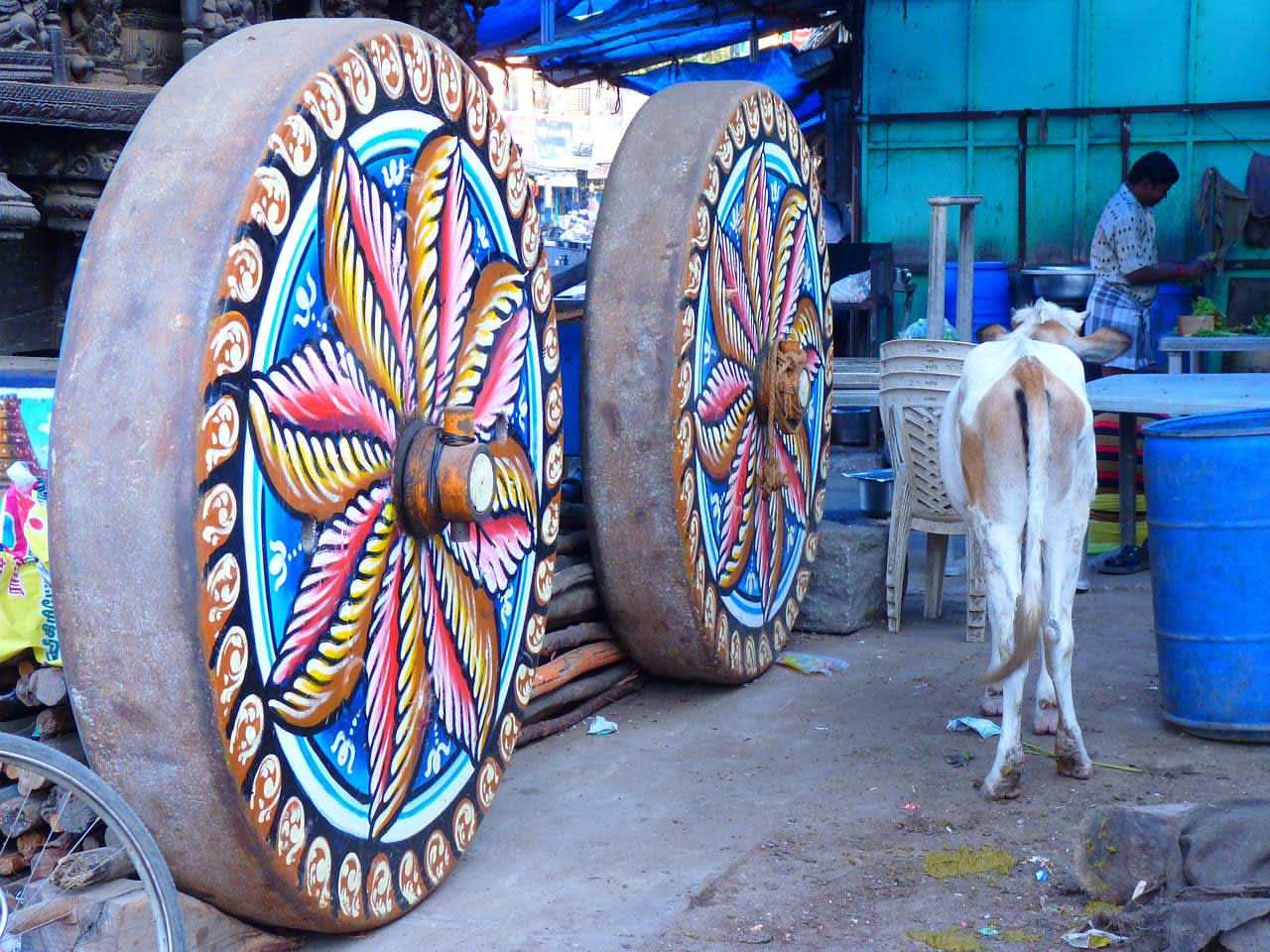
The Utsavar is the one carried out. During a temple's annual Brahmotsavam, or on any procession day, it is bathed, dressed, garlanded, set on a palanquin or a great wooden chariot or a mount shaped like a lion or a bird or a horse, and taken out among the streets. This is the god coming to the people who could not come to the god — the old, the sick, those who live along the route, everyone who lines the road as the bearers pass.
If you have ever stood in a crowd and watched a deity go by on a swaying platform, you were watching an Utsavar. The Moolavar was back in the sanctum the whole time.
At Tirumala the distinction is famous. The Moolavar is Venkateswara, standing in the hill sanctum, who by long tradition never leaves it. The god who goes out for the Brahmotsavam processions is the Utsavar, Malayappa Swami. Two forms, one Lord — and most pilgrims have stood before both without quite realising they were doing two different things.
Why temples keep two forms at all
Once you see the split it makes complete sense. A consecrated stone Moolavar carries an enormous weight of ritual — it cannot simply be lifted and jostled through a crowd without breaking the whole discipline of its worship. But a god that never comes out would be a god only the able-bodied and the near could reach.
So tradition solved it the way it solves many things: not by choosing, but by keeping both. The Moolavar holds the still centre, the unbroken presence you go inward to meet. The Utsavar carries that same presence outward, into weather and noise and daylight, so that darshan can happen on a street corner as well as in a sanctum.
The Moolavar is depth. The Utsavar is reach. A temple needs both, and a devotee, over a lifetime, meets the god in both ways.
How to tell which one you are looking at
Here is the plain version, the one I wish someone had handed me on Beach Road.
- Are you inside, in the dark innermost chamber, before a large fixed figure? That is the Moolavar. It will not be going anywhere.
- Is the deity out in the open — on a palanquin, a chariot, a mount, being carried or pulled through the streets, usually a smaller metal figure richly dressed? That is the Utsavar.
- Is it a festival day, especially the temple's annual Brahmotsavam? Then the figure you see moving is almost certainly the Utsavar, and the Moolavar is still in the sanctum. You can, on the same day, do both: bow to the Utsavar on the street, then go in and stand before the Moolavar.
You will sometimes hear other regional words — dhruva bera for the fixed image, utsava bera for the processional one — but the idea underneath is the same everywhere. The god who stays. The god who walks.
The recommendation, if you want one
Do not treat the street form as the lesser one. This is the mistake I made as a child without knowing it — thinking the "real" god was inside and the thing on the platform was a kind of stand-in for a parade. It is not a stand-in. The Utsavar is fully the deity, dressed for the world instead of the sanctum. When it stops in front of your house, or your stretch of the road, that is not a rehearsal for darshan. That is darshan.
And if you go into the sanctum afterward, do not rush the Moolavar because you have "already seen the god outside." The stillness of the inner chamber is its own thing — cooler, quieter, older. Some of us light a stick of incense at home each evening precisely to keep a little of that inner stillness in a house that has no sanctum, and on procession days I have watched people do the reverse, carrying the outside celebration home in their faces. Both movements are the tradition working as designed.
Two forms, one God. One holds the centre and never moves. One comes down to the sea road to find you. Once you can name them, you never mistake a festival for a farewell again — you know the god has not left. He has only stepped out for the evening, and he will be home before dawn.


