
Mundeshwari Temple, Kaimur — Bihar's Oldest Shrine
Ask a man from Bihar what our state gave the world and he will start with Nalanda and Vikramshila, get to Ashoka, remember the first republic at Vaishali, and if you let him go long enough he will claim the number zero as a Bihari invention too. Most of it is even true. But there is one thing we almost never put on the list, and it sits on a small hill in Kaimur where hardly anyone bothers to look — a squat, eight-sided stone temple that has, as far as anyone can tell, never once been closed for business.
That is the Mundeshwari temple. And the quiet claim made about it — that it is the oldest functioning temple in the world, a place where worship has gone on without a single break — is either the biggest thing Bihar has forgotten to brag about, or a lovely exaggeration. Let us go and see which.
Where it actually is
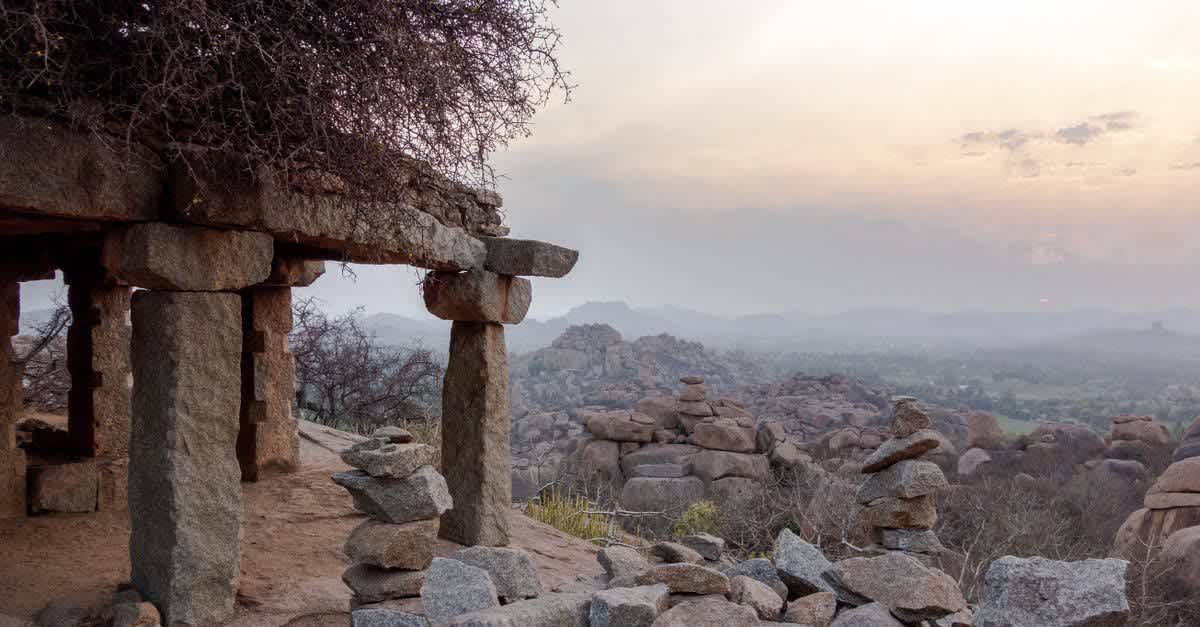
First, geography, because half the pilgrims who mean to go here never make it. The temple stands on Pawra hill (locals say Panwra), above Ramgarh village in Kaimur district, roughly 22 kilometres from Bhabua Road station. This is the far south-western corner of Bihar, up against the Kaimur plateau — closer in spirit to the forests of the Vindhyas than to the flat sugarcane country of my own Muzaffarpur. You climb a set of steps, and the plain opens out below you. It is not a grand approach. It is a hill temple that has simply outlasted everything grander.
The fight over the date
Here is where it gets good, and here is where the mode of this piece — history — earns its keep, because the whole reputation of Mundeshwari rests on one inscription and how you read a single number.
Set into the site is a stone record mentioning a ruler named Udayasena and a "year 30." An unknown era. That is the entire problem in one line. Which era? Count from the wrong starting point and you are off by five hundred years.
The Bihar State Religious Trust Board, and the plaque the Archaeological Survey of India once put up, read that "30" as the 30th year of the Śaka era — which lands the temple at around 108 CE. Say that out loud in Kaimur and people stand a little taller. First century. Older than most of what the tourism posters show you.
The historians are not so sure. Read the shape of the letters — the paleography, the way the script was actually written — and it looks a good deal later, post-Gupta, somewhere around 570 to 635 CE. Some scholars tie that "year 30" to the regnal count of Harsha and land near 636 CE. So the honest answer is a range: a temple that is either about nineteen hundred years old, or about fourteen hundred. I am not going to settle a debate here that better-read people have not settled in a century. I will only say this — even the cautious number makes Mundeshwari older than almost any temple you can name that still has a priest turning up for the morning worship. Fourteen hundred years of unbroken lamps is not a thing you argue down.
What is not in dispute is that the ASI has protected the place as a monument since 1915, that it is dedicated to both Shiva and the goddess in her Mundeshwari form, and that it belongs to the world of tantric worship that eastern India carried for a very long time.
The stone itself
Walk up and the shape hits you before the history does. Most temples you know are square at the base, building up to a spire. Mundeshwari is octagonal — eight sides of dressed stone — which is rare enough that it gets called the earliest surviving specimen of the Nagara style in Bihar. The sanctum is the reason people call it a Shiva-Shakti temple at once: it holds a four-faced linga, a Chaturmukh, one face looking out to each of the main directions, and near it a striking image of the goddess with many arms, riding her mount, in the posture of Mahishasuramardini — the slayer of the buffalo demon.
There is a piece of folklore about that linga changing colour through the day with the light. I have not stood there long enough to swear to it, and the brief I follow does not let me sell you a miracle I did not witness. What I can tell you is that a four-faced linga this old, in stone this worn, does something to a room that no amount of new marble manages.
The sacrifice that spares the goat
Now the story every Kaimur grandmother tells, and the one detail visitors remember longest. Mundeshwari is a Shakti shrine, and the old tantric shrines took blood. But here the practice turned into something else. When a goat is brought to the goddess, it is not killed. The priest takes a handful of rice, offers it, touches the animal with it — and the goat drops as if the life has gone out of it. A moment later it is up again, shaken, alive, and given back to its owner. The offering is made; nothing dies.
You can call it a trick of pressure points, you can call it grace, you can call it the most sensible bit of theology a village ever invented. I will only note that a Shakti temple that learned, centuries ago, to accept the intention of a sacrifice without the killing is a temple that had thought harder about devotion than most. Bihar quietly working out a bloodless offering while everyone else was still swinging the knife — put that on the list next to zero.
Why it never closed
The real marvel is not the age or the octagon. It is the "functioning" in "oldest functioning temple." Somnath in Gujarat was smashed and rebuilt so many times its history reads like a ledger of demolitions. Grand temples all over the north were sacked, abandoned, swallowed by forest, dug up again. Mundeshwari, tucked up its unimportant hill, too far off any conqueror's road to be worth the climb, just kept its lamp lit. Ramnavami, Shivratri, Navratri — the crowds come for those, the same festivals the same way, year after year, on a site that may have been receiving them since before the Gupta kings.
Incense has a part in that continuity, and here I will make my one plain admission of trade: we make ours in Samastipur, a few districts north of that hill, and the smoke that rises in a shrine like Mundeshwari at dawn is the same simple act — a stick lit, a prayer said — carried on through every one of those disputed centuries. If you keep our Jyotirlinga range at your own mandir, you are doing the smaller version of what that hilltop has done unbroken for a very long time.
If you go
Go in the cooler months, climb the steps early, and do not expect a spectacle. Expect a plain octagon of old stone, a four-faced god, a goddess on her buffalo, and the odd, humbling knowledge that whatever the true date, people were standing exactly where you stand, doing exactly what you are doing, before your language existed. Bihar forgets to brag about it. The temple does not need us to. It has had enough centuries to learn patience.


