Nag Panchami Rituals: What Bihar Households Observe

The monsoon is what makes this festival make sense.
If you want to understand why an entire day in the Hindu calendar is given over to snakes, do not start with the mythology. Start with the water. By the middle of Shravan the fields around Samastipur are under it. The Burhi Gandak is up, the bunds are soft, and everything that lives in a hole in the ground has been evicted. Rat, mongoose, scorpion, snake — all of it comes up looking for dry earth, and dry earth in that month means the raised plinth of somebody's house, the grain store, the stack of firewood, the drying racks. This is the season when a person walking barefoot to the field at first light is most likely to step on a krait.
Nag Panchami sits exactly there. Not by accident.
When it falls in 2026
Monday, 17 August 2026 — Shravan Shukla Panchami, the fifth day of the bright half of Shravan.
The tithi does not line up with the clock, so the useful detail is this: Panchami begins late on the afternoon of Sunday the 16th, around 4:50 pm, and runs until roughly 5:00 pm on Monday the 17th. The observance is kept on the morning of the 17th, in the couple of hours after sunrise — broadly 6:00 to 8:40 am — though that shifts with your longitude, so take the timing from a local panchang rather than from an article.
One thing worth flagging, because people get caught by it every year: not everybody keeps Nag Panchami on the same day, and it is not simply a matter of one calendar running late. Gujarat keeps Nag Pancham on a different tithi altogether — Shravan Krishna Panchami by the amanta reckoning, the dark-half fifth, which falls a fortnight after the north's Shukla Panchami rather than on it. Maharashtra, also amanta, lands on the same Shukla Panchami morning as Bihar does. If your household is not from the north, check the tithi your family's panchang actually names, not just the date somebody forwarded you.
And note that in 2026 it falls on a Monday, which in Shravan is its own thing. A Shravan Somvar and Nag Panchami in the same daylight is a heavier day than usual for a Shiva household.
Why snakes at all
Two answers, and both are true at the same time.
The practical one is the flood. In a delta district the snake is not an abstraction. It is a thing that gets into the house in August. A tradition that formalises respect — that says this creature has a claim on this land too, do not go at it with a lathi by reflex — is a tradition that keeps people from panicking, and panicking is how most bites happen.
The devotional one runs deeper. The nagas are not villains anywhere in this tradition. Vasuki is around Shiva's throat. Shesha, also called Ananta, is the coil Vishnu rests on. Krishna does not kill Kaliya in the Yamuna; he subdues him and sends him away alive. Traditional lists of nagas to be honoured vary from region to region, but Ananta, Vasuki, Shesha, Takshaka, Karkotaka and Kaliya turn up in most of them.
There is also the story that gets told for the day itself — the snake sacrifice of King Janamejaya, and the young Astika who talked him into stopping it. The day the burning stopped is the day the nagas were spared. Whether your family tells that version or another one, the shape is the same: this is a day about not destroying something.
What is actually done
Strip away the regional decoration and the core is small.
The image above the door. In most of Bihar and eastern UP this is the visible marker of the day. A printed paper picture of the nag — they turn up at any bazaar in the week before — goes up on the wall above the main doorway, stuck with a paste of cow dung or wet flour. In older households somebody draws it instead, in rice paste or turmeric, straight onto the plaster. It stays up through the year, faded, until next Shravan replaces it.
The offering at the threshold. Milk, and with it lawa — puffed rice — durva grass, flowers, and often a little kheer. It is set down at the doorway, at the base of a peepal tree, at a nag stone if the village has one, or at an anthill, which is the old understood address for anything that lives underground. Some families put a small clay bowl out and leave it. That is the whole ritual. It does not require a priest.
Sisters and brothers. In a lot of Bihari households the day carries a family observance too — sisters offering at the nag image and praying for a brother's protection. It rhymes with the same idea running through Shravan generally.
The things not done. No digging. No ploughing, no turning the earth with a spade, no breaking ground for a wall — because the earth is where they are, and you do not put a blade into somebody's roof. Many households also keep off the tawa that day and cook nothing that needs frying on an iron griddle; the reason usually given is that the hot flat iron is the serpent's hood. Whether or not that reading holds, the custom is widely kept, and it is the sort of small restraint that carries the day.
Bisahari, in the east of the state
Across Mithila, and further east into Bengal and Assam, the same season carries the worship of the serpent goddess — Manasa, called Bisahari or Bishahari in a lot of Bihari households. She is invoked through Shravan for protection from snakebite and for the household's children, sometimes at a clay image, sometimes at nothing more than a branch and a pot.
It is not a competing observance. In practice the two run together, and in many villages the Panchami morning and the Bisahari songs belong to the same fortnight.
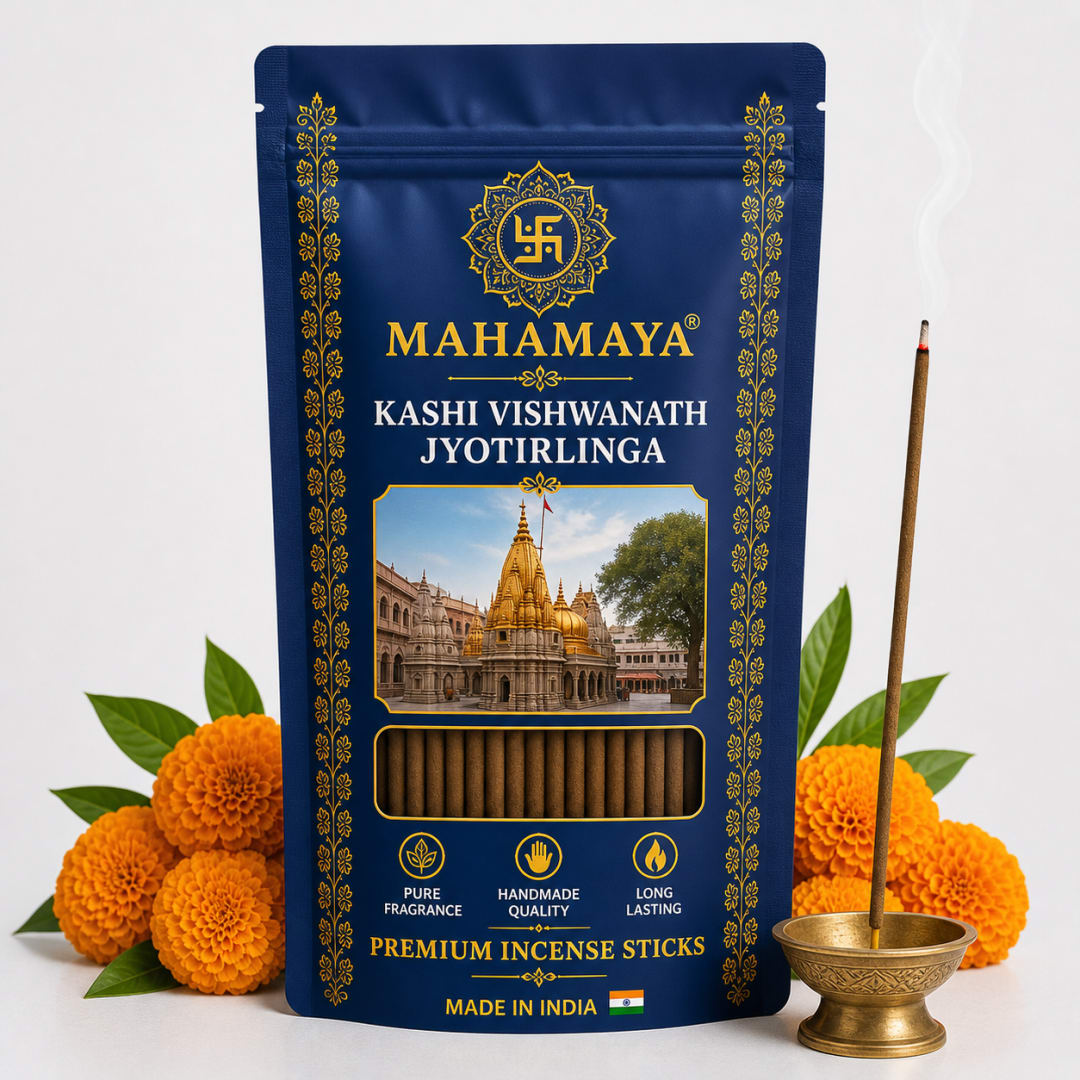
The preparation is unglamorous and it happens the day before: the house swept, the courtyard washed, the doorway wiped down so the paste will hold, the milk set aside, the puffed rice and flowers bought, and the incense kept somewhere it will not damp — which in Shravan is the real problem, because everything in a Bihar house in August is faintly wet. We hand-roll and slow-dry our sticks in this same weather, including the ones we name for the Jyotirlinga shrines, and the drying is always the part the monsoon fights hardest.
The one thing to leave out
Do not give milk to a live snake.
This is worth saying plainly because it is the single most photographed part of the festival and it is doing real harm. Snakes are not milk-drinkers. They are carnivores with no use for lactose, and they do not seek milk out in any circumstance. The animals that appear to drink it on Nag Panchami have generally been caught weeks earlier, kept without water, sometimes with the mouth sewn or the fangs pulled, and then set in front of a bowl — at which point a badly dehydrated animal will take any liquid at all. Snake rescuers and wildlife groups across India spend every Nag Panchami collecting the ones that are dumped afterwards, and a large share of them do not survive it.
None of that is in the tradition. The tradition is an offering placed at a doorway, an anthill, a stone. It was never about a captive animal in a basket. Put the milk on the threshold, where it has always gone, and if a snake charmer turns up at your gate with a cobra, the observant thing to do is not to pay him.
Getting ready for the 17th
If you are keeping it this year, the whole preparation is one small list:
- Buy the nag image in the week before — they run out in the bazaars by the Sunday.
- Sweep and wash the courtyard and the doorway on the 16th, and wipe the wall above the door.
- Keep aside milk, lawa, durva grass, flowers, and kheer if you are making it.
- Do the offering in the morning window on the 17th, at the threshold or at a nag stone or peepal.
- No digging, no ground broken, nothing on the tawa.
- Nothing given to a captive animal.
That is it. It is one of the shortest observances in the calendar and one of the oldest, and it asks for almost nothing — an hour after sunrise, a bowl set down at the edge of your own house, and a day of not putting a blade into the ground.
Which, in the middle of a Bihar monsoon, with the water up and everything underground looking for somewhere dry, is a fairly reasonable thing to be asked for.