
Nanda Devi Badi Jat 2026: The Long Walk to Homkund
In Dehradun, news of the jat does not arrive the way other news arrives. There is no announcement anyone waits for. Somebody's mother-in-law in Chamoli says the date has been fixed, and by the evening three houses on our lane are discussing whether the passes will be open, and whether the old people should go at all. This year the talk has been more confused than usual, because two different things have been announced and most of the internet has flattened them into one.
So let me separate them first, because if you are planning to travel this September, the difference is the whole thing.
What moved, and what did not
The Nanda Devi Raj Jat — the great one, the one held roughly once every twelve years, the one people call the Himalayan Mahakumbh — was due in 2026. In January the Raj Jat committee met at Karnaprayag and postponed it. Its chairman, Rakesh Kunwar, gave two plain reasons: the weather in the high Himalaya around the auspicious days, where hail and snow and hard cold are all ordinary, and the fact that basic arrangements along the uninhabited stretches were not finished. The committee's decision was unanimous. The Raj Jat is now set for 2027. The last one was walked in 2014.
But the Kurud temple committee has announced a Nanda Devi Badi Jat beginning 5 September 2026 from Siddhpeeth Kurud, running about twenty-one days across roughly 280 kilometres, with the palanquin setting out for its first halt at Charbang village and the journey ending, as it always ends, at Homkund. The right-holders of Badan, Dasholi, Lata and Band walk it. By tradition it is led by the chausingya khadu, the four-horned ram.
That is why you will find headlines this month calling a September 2026 departure the Raj Jat. It is a Badi Jat. If you are going, go for the Badi Jat, and check the committee's own published stage list before you book anything — the halts are fixed by the temple, not by a tourism office.
Why a goddess is walked home
Everything about this makes sense the moment you stop reading it as a pilgrimage and start reading it as a vidai.
Nanda is a daughter of these hills. She is married to Shiva, whose house is Kailash, and the jat is the family walking her there — the same walk any hill family made when a daughter left, on foot, with the whole village coming to the edge of the fields and then a little further than they meant to. That is the emotional grammar of it. Not a procession to a shrine. A send-off. The songs sung along the route are the songs of a mother whose daughter is leaving, and the men carrying the doli are not carrying an idol so much as escorting a girl to a house she has not seen.
Once you hear that, the ram stops being folklore and becomes a member of the party. The chausingya khadu is born with four horns — rare, and taken as a sign. It is loaded with offerings for the bride's new home, it leads the column, and at Homkund it is let go to continue alone into the high snow. Nobody follows it. That is the point at which the family stops and the daughter goes on.
While it is still a road
The first days are not hard. The doli travels through inhabited country, down where the Pindar and the Alaknanda still have terraced fields above them, and the walking is the easy part. What is not easy is the stopping.
Every village on the route comes out. The palanquin is set down, and people bring what they have: a length of cloth, grain, a coin pressed to the forehead first, flowers if the season has any left. Someone lights dhoop, and the smell of it hangs in the wet air the way it only does in the hills after rain — we make incense named for the Garhwal shrines ourselves, so I notice this more than most, but any household stock does the same work here. Old women who cannot walk to the next village at all will walk to the boundary stone and stand there until the drums are out of hearing.
This is the stretch most visitors will actually see, and there is no shame in seeing only this. Half the jat's meaning lives in these halts.
The last village
Then comes Wan, and Wan is a threshold. It is the final inhabited settlement before the high country. Above it there are no shops, no chemist, no phone signal you can rely on, and no road worth the name.
Wan has the temple of Latu Devta, who in the local telling escorts Nanda partway and can go no further himself. The tellings vary from valley to valley and I would not flatten them into one version. What does not vary is the function: at Wan, something is handed over. Below is the world where people live. Above is not.
Where it stops being a walk
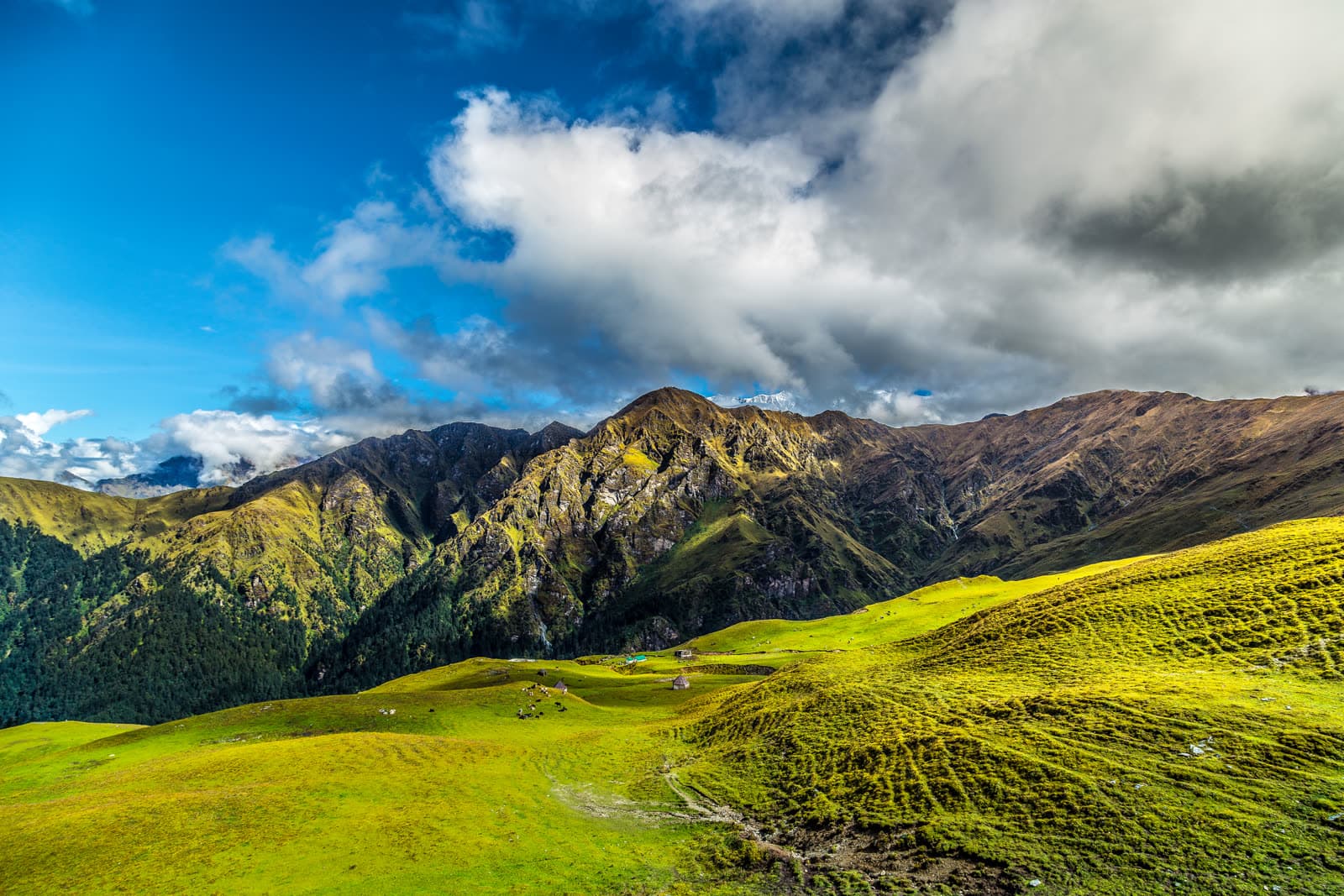
Past Wan the trail climbs into Bedni Bugyal, a meadow a little over 3,300 metres up, and the first sight of it undoes people. It is enormous and green and gentle-looking, with stone shepherds' huts and animals grazing, and the snow line standing over it like a wall.
It is also the place where the weather does its trick. Bugyals hold cloud. A morning can be pure blue and by two in the afternoon you cannot see the hut fifty metres off, and the temperature drops through the evening in a way that the green grass does not warn you about at all. September nights up there are cold in a serious sense, not a bracing one.
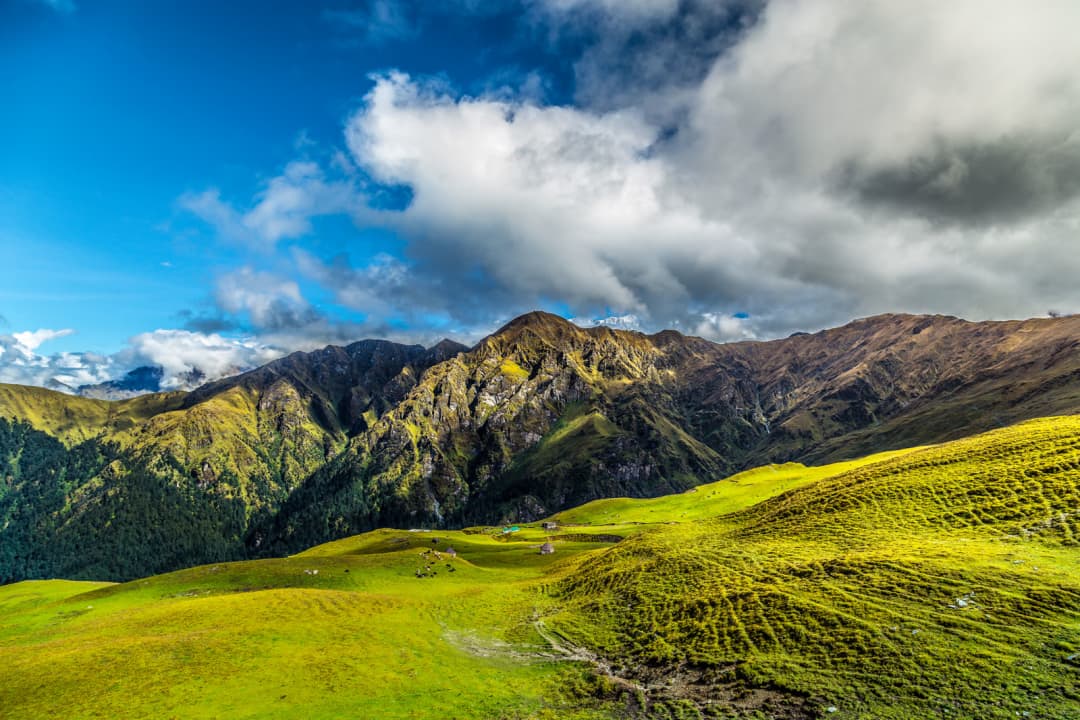
Above Bedni the grass thins and gives out — Patar Nachauni, then the steep pull to Kalua Vinayak, and the ground turns to rock and old snow. Somewhere near five thousand metres the route passes Roopkund, the small lake that holds human bones.
You will hear the folk version: a royal party crossing with the jat, punished for some impropriety, killed by a hailstorm. It is a good story and the hills have told it for a long time. It is worth knowing that genetic work published in 2019 found the dead are not one party at all — they belong to more than one group of people, separated by centuries. Both things can sit side by side. The lake is still a grave, and the route still goes past it.
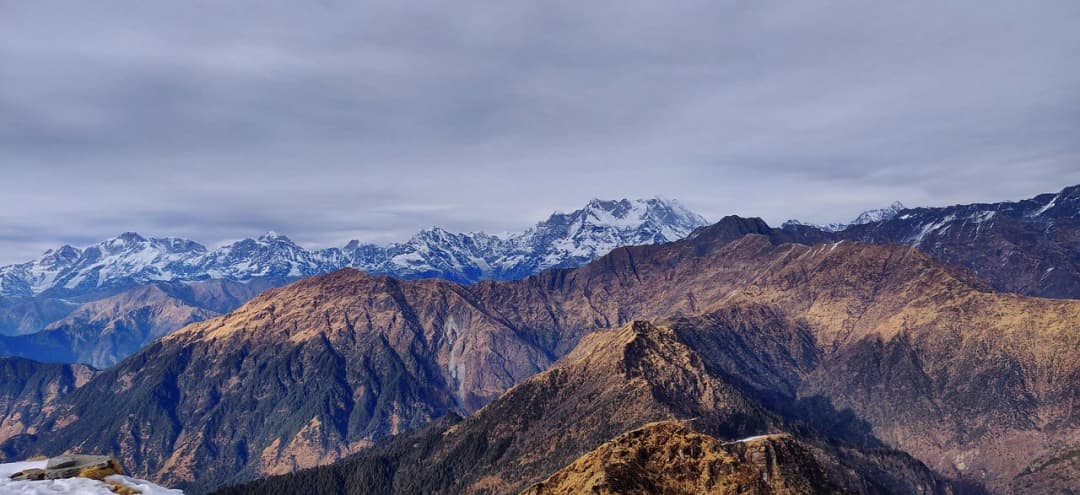
Beyond that is Shila Samudra, the sea of stone — a moraine field under the peaks — and then Homkund, in the shadow of Nanda Ghunti. The arrival is not a temple, not a queue, not a bell. It is a bowl of high ground where the offerings are made and the ram is released, and the party turns around and comes down. People who have been say the walk back down is the quiet part.
If you are thinking of going
Say the honest things first. This is not a trek you sign up for on a website in the week before. It is a religious procession that a community walks, and it crosses terrain that will hurt an unprepared body: altitude that needs real acclimatisation, glacial ground, and post-monsoon weather that turns without asking. Register with the organising committee, follow the stage schedule they publish, and if you are coming from the plains, give yourself days in the hills before you start, not hours.
And decide honestly which walk you are doing. Going as far as the inhabited halts — Kurud, the road villages, up to Wan — is a real thing to do and it is where you will meet the jat as the hills actually experience it. Going beyond Wan is mountaineering with a doli in front of you.
Either way, the thing to carry is the frame. A daughter is being walked to her husband's house. Whatever you take up there — a stick of dhoop, a handful of grain, or only the willingness to stand at the boundary stone until the drums fade — the offering the jat asks for has always been the same one: that you come out of your house and go with her a little way.


