
Navratri Abroad: Nine Nights in a Rented Suburban Hall
The booking goes in around February. Somebody on the committee calls the city's recreation department, or the banquet hall off the highway, or the high school that rents its gymnasium at a rate for non-profits, and asks what is free in the second half of October. This is eight months before anyone will dance. It has to be. In a suburb with three Gujarati associations and one large hall, the calendar is the real constraint, not the devotion.
That is the first thing to understand about Navratri outside India. It is not a festival that spills out of a courtyard. It is a festival that has been booked, insured, permitted and scheduled around other people's weekends — and it survives all of that, which is the interesting part.
Sharad Navratri falls on 11 to 19 October in 2026, with Vijayadashami on 20 October. Worth sitting with those dates for a second if you live outside India, because they decide almost everything about how the nine nights will go.
Nine nights, two of which are Saturdays
Ghatasthapana is a Sunday this year. Then the festival walks straight into a working week. The Ashtami tithi does not begin until the middle of Sunday morning on the 18th, well after sunrise, and it runs on until about eleven the next day — so under the sunrise rule most North Indian households follow, Ashtami and Navami land together on Monday the 19th. Dussehra is Tuesday the 20th. Some printed calendars still show Ashtami on the 18th, and Bengal keeps Maha Navami on the 20th; check your own panchang before you book anything around it.
In Ahmedabad or Vadodara none of this matters much, because the city bends around the festival. Abroad, the festival bends around Monday morning. So the committee makes a choice that would look strange to anyone back home: they hold the big garba nights on the Fridays and Saturdays — the 16th, the 17th, sometimes the weekend before — and keep the weeknights small, or skip them entirely, or move them into somebody's basement.
What you end up with is a nine-night festival compressed into three or four real nights, with a thin thread of home observance running through the gaps. Nobody planned that. It is what a lunar calendar does when it meets a Gregorian work week.
The awkward part of 2026 is that Ashtami and Navami compress into a single working Monday. Kanya pujan, the hom, the big collective aarti — the heaviest morning of the nine nights lands on a day when most of the house has to leave early. Families abroad end up doing it at seven before work, or moving it onto the Sunday while the tithi has begun and quietly accepting the compromise. Whichever you choose, decide it in September and tell the girls' parents then, not the night before.
What the hall looks like at eight o'clock
Doors open at seven-thirty. Almost nobody is there at seven-thirty.
By eight there is a folding table inside the entrance with a cash box, a card reader that works intermittently, and two volunteers selling wristbands. Shoes go in rows along the wall, or into a designated corner that overflows within the hour. The floor of the hall is usually sprung wood meant for basketball, with the three-point line still visible under the feet of four hundred dancers.
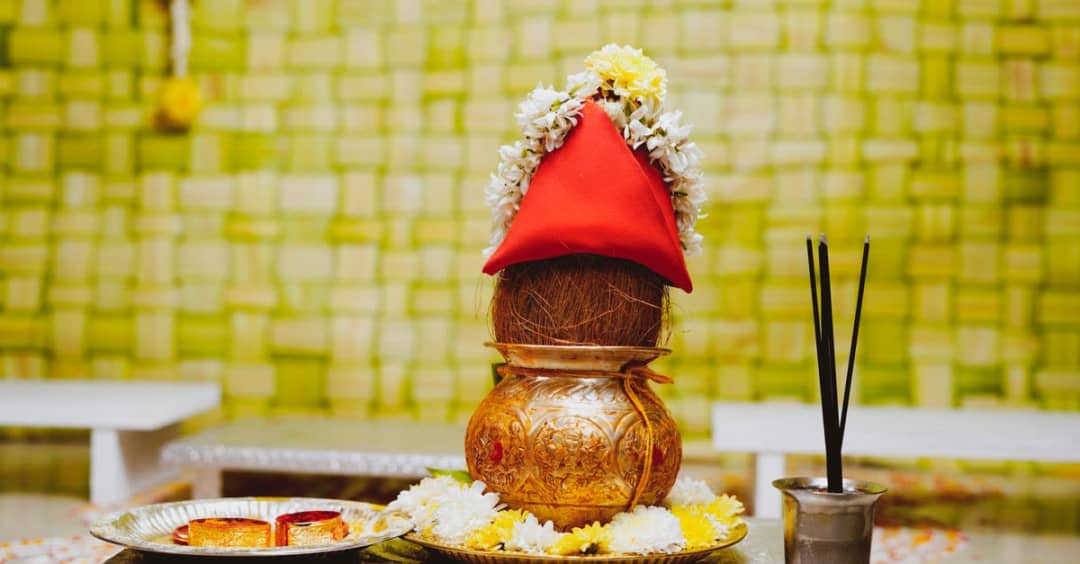
At one end is the mandap — a garba or a framed image of the goddess, a kalash, marigolds that were driven in from the wholesale flower market that afternoon, and a lamp. The aarti happens first, before the dancing, because the hall's licence ends at eleven and everyone knows it.
Then the music starts, and the thing you notice is how the circle assembles itself. Three generations, moving at three different speeds, in concentric rings. The outer ring is the fast one — young people who learned the steps at a Sunday class in a strip-mall studio. The inner rings are slower, older, and more accurate. Children run across the middle until somebody's grandmother redirects them.
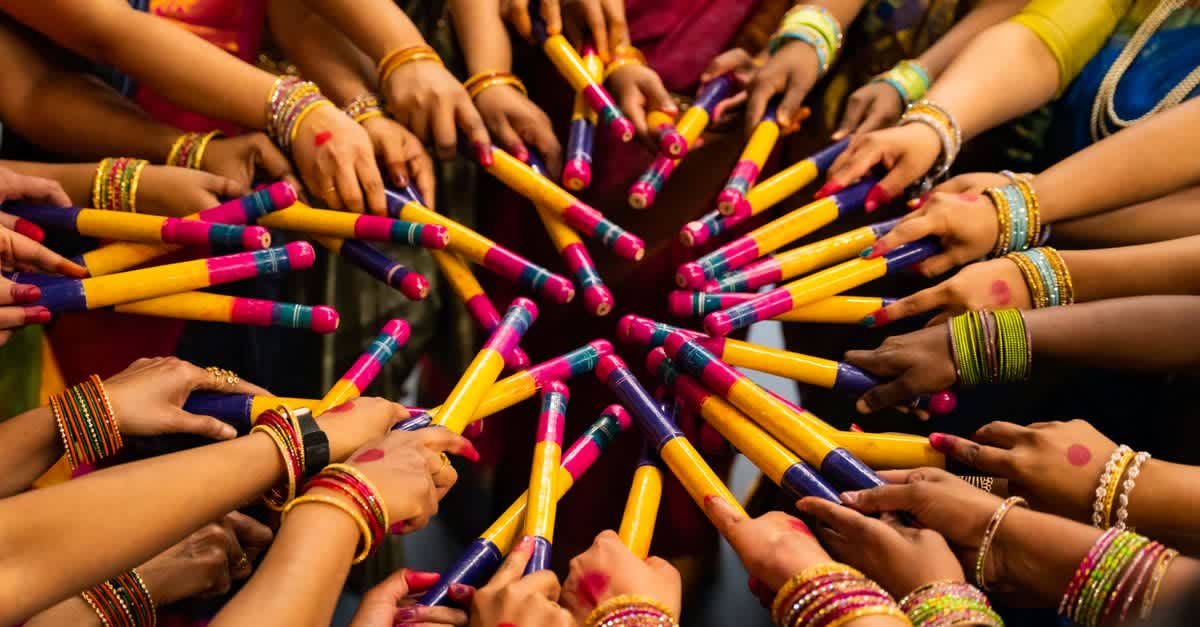
Around nine-thirty the dandiya comes out of cardboard boxes. There is always a shortage. There is always somebody's cousin distributing sticks and taking them back at the end.
At ten-forty-five the lights go up, because the caretaker is being paid until eleven-fifteen and the parking lot has to be clear. People stand in the car park in their chaniya choli and their winter coats, which is a sight you do not get in Gujarat, and the whole thing ends in a slow scatter of headlights.
The quieter half
Not everyone goes. This is the part that gets left out of the photographs.
A large share of the diaspora observing Navratri is nowhere near a hall on any of these nights. They are in a flat in a city with no Gujarati association, or they work night shifts, or they have a newborn, or the nearest event is a ninety-minute drive and the tickets sold out in a WhatsApp group they are not in.
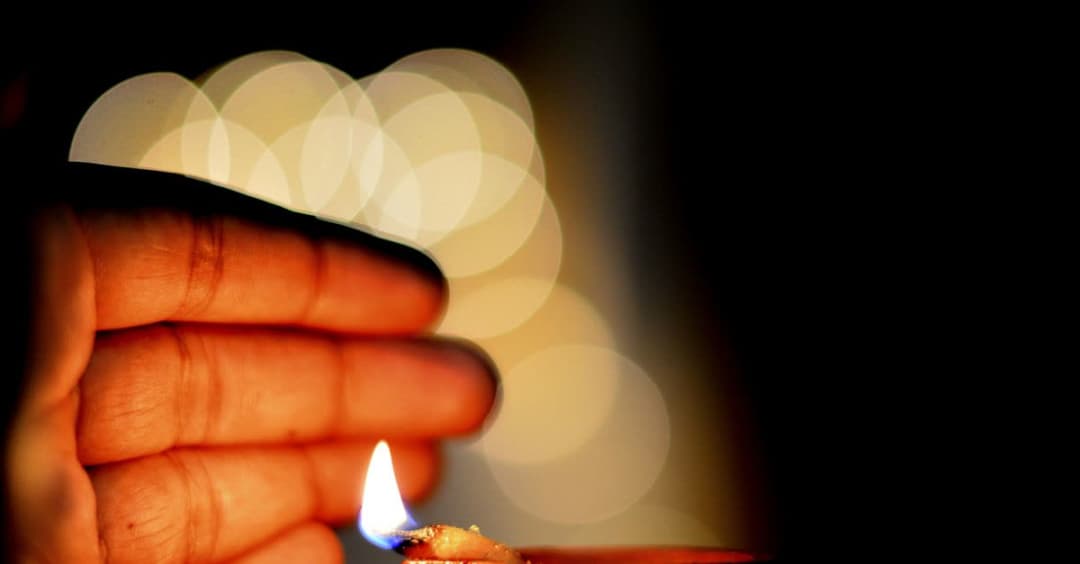
What that version looks like: a kalash on a shelf, sown barley in a steel bowl on the windowsill where it gets whatever October light there is, a lamp lit in the evening, and nine days of someone keeping a small thing going alone. Some people play the garba playlist while cooking. Some read a chapter of the Durga Saptashati. Many do nothing more elaborate than light a lamp and a stick of incense before dinner, which — as forms of practice go — is not a lesser one. We make a range of fragrances that end up in exactly this kind of nine-day routine, and the honest observation from people who keep it is that the scent is mostly a way of marking a boundary: work stops here, the evening starts here.
That boundary is what the hall provides too, in its loud way. The quiet version just does it with less parking.
The fast, on a nine-to-five
The practical questions people actually ask are about food.
Navratri vrat rules vary by family — some fast all nine days, some only on the first and last, some only on Ashtami. What is consistent is the exclusion: no grains, no onion, no garlic, usually no common salt. Abroad, this collides with a canteen, a client lunch, or a shift with one break.
What people do, in practice: batch-cook sabudana khichdi or rajgira rotis on Sunday and carry them. Keep a jar of roasted makhana and a bag of dates in the desk drawer. Learn which of the local grocery chains stocks sendha namak so you are not driving across the city on day two. Nothing about this is romantic, and all of it is the actual work of keeping a fast in a country that has not arranged itself around one.
The other collision is alcohol and work events. October is conference season in a lot of industries. A fair number of people quietly decline for nine days and give no explanation, which is its own small form of observance.
What travels, and what does not
The steps travel. The songs travel — the same four or five garba records get played in Leicester, Edison, Mississauga and Melbourne within the same fortnight. The food travels, more or less.
What does not travel is the street. Back home, Navratri leaks. It is in the lane, in the housing society compound, audible from three blocks away, and you can wander into it without a ticket. Abroad, you have to opt in: buy a wristband, drive forty minutes, find parking. The festival becomes a destination instead of an atmosphere.
That is a real loss, and it is worth naming rather than pretending otherwise. But the fix people have found is not a bad one. What the hall gives back is intent. Nobody is there by accident. Everyone in that circle at nine o'clock on a Friday in October decided, months ago, in February, when someone made a phone call about a gymnasium.
Nine nights. Two of them on a weekend. The rest held together by a lamp on a shelf and a bowl of barley in an unfamiliar October light.


