
Navratri vs Durga Puja: Nine Nights Against Four Days
A cousin of mine who has lived in Delhi for eleven years said to me last October, in the tone of a man settling a matter, that Durga Puja is basically Bengali Navratri. I put down my tea.
He is not alone. It is one of the most common things said about the Indian autumn, and it is wrong in roughly the way that saying a wedding is basically an engagement is wrong. The two overlap. They are not the same event, and the differences are not decorative.
Here in north Bihar we are on the seam. Muzaffarpur keeps both, sometimes in one household, and nobody here confuses them, because you cannot confuse two things you have watched side by side.
They overlap, which is the whole problem
Both sit inside the bright fortnight of Ashwin, the one that opens the morning after the new moon that closes Pitru Paksha.
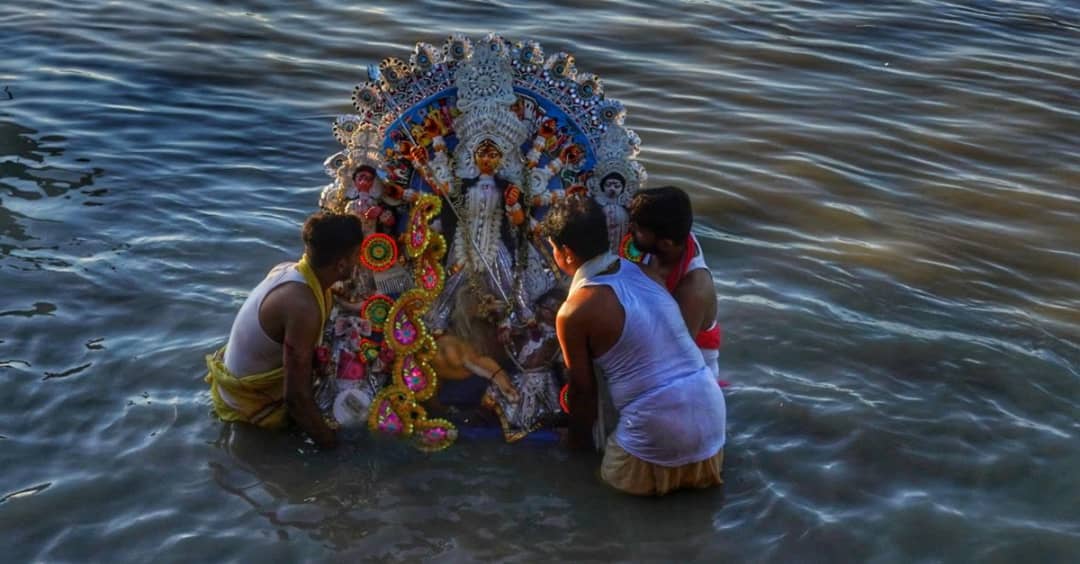
In 2026 that new moon, Mahalaya, is Saturday 10 October. Navratri begins the next day: Sunday 11 October, Ghatasthapana on that morning, running nine nights to Monday 19 October. Durga Puja, as a public festival, barely exists until Shashthi on Friday 16 October, and then occupies four days. Both finish on Vijayadashami, Tuesday 20 October — though Bengal keeps its own Bijoya Dashami, and the immersion, a day later on Wednesday 21 October, because the Dashami tithi does not begin until the afternoon of the 20th.
They share an identical end. In between, one is running for nine nights and the other has not begun. That is where most of the confusion comes from, and it is also the first real difference: a Navratri household is five days into something before a Durga Puja neighbourhood has started.
Why the autumn one is the late one
The autumn festival is not the original. The canonical time to worship Durga is spring — Basanti Puja, in Chaitra, which is why there is a Chaitra Navratri too. The autumn worship is the borrowed slot, and Bengal has never pretended otherwise. Its own name for it says so: akalbodhan, the untimely awakening.
The story is that Rama, needing the goddess before his fight with Ravana and unable to wait months for spring, woke her out of season. It is a good story. It also comes from the Bengali Ramayana of Krittibas rather than from Valmiki, and is routinely quoted as though it were simply "in the Ramayana", which it is not. A regional retelling became the explanation for a pan-Indian season.
It also quietly explains why Dashami afternoon looks like two different festivals: in one half of the country an effigy of Ravana burns, and in the other the goddess is carried to the river. Same story, told from opposite ends.
Nine nights: what a Navratri house actually does
Navratri is a household festival. It needs no pandal, no committee, no artist and, strictly, no priest.
It begins with a pot. On the first morning a kalash is installed, barley is sown in earth beneath it, and the sprouts are watched for nine days — I will not re-explain the pot and the barley here. Each of the nine nights is assigned to one of the nine forms: Shailaputri, Brahmacharini, Chandraghanta, Kushmanda, Skandamata, Katyayani, Kalaratri, Mahagauri, Siddhidatri.
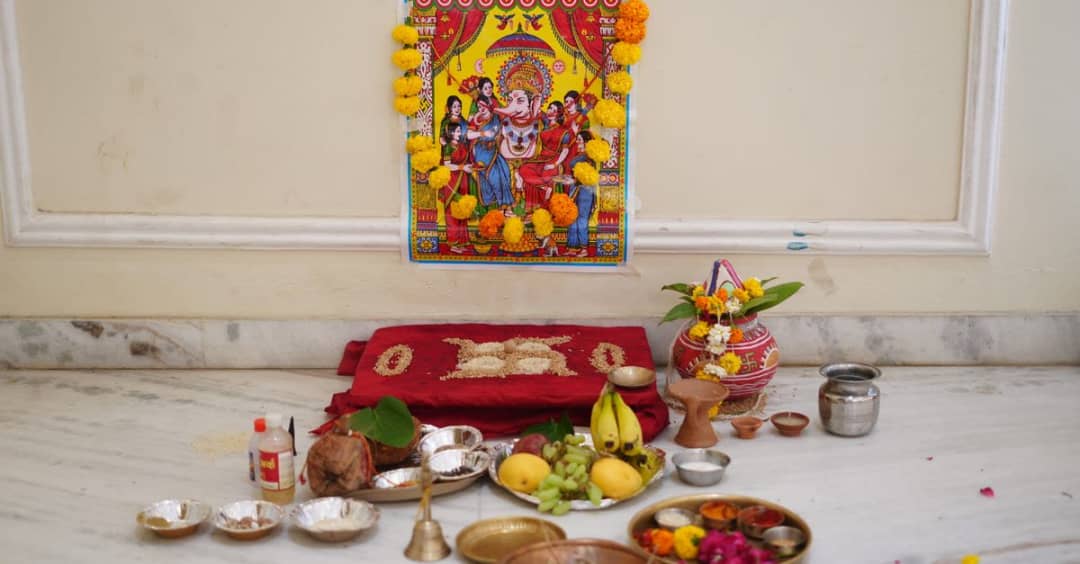
The governing verb is abstain. No grain, or one meal, or fruit only, depending on the house. No onion or garlic, no meat, no shaving, no new purchases, no starting of anything. On Ashtami or Navami, young girls are fed and their feet washed — the kanya pujan — and the fast breaks on a plate of halwa, puri and black chana.
Nobody watches any of this. It happens on the floor of a room, and if you were not invited you would not know.
Four days: what a Durga Puja actually does
Now the one nobody could miss.
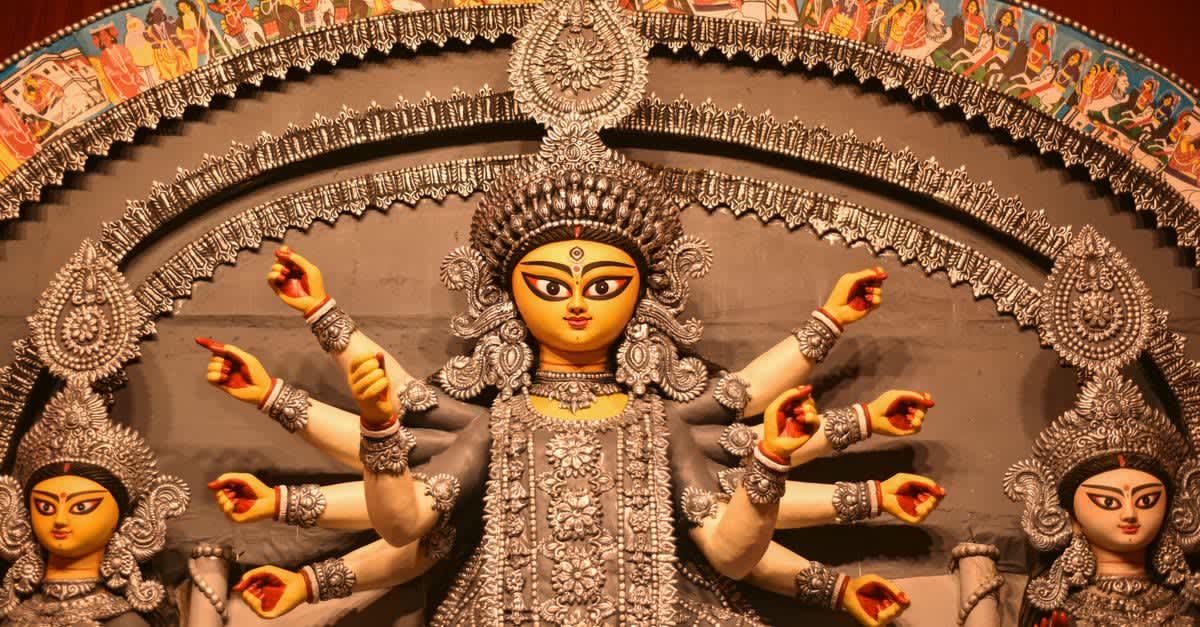
On Shashthi evening comes bodhon, the waking, when the goddess's face is uncovered. Before dawn on Saptami the navapatrika is taken to water and bathed: nine plants bound together — banana, colocasia, turmeric, jayanti, bel, pomegranate, ashoka, arum and paddy — then stood in a sari beside Ganesha. The lists vary a little between manuals, which is normal.
She is called kola bou, the banana bride, and is very widely described as Ganesha's wife. She is not. She is the goddess in her plant form. I said the wrong thing about her for most of my adult life.
The most fixed moment of the whole festival is Sandhi Puja: the last twenty-four minutes of Ashtami and the first twenty-four of Navami, forty-eight minutes across the joint of two days, marking the turn from Durga to Chamunda. The published rule is a hundred and eight lamps and a hundred and eight lotuses. It is set by the clock, not the date, so it can land at four in the morning and everybody turns up anyway.
There is also Kumari Puja, where a young girl is worshipped as the goddess herself; Belur Math's is the best known.
And then there is the noise: the dhak, and men dancing with earthen censers of smouldering sal resin held in both hands. It is a public art form as much as a rite — the pandals are commissioned, designed and judged, and the Kolkata festival went onto UNESCO's Representative List of Intangible Cultural Heritage in December 2021.
Two different lists of nine
This is the detail that settles the argument for me.
Both festivals are built on nine goddesses. The lists are not the same list.
Navratri's nine are the Navadurga, above. The navapatrika's nine plants stand for Brahmani, Kalika, Uma, Kartiki, Shiva, Raktadantika, Shokarahita, Chamunda and Lakshmi. Read them next to each other. There is almost no overlap.
If these were one festival with two accents, the goddesses would match. They do not, because these are two traditions that converged on a number and a fortnight from different directions.
Fasting against feeding
The plainest difference is what happens to your stomach, and it is an exact inversion.
Navratri's structure is renunciation. Durga Puja's is bhog: khichuri, labra, chatni, payesh, cooked in quantity and eaten by everyone present, with many households eating meat on Navami. Two observances of the same goddess in the same week, one asking you to give up food and the other to queue for it.
The objects invert too. Navratri's centre is a pot that stays in the house. Durga Puja's is a clay image built over months specifically to be dismantled in water within four days.
The thing they do share
Both put a living plant at the centre and nobody ever mentions it.
Navratri sows barley under the pot and reads the sprouts. Durga Puja binds nine plants, bathes them at a river and dresses them. Strip out the theology and you have two autumn observances, straight after the monsoon, whose actual object of attention is something green that has just come out of wet ground. Whatever else they became, they were once about the same anxiety: whether the crop would be all right.
Bihar keeps both, and it is not a contradiction
North Bihar leans east and south Bihar leans north, and Muzaffarpur sits where that stops being tidy. We have pandals on the main road and aunts nine days into a water fast who go out to look at them in the evening. Kali Puja follows a fortnight later, which the rest of the north does not do either.
I should say plainly that I am not a priest and I have never performed an anjali in Kolkata. What I have written about the four days is what the pujas publish about themselves and what people raised inside them describe. The nine nights I have watched at close range my whole life, which is a different thing from being an authority on them.
So which one are you at
Practical separation, which is what my cousin needed.
If you are invited to a house, Navratri. If you are told to come to a street, Durga Puja. If your host asks whether you are fasting, Navratri. If your host asks whether you have eaten, Durga Puja — and you should say no, whatever the truth is.
If you are planning travel, the four days are the ones worth the ticket, Shashthi to Dashami, 16 to 21 October in 2026. There is no equivalent trip for Navratri, because there is nothing to go and see. It is happening behind doors, on floors, with a pot of sprouting barley, and it has been doing that perfectly well for a very long time without an audience.
They end on the same afternoon. You can have both. We do.


