
The Ten Days of Onam: How Kerala Prepares for Thiruvonam

People outside Kerala tend to think of Onam as a single day — the feast, the flowers, the photographs of a banana leaf crowded with small mounds of food. Inside Kerala it is a season. It begins ten days before that feast, quietly, with a handful of yellow flowers pressed into the swept earth at the front door, and it grows a little each morning until the house can hardly hold it.
The ten days are named after the stars — the nakshatrams of the Malayalam month of Chingam, the first month of the Kollavarsham year, when the rains of Karkidakam have finally let go and the paddy stands green and drying in the fields. Chingam is the month of light after a dark, inward month, and Onam is what the light is for. In 2026 the first day, Atham, falls on the 16th of August, and Thiruvonam, the tenth, on the 26th. Everything between is a slow accumulation.
Atham to Anizham: the carpet begins
The first day is Atham. In Thripunithura, just outside Kochi where I grew up, this is the day of the Athachamayam — an old procession that once marked the Kochi king setting out, now a long, loud, joyful parade of caparisoned elephants, drums, folk dancers and tableaux moving down the road while the whole town lines the edges. It is the public announcement that the season has started.
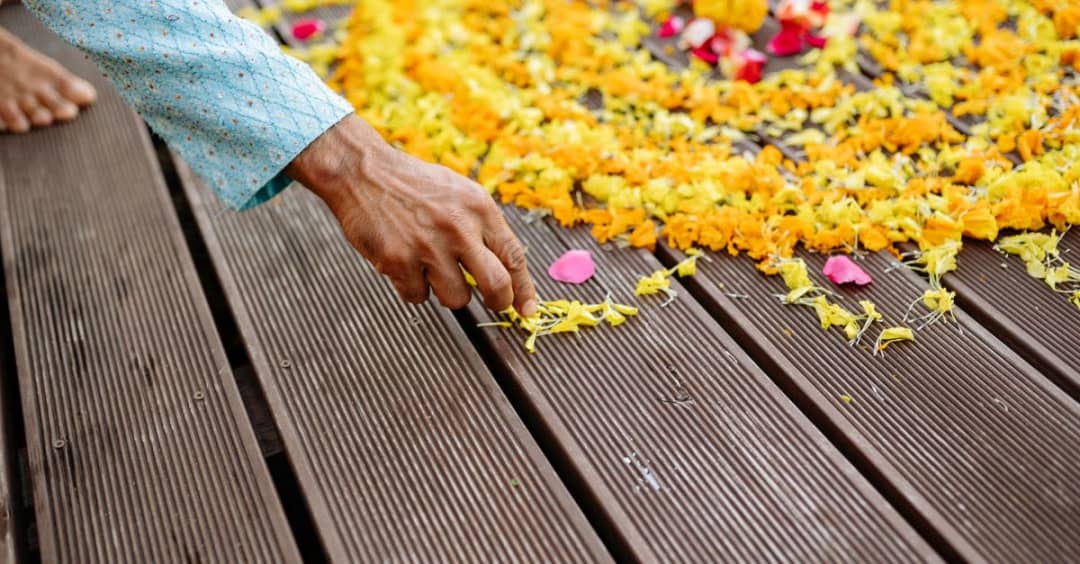
At home, Atham is smaller and more private. The front yard is swept clean and watered, and the first pookalam — the flower carpet — is laid. On Atham it is deliberately modest: a single small circle, traditionally of yellow flowers alone, no more than a hand's span across. There is a discipline to this. You do not begin big. The pookalam is meant to grow with the days, the way anticipation grows.
The days that follow — Chithira, Chodhi, Vishakam, Anizham — each add a ring. More flowers are allowed, more colours: the deep orange of marigold, the white and pink of thumba and chethi, the purple of whatever the neighbourhood children can gather from walls and roadsides. In the old rhythm, children were the keepers of the pookalam, sent out at first light to collect while the dew still held the petals. By Anizham, the fifth day, the circle at the door has spread into something you have to step around.
This middle stretch is also when the markets begin to fill and the house begins to plan. Onam is a harvest festival, and the feast at the end of it is not thrown together. Vegetables are counted, the good rice is set aside, the brass lamp — the nilavilakku — is taken down and cleaned. In a Malayali home the season carries its own smell: cut plantain leaf, jaggery melting for payasam, the wick-oil of the lamp, and the thread of incense someone lights near the nilavilakku in the early morning before anyone has spoken much. It is a domestic quiet that the noise of Thiruvonam has not yet reached.
Thriketta to Pooradam: the house tightens
By Thriketta and Moolam, the sixth and seventh days, the preparation turns serious. Moolam is when many households and temples hold a smaller feast, a rehearsal of sorts — the Moolam sadya — and when the sound of choppers on wooden boards carries from kitchen to kitchen. This is also the stretch when the older games and dances of Onam appear: women forming a ring for the Kaikottikali, clapping and stepping around a lamp or a pookalam, singing the Onam songs that everyone half-knows and no one learned on purpose.
Pooradam, the eighth day, has its own small rite. In many homes this is when the Thrikkakara Appan is set up — small conical figures of clay or, these days, other materials, placed on the pookalam to represent the presiding form of Onam, the deity of Thrikkakara and, in the popular heart, the returning king Mahabali himself. From Pooradam the pookalam is often built up into a raised mound to hold these figures. The door is no longer just decorated. It is being made ready to receive a guest.
Uthradam and Thiruvonam: the arrival
Uthradam, the ninth day, is sometimes called First Onam, and in practice it is the busier of the two. This is the great shopping and cooking day — Uthradappachil, the Uthradam rush, is a real phrase, the last-minute scramble through markets crowded shoulder to shoulder for the final vegetables, the flowers, the new clothes. Uthradam is believed to be the day Mahabali begins his annual visit to the land he once ruled, and the house is cleaned and finished as if for exactly that: an honoured guest who comes only once a year and must find everything as good as he left it.
Then Thiruvonam. The tenth day is the one the other nine were for. The pookalam is at its largest and most elaborate. The family bathes early, wears the Onakkodi — the new clothes given for Onam — and the lamp is lit. And then the sadya.
If you have never seen an Onam sadya it is hard to convey how much thought sits on one banana leaf. Rice in the centre; around it, in a fixed order that every Malayali argues about slightly, the parippu and ghee, the sambar, the avial and thoran and olan and kaalan, the tangy pachadi and kichadi, pickles and pappadam and banana chips and the dark sweet sharkara varatti, and at the end the payasam — often more than one — poured and eaten off the same leaf. It is vegetarian, it is seasonal, and it is the whole point: a harvest laid out in full, shared by everyone at the table regardless of who they are. That equality is the memory Onam keeps alive — the belief that under Mahabali no one went hungry and no one was cheated.
After Thiruvonam the season does not simply switch off. The following days carry the boat races, the Pulikali tiger dancers of Thrissur, visits between houses, the slow eating of leftovers. But the shape of it is complete. The flower carpet is swept away, the lamp goes back to its shelf, and the year gets on with itself — until Chingam comes round again and someone lays the first small circle of yellow at the door.
If Onam reaches your home this year far from Kerala, you do not need the elephants or the boat races to keep it. A swept threshold, a few flowers in a circle, a lamp lit in the morning — that is enough to mark the days. The rest is memory, and memory travels well.
Questions people ask
How many days is Onam?
Ten days, from Atham to Thiruvonam. Each day is named after a star of the Malayalam month of Chingam, and Thiruvonam, the tenth, is the main day with the sadya feast.
What is the day before Thiruvonam called?
Uthradam, the ninth day. It is known for the last-minute rush to the markets for vegetables and everything needed for the Thiruvonam feast.


