
Panch Kedar: The Five Shrines of Shiva in the Hills
Dear Arun,
You sent me that photograph from Kedarnath again last week — the one with the temple behind you and the peaks white above it — and you wrote under it, finally did it, off the list. I laughed when I read that, and then I felt I owed you a longer reply than the thumbs-up I sent back.
Because here is the thing nobody tells you when you go to Kedarnath as a first-timer, flown in from Delhi and up by pony in a single hard day: Kedarnath is not one temple. It is one of five. And the other four sit scattered across these hills around me, some of them a good deal harder to reach than the one you did. Together they are called the Panch Kedar. I grew up two valleys over from the last of them, so let me tell you what they are, and why they are five and not one.
Why Shiva broke into pieces
The story starts, as so many of ours do, at the end of the Mahabharata war. The Pandavas had won, but winning had cost them their own — cousins, teachers, elders, all killed by their hand. The sin of killing your own kin is not a thing you simply walk away from. They were told the only one who could absolve them was Shiva himself.
So they came looking for him here, into the high country. And Shiva — for reasons the tellers argue about; some say he was not ready to forgive so easily, some say he only wanted to be sought properly — did not want to be found. He took the form of a bull and hid himself in a herd of cattle near a place we now call Guptkashi. Gupt means hidden. The name still carries the memory of it.
Bhima, who was never a subtle man, saw through it. He straddled the two mountainsides and let the whole herd pass under him, and only one bull refused to walk beneath his legs. That was the one. Bhima lunged and caught it — but the bull dived into the earth and came apart, and its body surfaced again in five places across these ranges. The hump at Kedarnath. The arms at Tungnath. The face at Rudranath. The navel and belly at Madmaheshwar. And the matted hair at Kalpeshwar. The Pandavas built a shrine at each, and at each they were a little more forgiven.
That is why there are five. Not five temples to five gods — five parts of one god, scattered where he fell.
The one you did
Kedarnath you know now, so I will not describe it back to you. The hump of the bull, the grey stone that is not carved into a figure but worshipped as it is, the walk up from Gaurikund that leaves your legs shaking. You saw the temple that stood through the 2013 flood while the town around it was carried away — the boulder behind it that split the water is still there, and people touch it now as if it too were part of the shrine.
What you should know is only this: of the five, Kedarnath is the one the crowds reach. It is the most famous, the most photographed, the one that lends its name to the incense on shelves far from here — we make one in our own Char Dham range, and I will not pretend I don't feel a small pride seeing our valley's name on a box in a shop in another country. But fame is not the same as being first among them, and the pilgrims who do the full circuit will tell you the other four ask more of you and give something quieter back.
Tungnath, in the sky
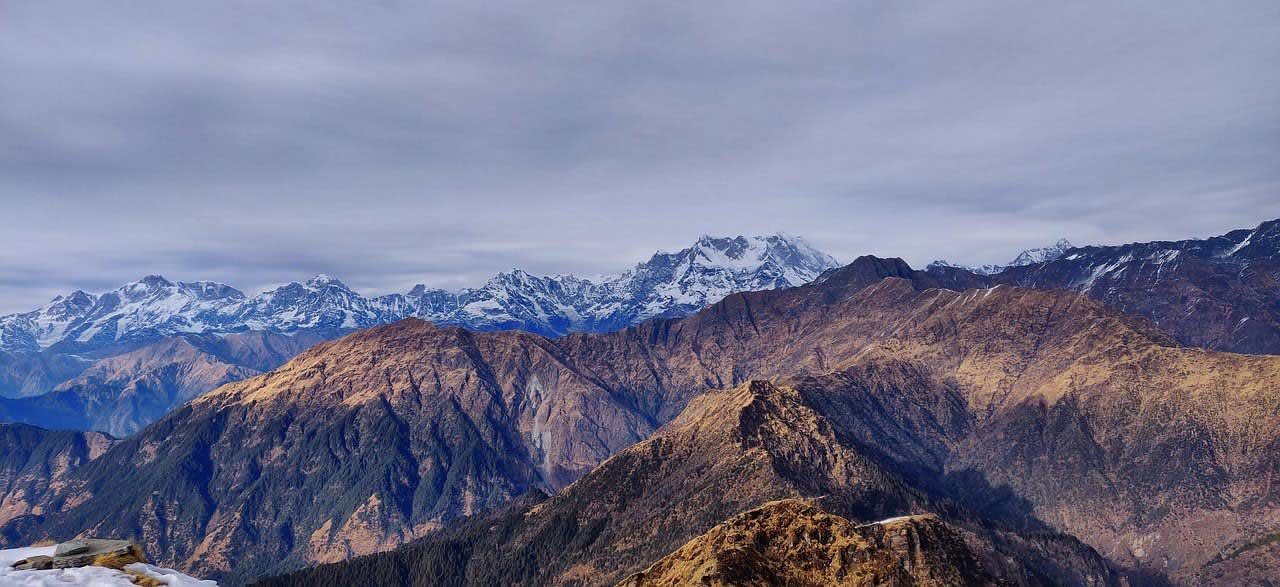
If you ever come back with two more days, do Tungnath. It is the highest Shiva temple in the world — a little under three thousand seven hundred metres — and yet it is the gentlest walk of the five. Three, three and a half kilometres up from Chopta through meadow and rhododendron, and there it is, small and stone and very old, with the Chandrashila peak rising another hour above it if your lungs are willing.
Go early, before the cloud comes up the valley, because by afternoon the whole thing can vanish into white and you will have climbed to a temple you cannot see. That is not a metaphor. That is just how weather works up here, and the mountain does not care that you took leave from work to come.
Rudranath and Madmaheshwar, for the stubborn
These two I will be honest with you about, because I would rather you were annoyed with me than stranded. Rudranath — the face of Shiva, the one form of the five carved as a face — sits at the end of a long, steep, unforgiving trek from the villages near Gopeshwar. Madmaheshwar, the navel, is a two-day walk in through some of the most beautiful and least visited country in Garhwal. Neither has a pony line to save you. Neither has a shortcut. People do them every year, ordinary people, but they train for it, they carry proper shoes and a warm layer even in summer, and they do not do it in a weekend flown in from the plains.
I say this because every season the rescue teams here bring down someone who read a blog, saw a pretty photo, and started walking in canvas shoes at noon. The hills are generous to those who respect them and quite indifferent to those who don't. If you come for these two, come slow and come prepared, and they will be among the finest days of your life.
Kalpeshwar, the one that never closes
And then there is Kalpeshwar, in the Urgam valley, in my own Chamoli district — the matted hair of Shiva, worshipped in a small cave you reach through a green side-valley of apple orchards and old wooden houses. It is the least dramatic of the five to look at and, to me, the dearest.
Here is why. The other four Kedars close for winter. When the snow comes, the deities are carried down to lower temples and the high shrines are sealed against six months of ice, exactly the way Badrinath just up the road from me does. But Kalpeshwar stays open all year. It is low enough, sheltered enough, that the worship never stops. So when the whole high country is shut and white and silent, there is still one of the five where a lamp is burning and a priest is present and you can go and sit. In a land where the gods themselves come down for winter, Kalpeshwar is the one that keeps its door open. I have gone there in January, when everything else was closed, just to sit in that cave and smell the ghee lamp and be somewhere the season could not shut.
What I am really writing to tell you
The circuit usually runs Kedarnath, then Tungnath, Rudranath, Madmaheshwar, and it closes at Kalpeshwar — the pilgrim gathers Shiva back together in the order the story allows, ending with the hair. Very few people do all five in one life. That is alright. The point was never to tick five boxes.
The point, cousin, is the one you missed when you wrote off the list. Kedarnath is not an item. It is a doorway, and behind it are four more, quieter rooms of the same house. You went through the door and turned back at the threshold, which is what almost everyone does, and there is no shame in it.
But now you know the house is bigger than the one room. Next time you are here, don't fly in and out. Give it a week. Let me take you at least to Tungnath and to my own Kalpeshwar. We will go slow, we will watch the weather, and I will show you the parts of the story that don't fit in a photograph.
Come back. The other four are waiting, and so am I.
— Deepak


