
Pitru Paksha: The Fortnight India Gives Its Ancestors
A friend in Pune cancelled a plan on me one September. Nothing was wrong. She wrote, not this fortnight — after the tenth, and left it there. I assumed a deadline at work. It was not a deadline at work. For sixteen days her family would not be starting anything new, and the reason had a name I had to ask for twice.
I live in Lisbon, and the calendar I grew up with gives the dead one day. The first of November, chrysanthemums, a walk through a cemetery, and by evening it is finished for another year. Sixteen days was an entirely different proposition, and it took me a while to stop asking the wrong questions about it — chiefly, is it sad?, which turns out to be beside the point.
This is the plain version, for anyone else who has met Pitru Paksha from the outside.
When it falls in 2026
It is a lunar fortnight, so the dates move every year and are worth checking rather than remembering. In 2026 it opens with Purnima Shraddha on Saturday 26 September, runs through the dark fortnight from Pratipada on 27 September, and closes on Sarva Pitru Amavasya — Mahalaya Amavasya — on Saturday 10 October.
Two days inside it are named separately. Maha Bharani falls on 29 September, and Matri Navami, kept for mothers and for married women who have died, on 4 October.
One thing confused me early: people describe the same fortnight as falling in different months. In the reckoning used across much of the north, it sits in the dark half of Ashwin; in the reckoning used in Maharashtra, Gujarat and the south, where months end at the new moon, the same nights belong to Bhadrapada. Two calendars, one fortnight, no disagreement about which nights they mean.
And then it turns, sharply. The day after it ends, Navratri begins — 11 October in 2026. The quiet fortnight is the doorstep of the loudest season of the year.
What the fortnight is actually for
Pitru is ancestors, paksha is a lunar fortnight. The plural matters less than the specificity: this is not remembrance of the dead in general. It is addressed to a named line — a father, a grandfather, a great-grandfather, and the mother's side alongside them. People know whose names they are saying.
The story most often told to explain it concerns Karna, who gave away gold his whole life and, arriving in the afterlife, was served gold to eat. He had never given food or water in anyone's name. He was sent back to earth for sixteen days to make the offering he had missed. Whether you take that as scripture or as folklore, it tells you what the fortnight is: a window granted for a debt that can still be settled.
Shraddha, tarpan, pind daan
These three words get used interchangeably in English write-ups, which is unhelpful, because they are three different things.
Shraddha is the rite as a whole. The word comes from shraddha, faith — the thing offered in good faith, on trust, to someone who cannot acknowledge it.
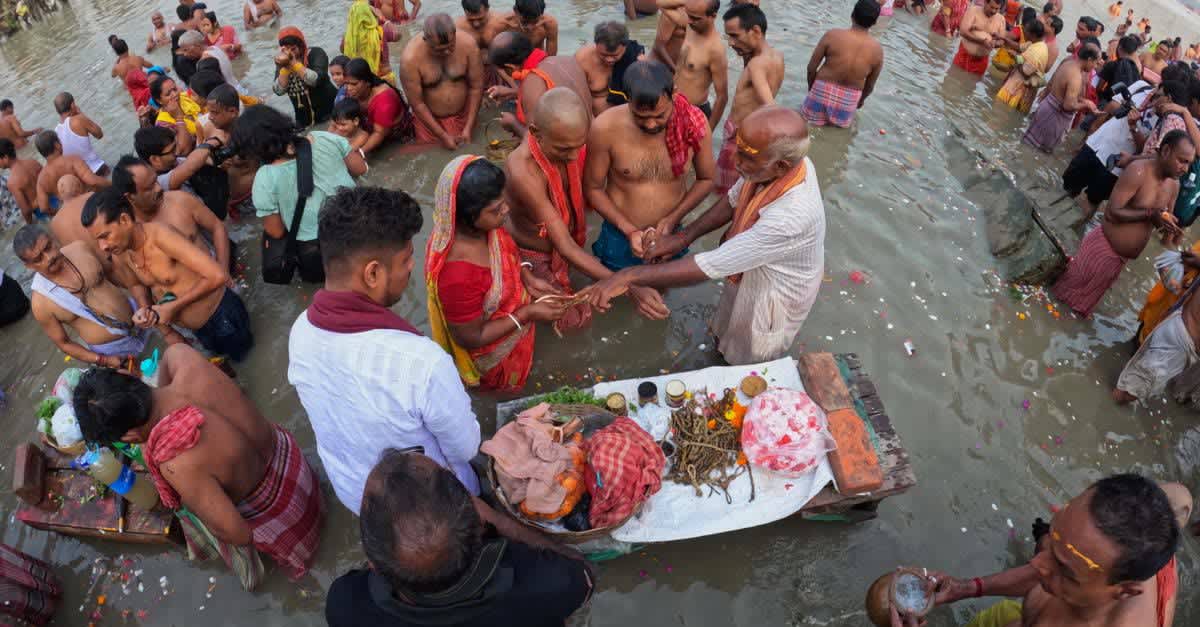
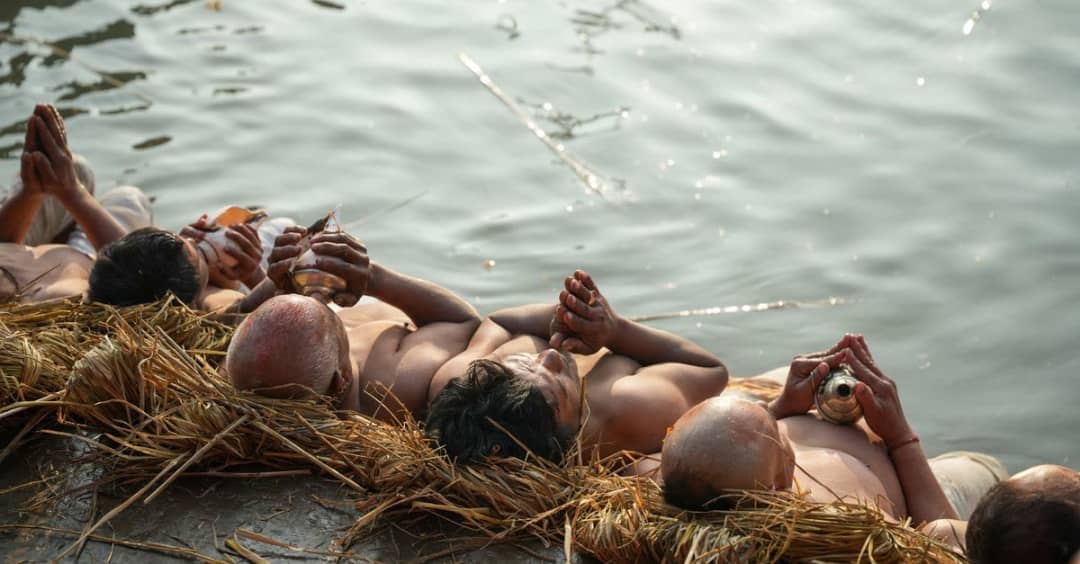
Tarpan is water. It is poured through the hands with black sesame seeds, often with a ring of kusha grass worn on the finger, and it is the part most often done at a river. Simple enough to do and quietly difficult to watch without feeling something.
Pind daan is the offering of pinda — balls of cooked rice, or barley flour, worked with ghee, honey and sesame, set out and then given away to what comes for them.
You do not choose your day
This was the detail that rearranged my understanding of it. A family does not observe on the anniversary in the Gregorian sense. They observe on the tithi — the lunar day — on which the person died, and that tithi comes round once inside this fortnight. If your father died on a Navami, Navami is your day.
Which means the fortnight distributes itself. Different households in the same street are busy on different mornings, and the last day, Sarva Pitru Amavasya, gathers up everyone who was missed: ancestors whose tithi nobody recorded, relatives who died far away, the ones two generations back whose names have gone soft.
There is a time of day for it as well. Shraddha is not done before sunrise or after dark. It belongs to the middle of the day — the windows called Kutup, Rohina and Aparahna, running roughly from late morning into the early afternoon. A rite for the dead, held in full sun, which is not what I expected either.
Why nothing new is started
This is what my friend was telling me, and it is the part outsiders notice first. Through the fortnight, families who keep it avoid new beginnings: no weddings, no moving into a house, no new vehicle, often no new clothes.
I asked whether the days were considered unlucky and was gently corrected. The fortnight is not cursed. It is spoken for. The attention of the household is pointed backwards for sixteen days, and you do not begin something forwards in the middle of that. Shops in some markets feel it — furniture, cars, gold — and then get a fortnight's worth of business back in a single week when Navratri opens.
How a house gets ready
The food is cooked plainly and without onion or garlic, often including kheer, and served on a leaf plate rather than the everyday steel. Sandalwood and loban are lit the way they are for any rite in the house, because incense is simply part of how an offering is made in India, and a household that keeps this fortnight will get through more of it in these sixteen days than in most months.
Then there is panchbali, the five portions set aside before anyone eats: for the cow, the dog, the crow, the ants, and for the fire. The crow is the one people wait on. A crow taking the offering is read as the ancestors having come, and families genuinely wait — sometimes a long time — for a bird to drop onto the wall. Nobody I asked wanted to argue about whether the bird is really the ancestor. The waiting is the point.
The places people travel to
Some families go somewhere to do this. Gaya, in Bihar, is the best known — pind daan on the banks of the Falgu and at the Vishnupad temple, with a fortnight-long mela around it and lodgings booked out. Others go to Brahma Kapal at Badrinath, to Varanasi, to Trimbakeshwar, to Rameswaram, or to Siddhpur in Gujarat, which is particularly associated with rites for a mother.
It is an unusual kind of travel. Nobody is going to see anything. They are going because a rite is held to work better in that spot, and because their family has gone there before.
Watching it from outside
If you are not part of it, nothing is being asked of you. The one useful thing I learned is to not schedule a celebration into someone's fortnight, and to not read the refusal as coldness.
What stayed with me is the structure of it. Sixteen days, fixed, arriving whether or not anyone feels like it, in which the dead are named out loud, fed, and given water — and then a firm end, after which the drums start. Grief in my own culture is left to find its own shape, which usually means it finds none. This one has edges. I have started marking the dates in my calendar, not to observe them, but because I like knowing that somewhere a fortnight is being kept.


