
Pundalik's Brick: The Story Behind Vitthal of Pandharpur

There is a temple in Pandharpur, on the Bhima river in southern Maharashtra, where the god is standing on a brick.
Not seated on a lotus. Not reclining on a serpent in an ocean of milk. Standing upright, both hands on his hips, on a single rectangular block of the most ordinary building material there is. Even the name is usually read as a description of the posture: vit, brick, joined to a word for standing. The one who stands on a brick.
I live in Pune, which sits between the two towns the pilgrims set out from, and I have heard this story my whole life without ever hearing it examined. So here it is told plainly, followed by everything about it that does not add up.
The story as it is usually told
A man named Pundalik lived with his wife and his aged parents. In the popular telling he was a bad son: he had married, his attention went to his wife, and the old people became an inconvenience he stopped attending to.
Then something changed him. In the version most Maharashtrians grow up with, a sage he encounters is the cause. Pundalik goes home and turns completely to the care of his parents — feeding them, washing them, doing the daily work of looking after two people who can no longer look after themselves.
Word of this reaches Krishna, who comes to Pandharpur in person. He arrives at the door and calls. Pundalik is inside, in the middle of attending to his father and mother, and does not come out. It had been raining and the ground was mud, so — without turning around, without stopping — he pushes a brick out through the doorway for the visitor to stand on, and asks him to wait.
The god waits. That is the whole climax. He is still waiting, is the claim: the figure in the sanctum is the one who was asked to stand outside, hands on hips, and never left.
The versions do not agree with each other
Here is where an honest account has to slow down, because there is not one Pundalik story. There are several, and they differ on the parts that matter most.
Was he ever a bad son? In the telling that appears in the Skanda Purana, he is devoted to his parents from the start. There is no neglect, no wife pulling him away, no moral turnaround. The version with the ungrateful son who reforms belongs to a later retelling, associated with the writer Sridhara and preserved as a variant in Padma Purana material.
Who set him straight? Where a reform does appear, the catalyst is a sage — usually named Kukkuta. In other manuscripts the advice comes from someone else entirely, and in some it comes not from a person but from the river Ganga.
How old was the god who turned up? Some texts describe a young cowherd Krishna arriving from Govardhana. Others describe Bala Krishna, the child form.
And the brick? This is the one that should give any reader pause. The brick is close to universal in the Maharashtrian versions and substantially absent from tellings elsewhere. The single most famous physical detail of this deity — the thing his name is read as meaning, the thing he is literally standing on — is regionally local to the tradition that grew up around the temple.
Some scholars doubt Pundalik existed at all
It gets harder. Pundalik's historicity has been questioned by several researchers — Raeside, Dhanpalvar and Vaudeville among them — who treat him as legendary rather than historical.
Meanwhile the scholarship on where the deity himself came from points somewhere else entirely. The Marathi scholar R. C. Dhere, whose study of Vitthal won a Sahitya Akademi award and was later translated into English by Anne Feldhaus, argued that this was originally a folk god of the southern Deccan — connected to pastoral, cattle-keeping communities, worshipped by the Dhangars, and only gradually drawn into the Vaishnava fold and identified with Krishna.
None of that is a debunking, and I want to be careful here. A story being unhistorical is not the same as a story being worthless; the poets who built their lives around this shrine were not making claims about the archaeological record. But anyone who tells you the Pundalik legend is one fixed account handed down unchanged has not looked closely.
What survives all the versions
So strip out everything the tellings disagree on. Take away the neglectful son, the sage, the visitor's age, even the brick itself, and see what is left standing in every version.
This: a man was doing something ordinary and necessary, God turned up, and the man did not drop what he was doing.
That is the constant. The care of two old people at home outranked, for that interruption, the arrival of the divine at the door. And the divine did not overrule him — did not insist, did not take offence, did not leave. It waited until he was finished.
The tradition that grew on it
A whole religious movement took that as its founding idea. The Varkaris, the community centred on this temple, are strikingly light on ritual machinery. There is no elaborate apparatus to master: the practice is singing, walking and keeping to your word.
The poet-saints the tradition venerates were, pointedly, not priests. Namdev was a tailor. Gora was a potter. Sena was a barber. Janabai was a maidservant in Namdev's household, and she addressed the god as her mother rather than her father. Tukaram, the most quoted of them, was a grocer whose business failed. Dnyaneshwar, by tradition, died very young.
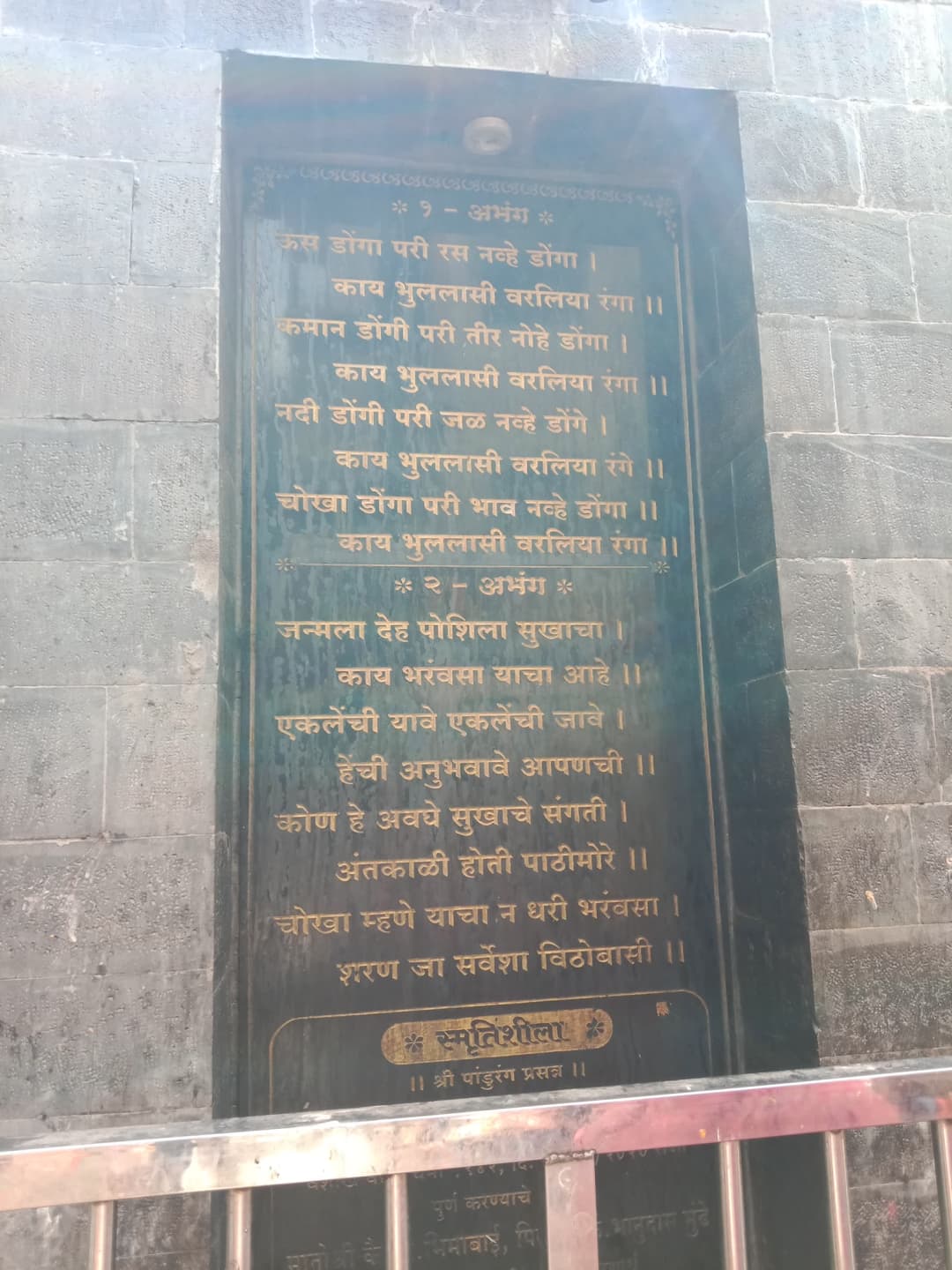
Chokhamela was a Mahar, from a community treated as untouchable, and he was not permitted inside the temple. His memorial stands outside it, at the gate. The plaque above carries two of his verses, and the first is one of the most quoted lines in Marathi:
Us donga pari ras navhe donga — the sugarcane is crooked, but the juice is not crooked. The bow is bent, but the arrow is not. The river bends, but the water does not. And then the line the poet turns on himself: Chokha is misshapen, but his devotion is not. Kay bhullasi varaliya ranga — why are you deceived by the colour on the outside?
He was writing about exactly the thing that kept him at the gate. Varkaris going in still stop there first.
The walk
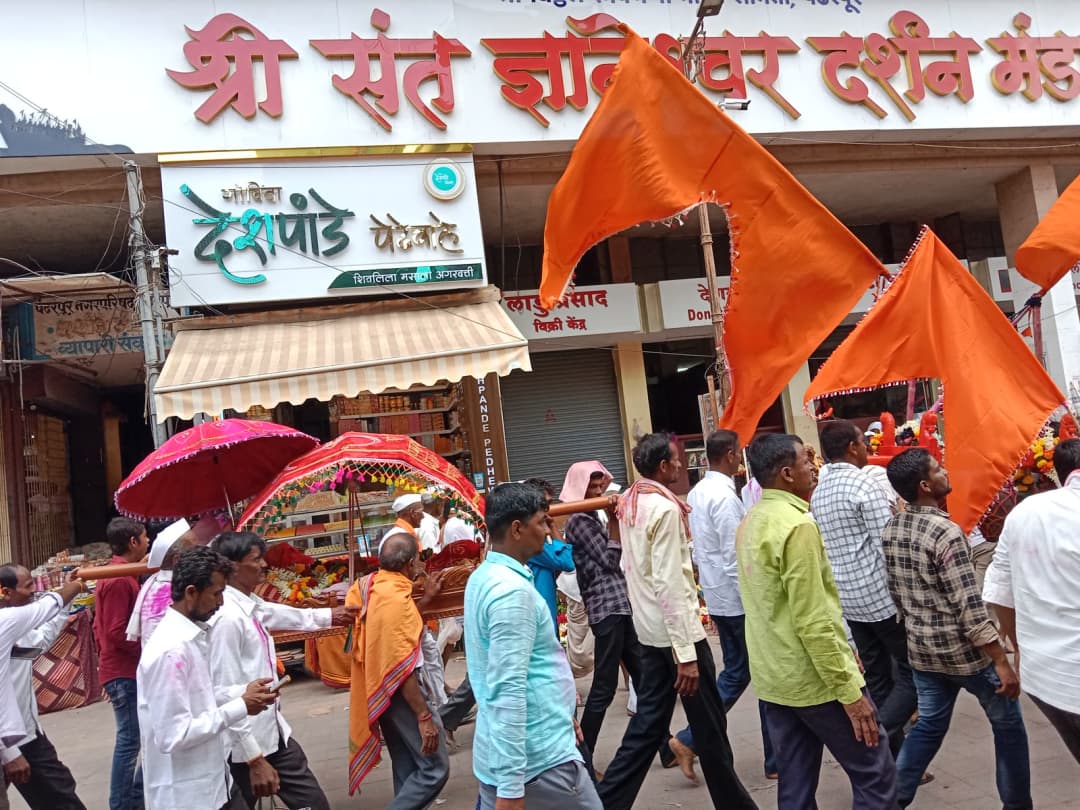
Twice a year, on the Ekadashis of Ashadha and Kartik, enormous numbers of people walk to Pandharpur. The two best-known processions leave from Alandi and from Dehu, the towns associated with Dnyaneshwar and Tukaram, and they do not carry idols. Dnyaneshwar's palanquin carries his sandals.
They walk in groups called dindis, singing the poets' verses the whole way, and they call each other mauli — mother. A stranger on that road is addressed as your mother. I should say plainly that I have not walked it; what I have described is what the tradition publishes and what those who walk it every year report.
Why I think the story is worth keeping
Most traditions, read carelessly, seem to say: leave. Go to the mountain, go to the river, go far enough that the holy can reach you.
The Pundalik story says the opposite, bluntly. The holy came to the house. It found a man doing something tedious and unrepeatable — the daily care of people running out of time — and the story's verdict is that he was right not to get up.
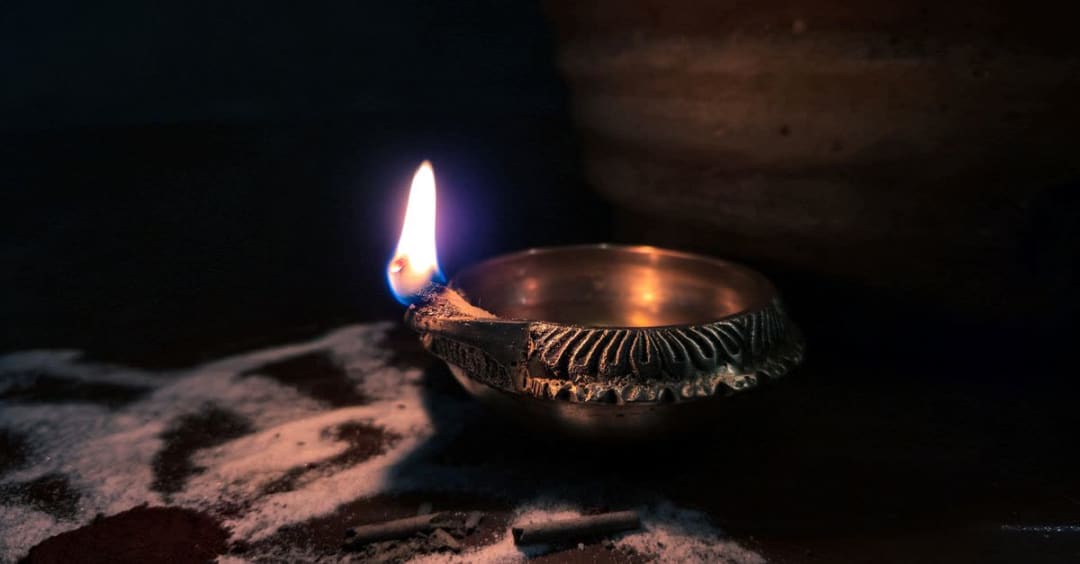
This is why it travels well to anyone building any kind of practice. The temptation is always to believe the real thing is elsewhere and larger: the retreat you will book, the hour you will have when work calms down. Almost no practice actually lives there. It lives in the five minutes at the end of a day, at a shelf in the corner of a room, with a lamp and a stick of the hand-rolled agarbatti burning down while you do nothing in particular. That is the version that survives contact with an ordinary week.
The brick is the point. It was not a sacred object. It was construction material lying in the mud by a doorway, and a man who had no time to be reverent shoved it out with his foot so that the thing he could not attend to yet would have somewhere dry to stand.
And it stood there. It is, by the account of everyone who tells the story, standing there still.


