
Raksha Bandhan Far From Home: A Letter to My Cousin
Dear Ananya,
So you're not coming home for Rakhi. I know, I know — the flights are absurd, the leave doesn't line up, and you've used up your "family emergency" excuse on a wedding you didn't even enjoy. You don't have to explain it to me. I've lived in London for eleven years and I think I've made it back for Raksha Bandhan exactly twice. The rest of the time it arrives the way it does for most of us now: as a padded envelope from India that the postman bends in half to fit through the letterbox, and a video call at a time that is either too early for me or too late for you.
I wanted to write to you about it anyway. Not the sad version — the practical one. Because you're doing your first Rakhi properly abroad this year, in a flat where nobody around you knows what the day is, and I remember exactly how strange that feels.
First, the date, because you will get it wrong
Raksha Bandhan falls on Friday, 28 August this year. It always lands on the full moon of Shravana — Shravana Purnima — which is why it wanders around the calendar and why Mum has phoned three separate relatives to confirm it, as though the moon might have filed an appeal.
Do not trust your memory for this, and do not trust mine. Every year some cousin insists it's "definitely the 19th" and every year they are wrong. Check it once, write it on the actual calendar on your fridge, and set a reminder — because the whole point of the thing is timing, and you are now living in a place where nobody else will remind you.
What it actually is, minus the greeting-card version
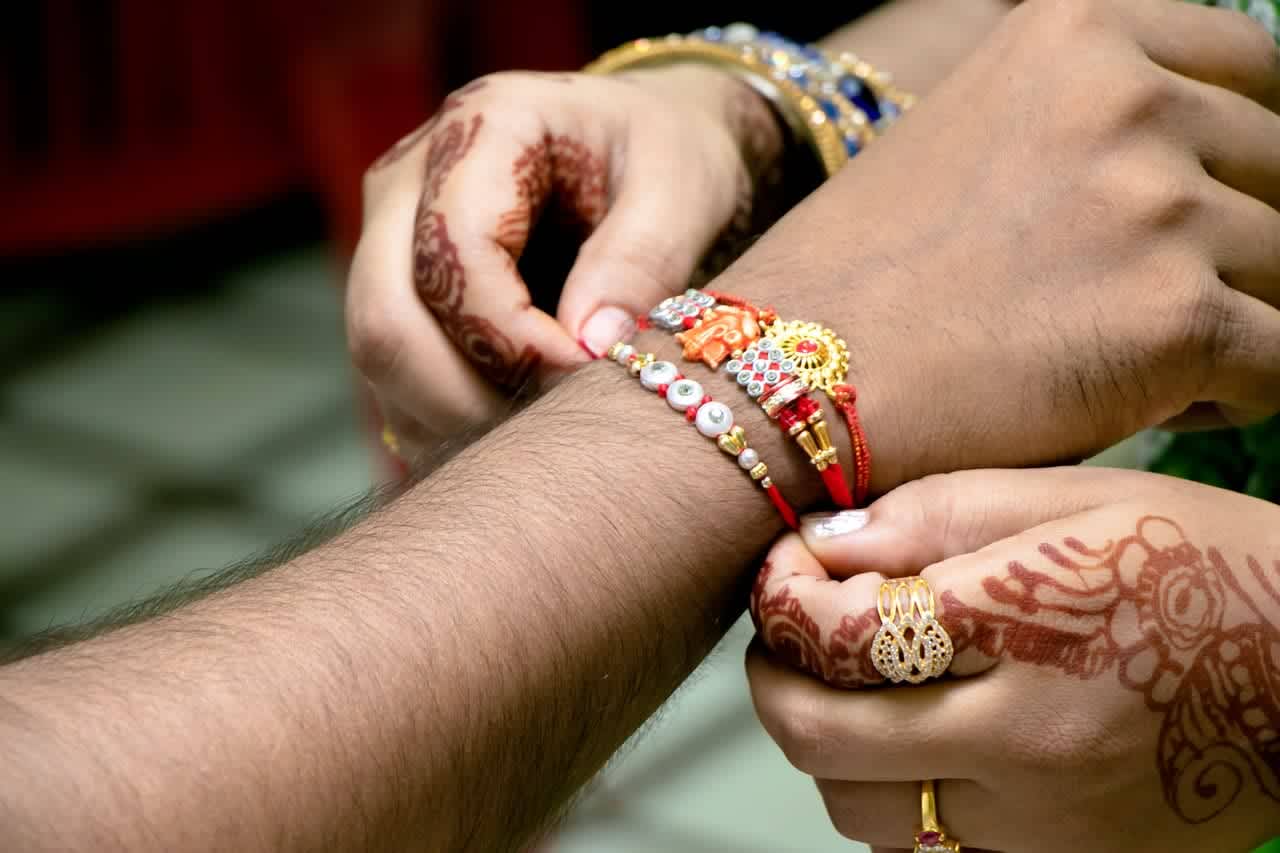
You know the outline: a sister ties a thread — the rakhi — on her brother's wrist, he promises to look out for her, everyone eats too much. But the greeting-card version flattens it, and you're old enough now for the real one.
The word raksha means protection; bandhan means a tie, a bond. The thread is the smallest possible object that can carry a promise. It isn't gold, it isn't expensive, and half the time it's a bit of coloured string with a plastic flower hot-glued to it. That's the genius of it. The value is entirely in the tying.
And it was never really only about brothers. The tradition stretches wider than that — cousins tie it, friends tie it, people tie it to those who have simply shown up for them. There's a lovely piece of history you should know: in 1905, when the British partitioned Bengal along religious lines to divide people, Rabindranath Tagore turned Raksha Bandhan into a public act — Hindus and Muslims tying rakhis on each other in the streets as a refusal to be split. The thread as a small, stubborn no. I think about that every year. It's a festival about deciding who your people are, and then saying so out loud.
So when you tie one this year — and you should, even if the only wrist available belongs to a flatmate who's mildly baffled — you're not doing a watered-down version. You're doing the real thing.
The problem with distance is that it has no ritual
Here's what I actually wanted to tell you. The hard part of doing this abroad isn't the missing sweets or the wrong time zone. It's that homesickness has no shape. It just sits there. Festivals back home come with a whole choreography — the cooking, the noise, the specific smell of the house on the morning of a puja — and that choreography is doing more work than we ever noticed. It gives the feeling somewhere to go.
When you move away, you lose the choreography and keep the feeling. That's the whole ache of it.
So you rebuild a small version. Not the full production — you don't have Nani's kitchen or six aunts — but the two or three things that reliably flip the switch in your head from ordinary Friday to this is a day that matters. For me it has always, embarrassingly reliably, been scent. I can be completely fine, forget the date entirely, and then catch the smell of incense drifting from a neighbour's window and be eight years old again in about a second and a half. Smell doesn't go through the polite part of your brain. It goes straight to the basement.
I'm not going to pretend a stick of incense fixes anything or does something to your nervous system that I could put in a brochure. It doesn't. But it marks a threshold, the same way lighting a candle at dinner does — it tells the room, and it tells you, that the next hour is different from the last one. That's genuinely most of what ritual is: a way of saying pay attention now.
What I'm suggesting, since you'll ignore me anyway
Here's the plan, and it's small on purpose.
Post the rakhi early — India post to Canada is a lottery and it will not arrive on time if you post it "with a bit of buffer." Post it now.
Then, on the day itself, set a time the two of us can both actually make — allowing for the fact that I'll be five hours ahead of you and pretending I'm not tired. And here's the bit that makes it a ritual instead of a phone call: we light the same thing at the same moment. You there, me here, Mum back home if she's awake. Something plain and familiar — sandalwood, or the rose Nani used, nothing clever. If you don't have a favourite yet, Mahamaya makes a whole set of the single-note fragrances we grew up around, and it turns out a scent is a very portable piece of home to keep in a drawer. Light it, and for the length of one stick burning down, the three of us are — near enough — in the same room.
That's the trick the distance can't take from you. The thread was always symbolic; nobody thought the string itself did the protecting. So it doesn't actually matter that this year the string travels by air mail and the ceremony happens over a laggy video call. The tie is a decision, renewed once a year, that says you are mine to look out for and I am yours. Geography doesn't get a vote in that.
One more thing
Don't wait for it to feel authentic. It will feel a bit awkward and improvised, standing in a Toronto kitchen lighting incense at a laptop. Do it anyway. Every diaspora tradition started as somebody, far from home, deciding not to let the day pass unmarked. You're not doing a lesser version of the festival. You're doing the version that keeps it alive.
Post the rakhi. I'll clear the evening. And whatever you do, don't let me tie one on my own wrist and text you a photo — I did that in 2021 and I have never lived it down.
Your cousin, Sameer


