
Ramanathaswamy Temple: History of Rameswaram's Shrine
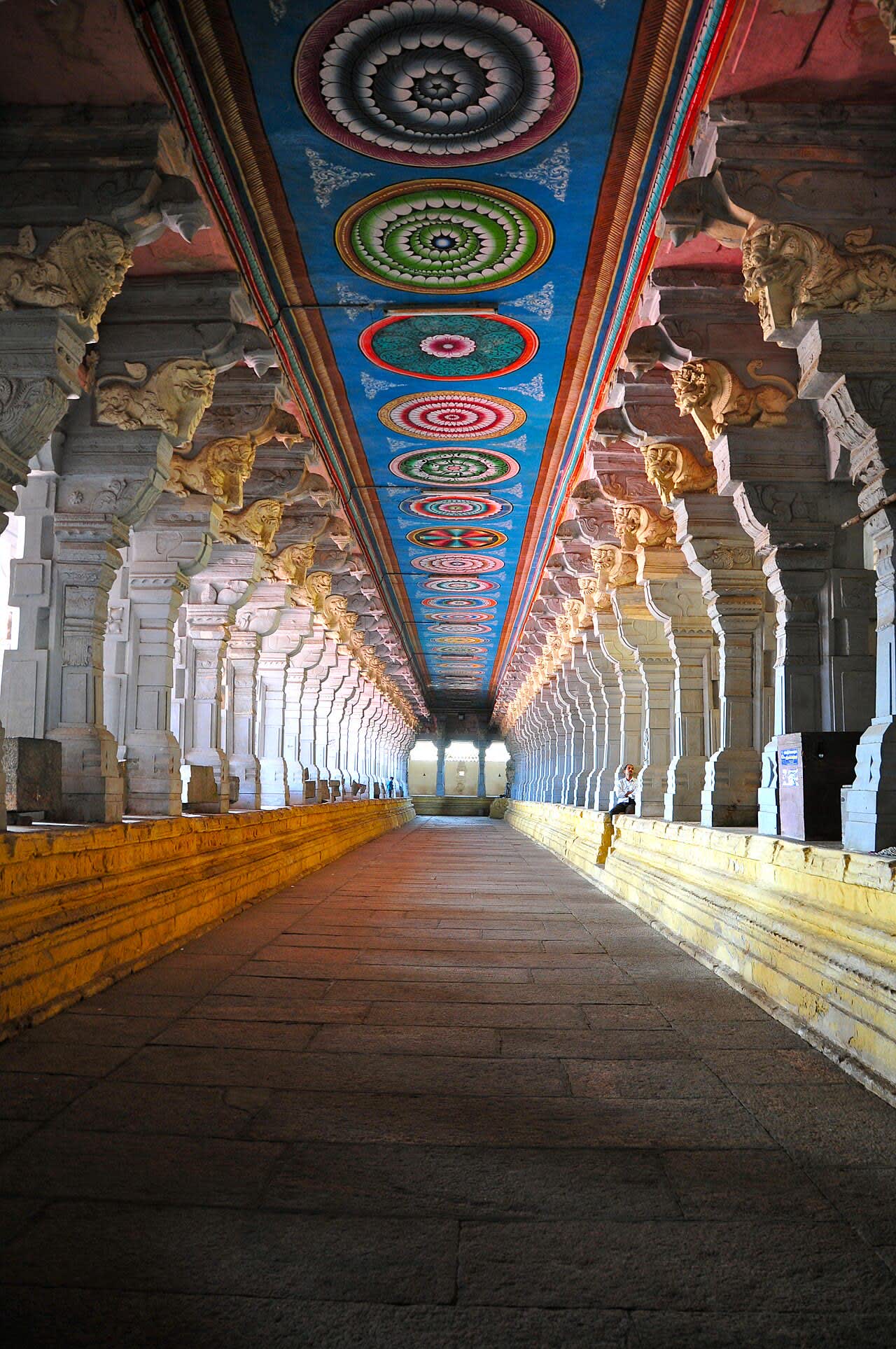
Stand at the eastern gate of the Ramanathaswamy temple, look down the corridor, and the pillars run away from you until they close into a point. It is a trick of straight lines and honest distance — a long straight arm lined with pillar after pillar, part of an outer corridor said to be among the longest in any temple in the world. People call it a miracle. I look at it and think about the men who set each stone, because a corridor like that is not a miracle. It is six hundred years of patience, and a good deal of stubbornness about getting the floor level.
I make incense for a living, in Samastipur, far to the north of Rameswaram. My trade is small and slow — you cannot hurry a drying stick any more than you can hurry a temple. So when I read the building history of this shrine, what stays with me is not the legend. It is the sequence. Nobody who started this work lived to see it finished.
A temple built by no single king
We like to imagine a temple as one man's vision, raised in one lifetime. Rameswaram was not. It was assembled across at least six centuries, by rulers who had nothing in common except the shrine.
The Pandyas were expanding the temple as early as the twelfth century. Around 1153 to 1186 a Sri Lankan king, Parakrama Bahu, is recorded as contributing to the inner sanctum. Between roughly 1380 and 1410 a monarch of the Jaffna kingdom, Jeyaveera Cinkaiariyan, renovated the principal shrine. In the seventeenth century the Nayaka period brought further building, and a Setupati chief raised parts of the eastern gopuram.
Then came the family that finished it. The Sethupatis of Ramanathapuram — the title itself means "lord of the bridge," the guardians of the causeway to the island — became the temple's protectors. It was under Muthuramalinga Sethupati, between about 1763 and 1795, with his minister Muthuirullappa Pillai, that the third corridor was built: the long one, the one that runs to a vanishing point.
Read that timeline slowly. A Pandya king begins. A Jaffna king renovates. A Sri Lankan king adds to the sanctum. A Nayaka-era chief raises a tower. A Sethupati two hundred years later lays the final corridor. Different dynasties, different tongues, different centuries — and the building simply kept going, each ruler adding to what he inherited rather than tearing it down to start again. That, to me, is the real marvel of Rameswaram. It is a relay race run across six hundred years.
The stone, and the trouble of moving it
Here is the part a maker cannot ignore. Rameswaram is an island. Good building granite is not.
The corridor stone had to be quarried on the mainland and brought across — by boat, by cart over the shallow strait, hauled the last stretch by hand and beast. Every one of those roughly twelve hundred pillars in the third corridor was a load that crossed water before it stood upright. The columns rise close to seven metres. Set them a hair out of plumb and the eye catches it at once down the length of an arm; the vanishing-point effect only works because each line is true. Getting an outer corridor that runs some 3,850 feet around the temple to read as clean, unbroken sweeps is not devotion alone. It is careful, unglamorous engineering, repeated a thousand times without a single sloppy afternoon.
I think about this in my own small way every time I cut and hang a batch to dry. Slow work is a chain of ordinary days where nobody cuts a corner. A cathedral of granite is that same discipline, scaled up beyond one lifetime, held to standard by men who would never meet the men who finished it.
Why two lingams sit in the sanctum
The shrine at the centre is older than any of the stone around it, and it belongs to the story of the Ramayana rather than to any dated reign — so I tell it as tradition, which is how it should be told.
By that tradition, Rama, returning from Lanka, wished to worship Shiva at this spot and asked Hanuman to bring a lingam from Kailash in the north. Hanuman was delayed. Rather than miss the auspicious hour, Sita is said to have fashioned a lingam from the sand of the shore. This is the Ramalingam, the sand-formed one, the temple's main deity. When Hanuman finally arrived with the lingam from the mountain — the Vishwalingam — Rama honoured his effort by directing that Hanuman's lingam be worshipped first. That order of worship is said to hold to this day.
You do not have to take the account as history to feel what it is doing. It ties a stretch of sand in the deep south to a mountain in the far north, and it makes a place for the one who was late. Rameswaram is where the Ramayana touches the ground of the map — the shore from which the bridge to Lanka is said to have been raised.
The twenty-two wells and the sea
Rameswaram is one of the few sites that sits inside two of Hinduism's great pilgrim circuits at once. It is the southernmost of the twelve Jyotirlingas, and one of the four Char Dham — the corners of India that a pilgrim traditionally hopes to touch in a lifetime, with Badrinath in the north, Puri in the east and Dwarka in the west. On our own shelves the shrine appears twice for the same reason; the temple that anchors both our Char Dham range and the Jyotirlinga set is this one. Two circuits, one island.
Inside the walls are twenty-two theerthams — sacred wells — said to stand for the twenty-two arrows in Rama's quiver. The pilgrim's practice is a bath at each in turn, a small drenching from well after well, before darshan. It begins outside the temple entirely, in the sea: Agni Theertham, the strip of the Bay of Bengal at the eastern shore, where the first bath is taken at first light. A bath there is spoken of as equal to a long penance. It is a fine sequence to picture — the pilgrim wet from the sea, then the wells, then the long cool corridor, then the sand-formed lingam at the heart of it.
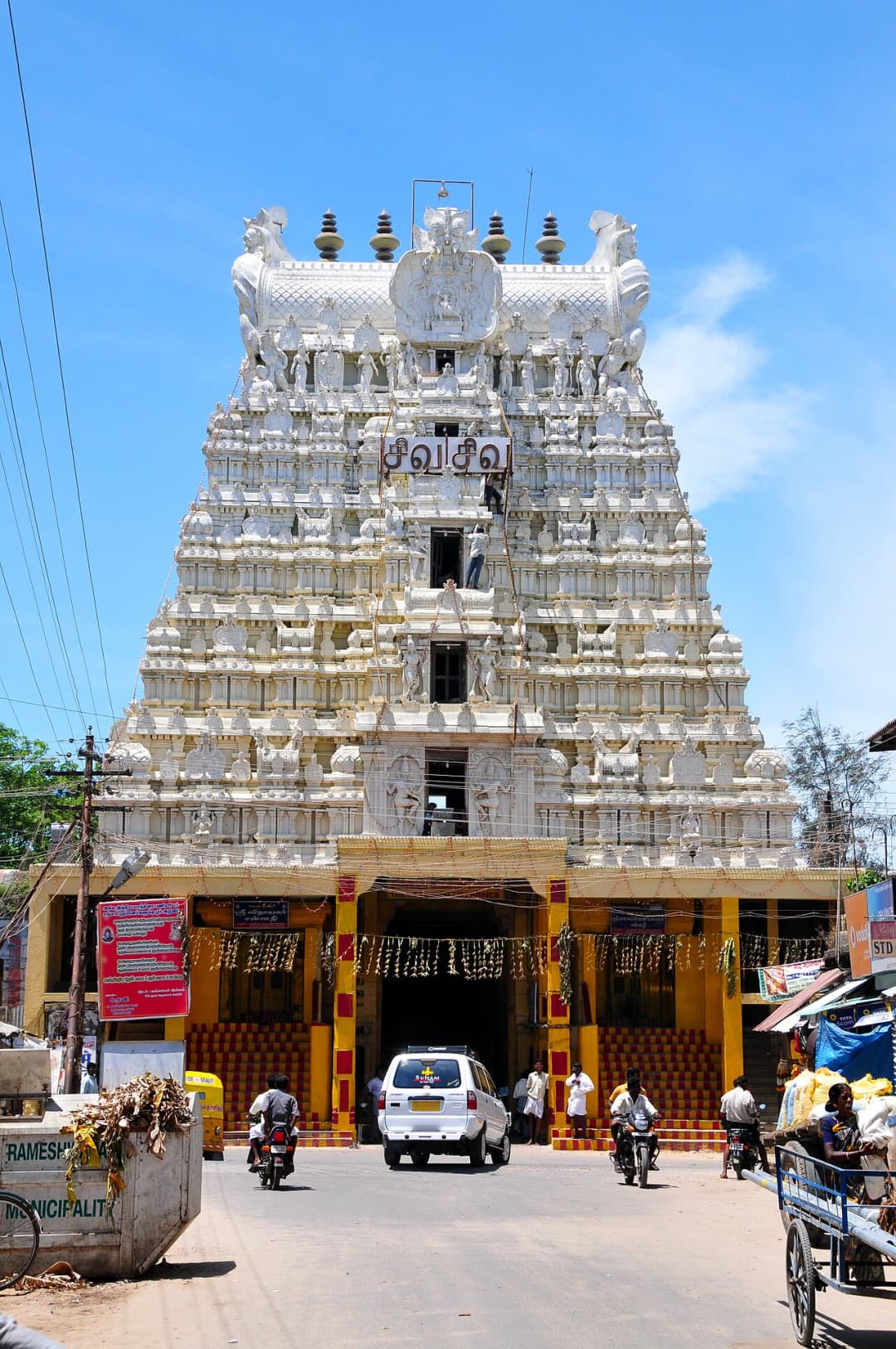
The rajagopuram, the main tower, rises about fifty-three metres over all of it, the last thing added and the first thing a pilgrim sees from the water.
What the corridor is really telling you
I burn a stick most mornings before the workshop opens. It is a small ritual and it ends in a few minutes. The corridor at Rameswaram is the opposite kind of offering — one that outlasts everyone who touches it, that no single person completes, that gets handed forward.
We tend to want our sacred things finished, whole, delivered. The lesson in the stone at Rameswaram is the other one: that some work is meant to be inherited and passed on unfinished, and that keeping faith with what an earlier hand began is itself a form of devotion. A Pandya king laid a foundation he would never see topped. A Sethupati two hundred years on set the last corridor over a plan he did not draw. Between them, patiently, across dynasties that rose and fell, the line stayed true all the way to its vanishing point.
That is worth more than a miracle. A miracle asks nothing of you. A relay asks you to carry your stretch well, and hand it on.


