
Sambrani and the 4am Puja: A Mylapore Memory
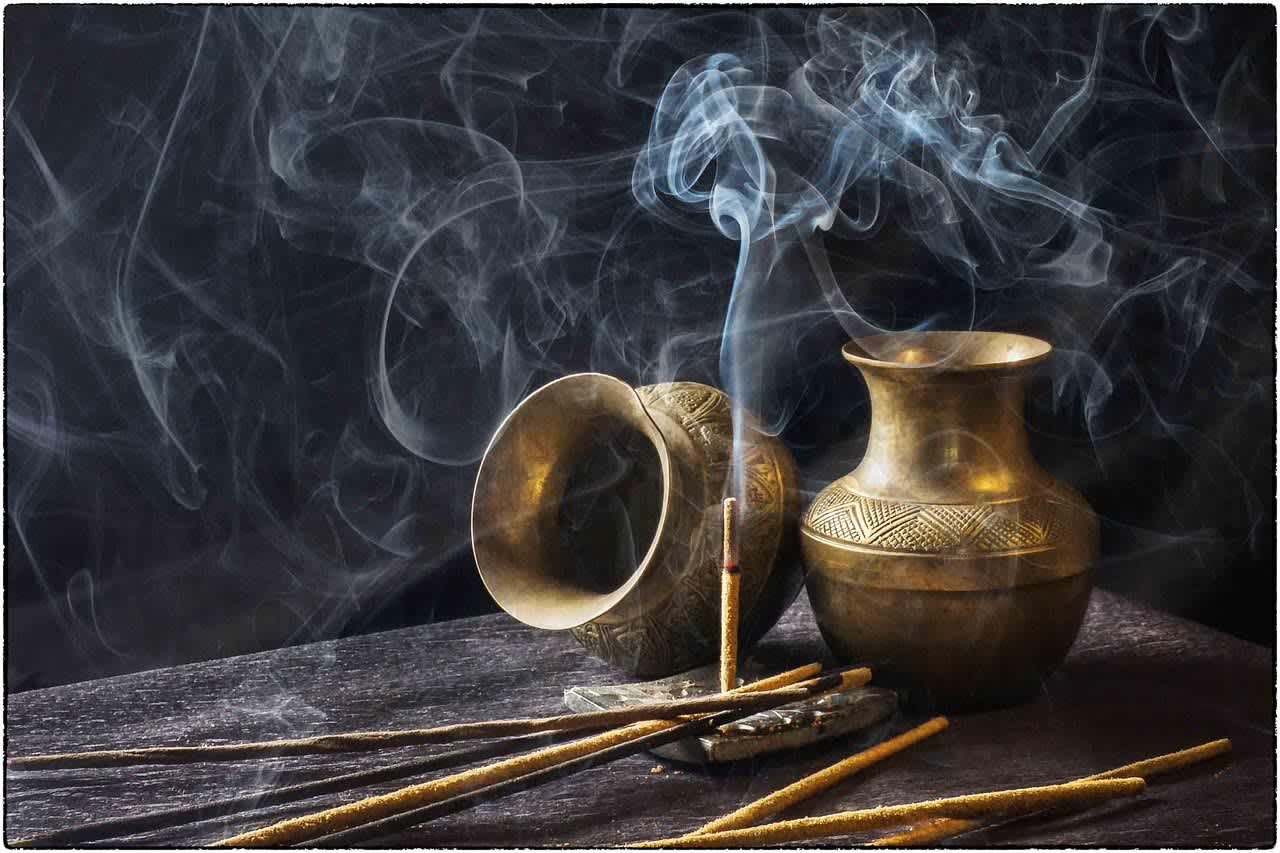
The Smoke Before the Light
I am not sure I can pinpoint when I first became aware of it. It was simply there — every morning, before the birds, before the autorickshaws on the street outside, before any thought I was old enough to have. The smell of sambrani.
My grandmother woke at four. This was not remarkable in our house; it was simply what happened. The rest of us — my parents, my brother, me — existed on the other side of that boundary, in the ordinary world of alarms and school bags. She existed somewhere else, in the dark hours before Mylapore came awake, with the brass lamp and the gods.
Sambrani is what she burned. I did not know that word as a child; I knew it as the thing in the small clay cup, the brownish lumps that glowed orange at the edge and released smoke in slow, deliberate spirals. She would hold it in both hands and move it in circles before the puja shelf — Ganesha, Murugan, Lakshmi, a small photograph of her own mother. The smoke went up and the room smelled like the inside of a temple.
This is precise enough: the smell of sambrani is not sweet the way jasmine is sweet, or floral the way rose is floral. It is resinous. Deep. Slightly woody, slightly medicinal, with something else underneath that I can only describe, as an adult, as "sacred." Temple air. The smell of accumulated years of ritual.
What Sambrani Actually Is
It took me embarrassingly long to learn what sambrani actually is. It is benzoin resin — the dried sap of trees in the genus Styrax, processed into the small dark lumps my grandmother kept in a brass box. In Tamil traditions, it has been burned as a fumigant and purifier for several centuries. The word itself is derived from the Arabic luban jawi — frankincense of Java — which entered Tamil through the spice trade routes that once ran through these waters.
My grandmother would not have put it this way. She would have said it cleans the house and pleases the deities. Both of these are, in some sense, accurate. Benzoin smoke has mild antimicrobial properties, though this is a useful fact rather than the reason she burned it. She burned it because her mother had burned it, and her mother's mother before that, in a chain of daily repetition that crosses the neat categories of science and tradition.
In North India, the same resin is sold as loban. It appears in temple ritual across regions — Tamil, Banaras, Bihar, Bengal — each house adjusting the proportion, the timing, the vessel. The incense traditions of this subcontinent have carried loban and sambrani across centuries without needing to be explained or curated. People burned it because it worked: it marked the beginning of something.
The Puja Shelf
The shelf was in the corner of what we called the puja room — a small room, barely larger than a cupboard, off the kitchen. Many Chennai houses of that generation have one. This room had a fragrance of its own even before she lit anything: old wood, kumkum, dried flower garlands going brown at the edges of the idols, and underneath it all, the residue of years of sambrani smoke.
She would not have wanted me there while she prayed. This was hers, not in the sense of exclusion, but in the sense that her morning hours had a quality of privacy that the rest of us understood without being told. I remember watching from the doorway sometimes — the back of her head, the lamp flame, the smoke — and understanding that this was serious work, even if I did not understand what "serious" meant then.
The prayers were in Sanskrit, which she knew phonetically. She could not read Devanagari, but she had the words in her mouth from sixty years of daily repetition. She sang some of them, in a thin voice that cracked slightly on the high notes. She paid no attention to whether anyone heard.
After the Puja
By six o'clock, she was in the kitchen. This was where she became someone I could speak to — grandmother, rather than the person who moved in the dark with the lamp. She made coffee the South Indian way, running it through a filter she had used since before my parents were married. The coffee and the last traces of sambrani smoke would mix in the doorway between kitchen and corridor, and that combination is what I mean when I say "home." Not a thing I can describe further. A fact of the body.
She drew kolam on the front step before the coffee, which means she was doing two things at once — drawing rice-flour patterns on the stone and watching the coffee slow-drip — which speaks to a kind of practiced efficiency I have never matched.
The kolam was renewed every morning. Rain, festival, illness, whatever else was happening — the kolam went down. I asked her once why she did it when it would just wash away. She looked at me the way grandmothers look at questions they consider not quite right. "That is the point of it," she said, and returned to her work.
The Quality of 4am
There is something distinct about the pre-dawn hours that I understand now as an adult, though I lacked the language for it as a child. The quiet is different. Traffic has not yet reshaped it. In Mylapore, at that hour, you can hear the bell at the Kapaleeshwarar temple if the wind is right — a sound that, on an ordinary morning, would be swallowed before it reached our street.
My grandmother moved through those hours at a pace she did not keep at any other time of day. The puja was not hurried and not drawn out. It was exactly what it needed to be. Flowers placed. Lamp lit. Sambrani smoke moved. Prayers spoken or sung. And then, done — the clock returning to ordinary time, coffee, kolam, the day.
I have read accounts of morning puja practice that describe it as meditative, or contemplative, or as a form of mindfulness. These are not inaccurate. They are also somewhat beside the point, which is that she was not trying to do any of those things. She was simply doing what she did, as her mother had done it, in a room that smelled a particular way at a particular hour, and that was the whole of it.
What Was Transmitted
I live in a flat now. I have a small shelf where I keep a Ganesha my aunt gave me and a lamp I light irregularly — which is to say I am a person of my generation. I do not wake at four. My kolam, when I make one, is awkward and approximate.
But I burn sambrani. I have a brass cup — not hers; mine is a newer one, bought in T. Nagar — and when I move it in circles before the lamp, I understand something that I understood bodily and incompletely, as a child in that doorway. Some practices carry their meaning in the doing, not in the explanation.
The smell still does what it did then. It makes a different kind of time. Not sacred in any formal sense, but different from the rest of the day. Still, resinous, pointed inward.
My grandmother is in her nineties now and no longer manages the four o'clock puja. But when I visit Mylapore and stay the night, the small room off the kitchen still holds the smell of decades of sambrani. No one burns it much anymore. It is still there.
Some things are absorbed into the walls. Into the wood. Into a person. They do not require maintenance. They simply are.


