
Sandhya Deepam: The Evening Lamp Hour of a South Indian Home
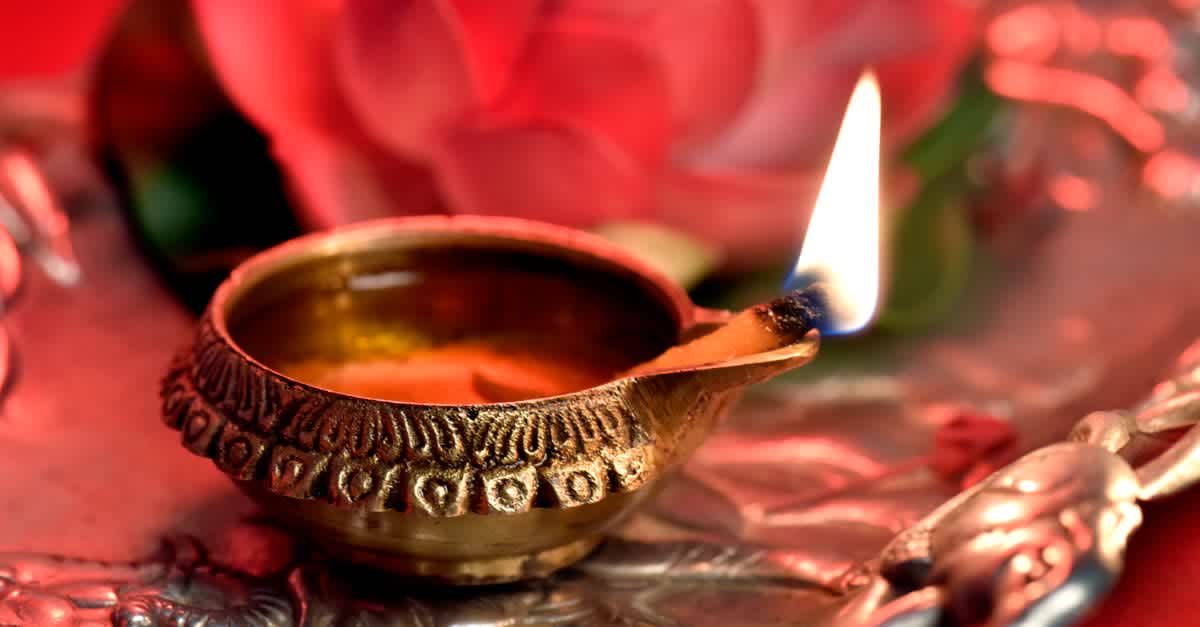
There was a particular half-hour in my grandmother's house in Bengaluru that I did not understand as a child, and now spend real money trying to recreate.
It came at dusk. Not a clock time — she never looked at a clock for it — but the moment when the light in the courtyard went from yellow to grey and the crows started their last argument in the tamarind tree. She would get up from wherever she was, wash her hands and feet at the tap by the back door, and light the lamp.
I want to describe it exactly, because the exactness is the whole thing. It was a small brass lamp, two wicks, filled with sesame oil that had gone slightly dark. She lit it with a match, then lit a stick of incense off the same flame, and then, some evenings, a pinch of camphor on a little steel plate that flared blue and vanished. The smell arrived in that order — oil first, then the incense, then the sharp clean top-note of the camphor burning off. Jasmine, usually. Sometimes sandalwood if a relative had sent some.
The hour had a name
We called it sandhya — the word simply means twilight, the join between day and night. Lighting a lamp at that join is one of the oldest domestic habits in the country, and it is not really a grand religious event. In most homes it is closer to what a Western family might mean by "we always eat dinner together." It marked a shift. The day's work — the errands, the arguments, the school bags dropped by the door — was over. The evening, quieter, was allowed to begin.
My grandmother was not solemn about it. She talked the whole time. She would light the lamp and, in the same breath, ask whether I had finished my homework and tell me to move my feet off the wall. The ritual and the ordinary life ran together. That is a thing I have had to relearn as an adult who reads too much about "mindfulness": the lamp was never a performance of peace. It was just something she did, every single evening, with her hands, at the same rough time, so that her body knew the day had turned.
I think that is most of why it worked.
What I can and can't tell you it did
I'll be careful here, because this is where a lot of writing about incense and ritual goes off the rails. I cannot tell you that the smell of jasmine incense at dusk lowers your cortisol or heals anything. I don't know that, and most of the confident claims you'll read about scent and the nervous system are running well ahead of the actual evidence.
What I can tell you is smaller and, I think, more honest. There is a real and reasonably well-studied link between smell and memory — the olfactory system sits unusually close to the brain's memory and emotion centres, which is part of why a single smell can drop you into a room you left decades ago. And there is the plain behavioural fact that a repeated cue, done at the same time each day, becomes a signal your own body learns to read. A lamp at dusk is a very good cue. It is tied to a time, a place, an action of the hands, and a smell all at once.
So when I light incense in my flat now at six in the evening, I am not medicating myself. I am giving my evening a beginning. The smell is doing two things: it is a marker in time, and it is a rope back to that courtyard. Both are worth something. Neither is magic.
Trying to rebuild it in a two-room flat
For years I got this wrong. I bought expensive candles. I bought a diffuser with an app. I tried to schedule "wind-down time" the way you'd schedule a meeting, and it felt exactly as hollow as that sounds.
What finally worked was going smaller and more physical, closer to what my grandmother actually did:
- One fixed trigger, not a mood. I don't light the lamp when I "feel like unwinding." I light it when the outside light goes. The whole point is that it doesn't wait for me to be in the right frame of mind.
- The hands have to be in it. Striking a match, lighting the stick, setting it in the holder — the little sequence matters more than I expected. A machine that puffs scent on a timer is not the same and never became the same.
- One smell, kept constant. I stopped rotating fragrances. My grandmother's house was jasmine; mine is jasmine. When the scent is always the same, it becomes the signal faster. I keep a plain jar of the same jasmine sticks by the window — I ended up going back to a small hand-rolled maker for it, the kind of natural agarbatti that actually smells of the flower rather than of something chemical pretending to be the flower — but the brand matters far less than the constancy.
- It's allowed to be ordinary. I answer texts while it burns. I don't sit in lotus position. The lamp is not asking me to become a calmer person. It is just marking the turn of the day, the way it did in that courtyard.
The part I only understood later
My grandmother has been gone some years now. The house was sold. The brass lamp is somewhere in a cousin's cupboard.
The first winter after she died, I couldn't work out why the evenings felt so unstructured, why six o'clock kept sliding into a grey nothing where I'd just keep working or keep scrolling until it was suddenly late. Then one evening I lit a stick of jasmine incense — not for any reason, I just found an old box — and the whole hour came back. Not as grief, exactly. More as shape. Here was the join between day and night, and here was something to do at it.
I don't think she was teaching me anything, those evenings. She would laugh at the idea. She was just lighting the lamp because it was dusk and that is what you did at dusk. But the habit was a small architecture, built into the day so quietly that I only noticed it when it was gone and I had to build it back myself, clumsily, out of a matchbox and a stick of incense.
If you are trying to give your own evenings some shape — and a lot of us, far from the houses we grew up in, are — you could do a great deal worse than this. Pick the moment the light changes. Light one thing. Let it smell of something you love. Then get on with your ordinary evening, with the day quietly, definitely, turned.


