
Shiuli, the Autumn Flower You Gather From the Ground
The first sound of autumn in our house was not a conch and it was not the radio. It was a broom.
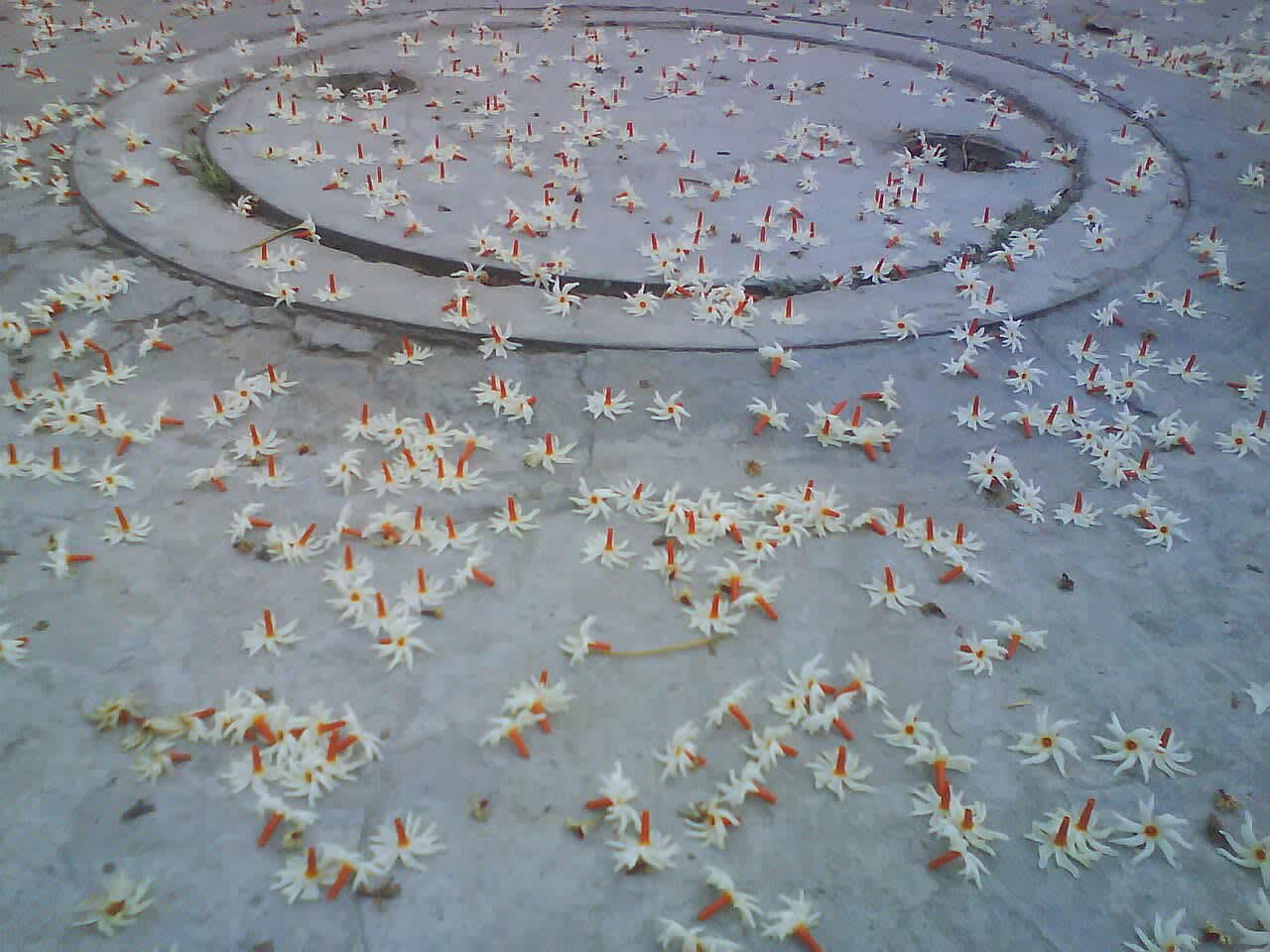
My grandmother went down to the strip of courtyard behind the building at a quarter past five, in the part of the morning when Kolkata has not yet decided to be loud, and she did not sweep so much as herd — short, patient strokes that drew things toward her rather than pushing them away. By the time I came down, barefoot and entirely unhelpful, there would be a low white drift on the concrete, and she would be crouched beside it with a thin cotton cloth spread flat, lifting the flowers a few at a time with two fingers, the way you lift something that has already been broken once.
The tree was not ours. It leaned in over the wall from the plot next door, a scrubby, unglamorous thing with rough leaves that felt like a cat's tongue, and for eleven months of the year nobody in either building gave it a second look. Then, some morning in the middle of September, you would step outside and the ground would be covered, and the air would have that smell in it — sweet, slightly green, faintly like something cooking — and my grandmother would say, without turning around, pujo eshe gelo. Puja has arrived.
A tree that will not be picked
The flower is shiuli in Bengali, shefali in the older books, harsingar or parijat across most of the north. Botanists gave it a name that reads like a small tragedy: Nyctanthes arbor-tristis, the night flower on the sorrowful tree. The sorrow, as far as anyone can tell, is administrative — the tree looks magnificent at night and faintly embarrassed by daylight, and someone with Latin decided that was grief.
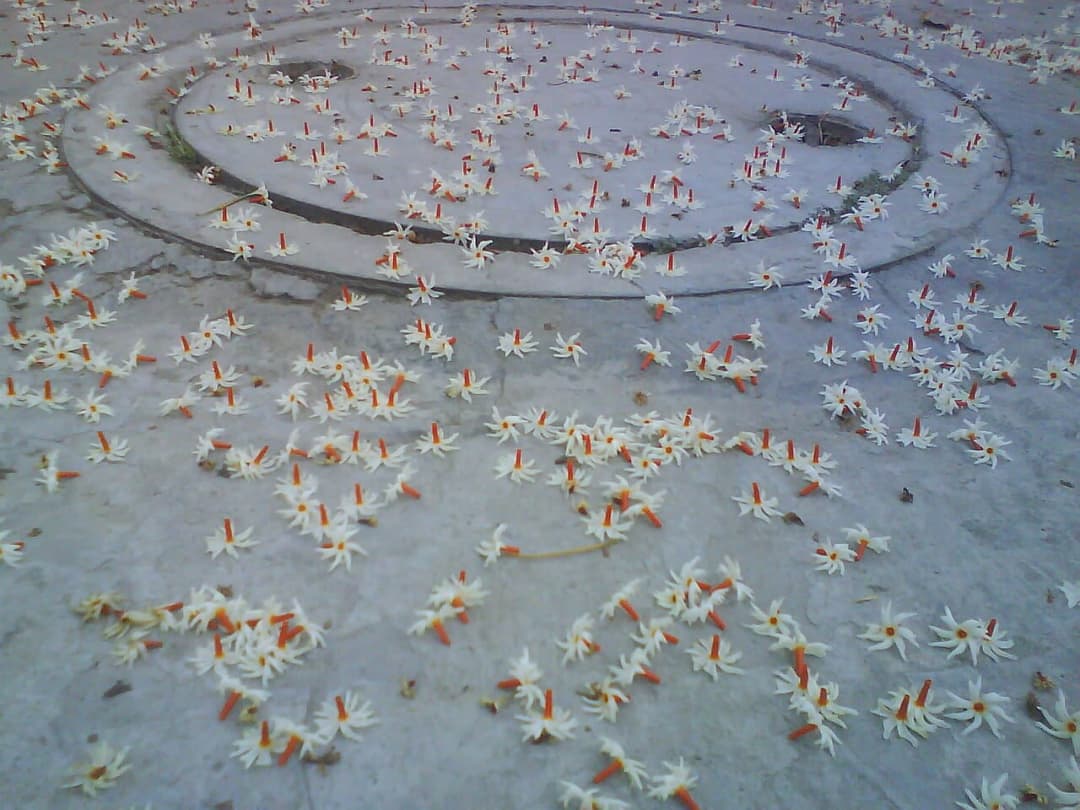
What it actually does is this. The buds open after dusk, all of them, over the space of an hour or two. The tree scents the whole night for the benefit of moths and nobody else. And then, in the last grey stretch before sunrise, it lets everything go at once — not petal by petal over a week, the way a considerate flower would, but the entire night's work dropped in a single hour onto whatever happens to be underneath. Concrete, usually. A parked scooter. Someone's bucket.
So you cannot pick shiuli. By the time there is enough light to see the tree, the tree has nothing on it. This is the only flower I know that arranges its own harvest and then refuses to attend.
The rule that gets bent, once a year
Here is the part that took me until adulthood to find odd. A flower that has touched the floor is generally not offered. It is the first thing you learn about handling anything meant for the thakur ghar — the basket goes on the stool, not the ground; the cloth goes down first; if it falls, it is finished.
And every September that rule quietly steps aside for one tree.
We were told — and I have never gone looking for the text that says so, and I suspect there isn't one so much as a very old shrug — that shiuli is the exception, because the flower does not fall in the sense of being dropped. It offers itself. The tree completes the puja and the household is merely collecting. My grandmother, who was not sentimental about very much, held this with total seriousness, and would not let the cloth touch the drift of flowers directly; the cloth was for carrying them up, and the flowers went onto it one small handful at a time, still cold from the night.
I have since met Bengali households who dispute every part of this and simply like the flower. Both positions survive the winter.
The orange stalks, which are the point
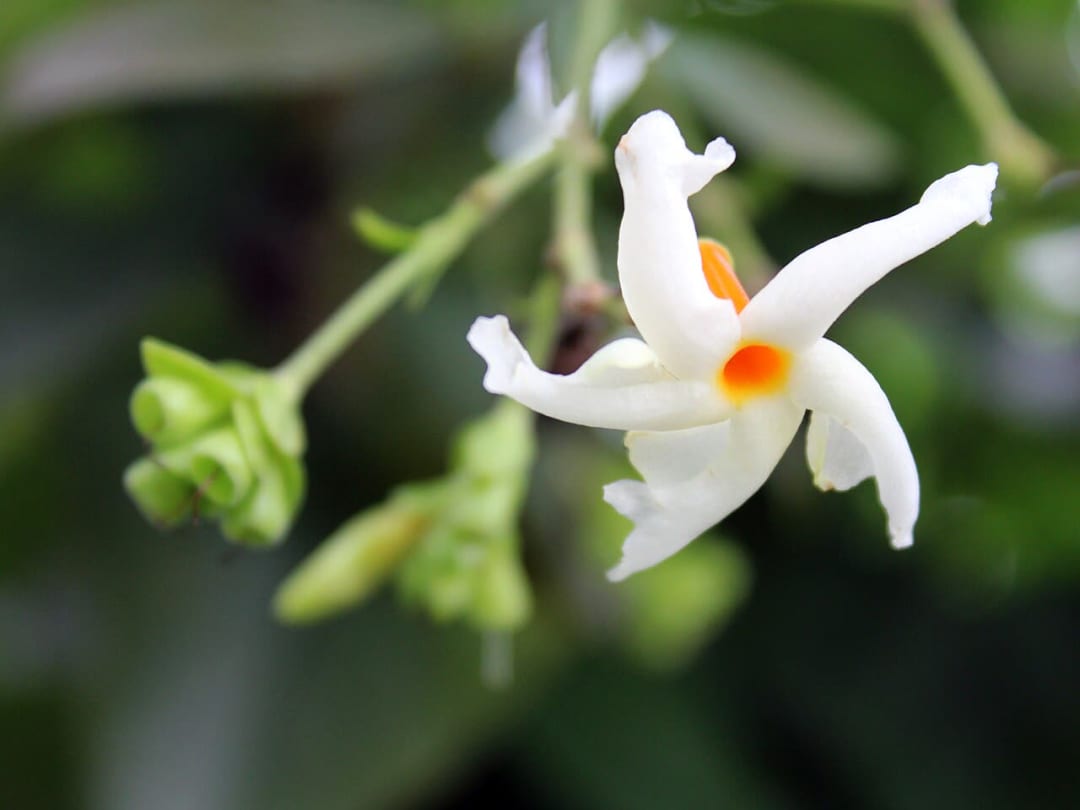
If you have only seen shiuli in a photograph you will have registered a small white flower. If you have held one you will have registered the stalk, which is the actual event — a short, waxy tube of a very specific orange, closer to turmeric than to marigold, and so saturated that it looks painted on by someone showing off.
That orange is a pigment called nyctanthin, and it is one of the few dyes in an Indian kitchen that will give up its colour without being argued with. No mordant, no alum, no long negotiation. You soak the tubes in hot water and you get amber and yellow on cotton and silk, which is the historical reason robes across South and Southeast Asia have been dipped in shiuli water for centuries — it is a poor person's saffron that grows over the wall for free.
In our house the ambition was smaller. Grandmother separated the stalks from the petals on the same cloth, pinching each flower, dropping white in one heap and orange in another, and the orange went into a steel bowl and eventually into a jar that produced, in November, a thin yellow water that dyed one small square of cloth and stained her fingertips for a week. She did this every year. It served no purpose I could ever identify. I have come to think that was the purpose.
What the tree is actually announcing
The calendar will tell you that Mahalaya is on the tenth of October this year and Shashthi on the sixteenth, and the pandals will go up on scaffolding some days before that, and the loudspeakers will be tested in the way loudspeakers are tested, at maximum, at noon, for no reason.
But in Bengal the announcement has never really come from the calendar. It comes from three things arriving at once: the light going thin and slanted, kaash grass coming up white along the railway embankments, and shiuli on the floor in the morning. None of them are scheduled. They simply turn up a few weeks ahead of the date, and every Bengali who has moved away will tell you that the ache of missing Puja does not start with the music, it starts with a September morning somewhere else that smells of nothing in particular.
That is the whole of it. Autumn is a smell before it is an event.
The scent you are not allowed to keep
There is no shiuli perfume worth having. People have tried; the flower is too delicate, too watery, and it does not survive the extraction — what comes out the other end smells like a polite idea of jasmine. Even the flowers themselves are spent by mid-morning. Gather them at half past five and by nine the cloth holds a heap of limp white that has nothing left to say.
This used to strike me as a design flaw and now strikes me as the flower's entire argument. You cannot stockpile shiuli, you cannot schedule it for a convenient evening, you cannot have it on demand. The only way to have it at all is to be standing in the courtyard in the dark, which means the flower's real gift is not fragrance, it is a reason to be awake at an hour you would otherwise sleep through.
Everything else we burn or bottle at home is a substitute for that, and an honest one. The evening stick of hand-rolled agarbatti that gets lit at dusk in most houses I know does the same small structural job as my grandmother's broom — it marks a boundary in the day, it asks for five minutes, and it is over when it is over. Nobody pretends it is the tree. It is simply available in February.
The cloth, folded
She stopped going down at some point, and then the building next door was sold and the tree went with it, which is how these things usually end — not with a decision, but with construction.
What I kept is a small piece of knowledge with no use: that a shiuli flower, picked up at a quarter past five from a concrete floor, is cold. Colder than the morning. It has been out all night doing its work and it comes into your hand like a stone from a riverbed, and it will be limp by breakfast, and next year the tree will do the entire thing again for moths and for whoever happens to be standing there.
My grandmother folded her cloth into quarters and carried it upstairs with the white heap in the middle, and the smell came up the stairwell behind her, and that was September, every year, for as long as it lasted.


