Shyama Mai, Darbhanga: The Temple Built on a Pyre
There is a rule most Mithila households keep without ever having been taught it: you do not take a new bride past a burning ground. You go around. You take the longer road even if it costs you twenty minutes, and nobody explains why, because in a family that has buried its elders properly the reason does not need saying.
Then there is Darbhanga, where on any ordinary Tuesday you will find a wedding party climbing the steps of a temple that was built on a pyre.
The pond comes first
You will smell the water before you see the shikhara. Shyama Mai sits at the Kathalbari end of what used to be the Darbhanga Raj estate, and in front of it is a pond of the kind north Bihar has thousands of — flat, brown, ringed with a low wall, holding the sky in it so completely that at dusk you get the temple twice.
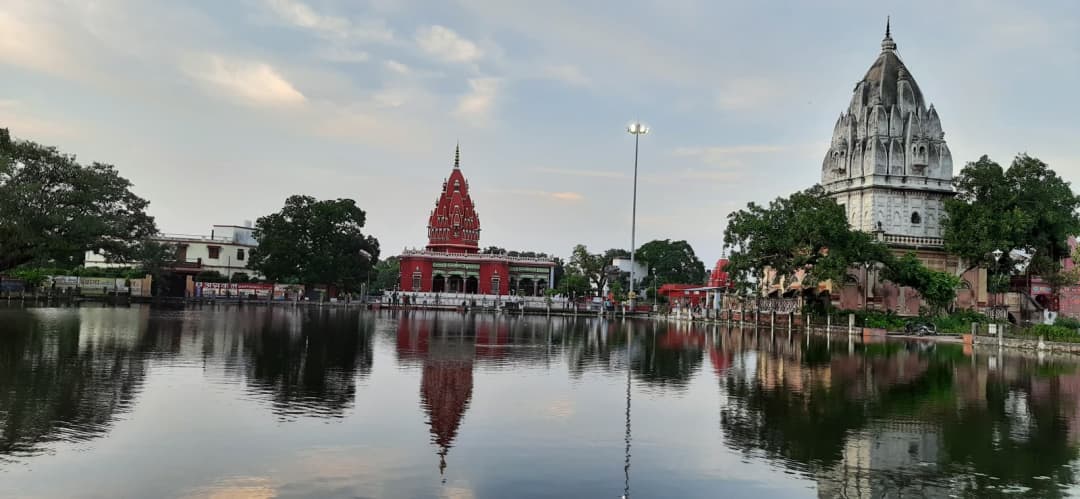
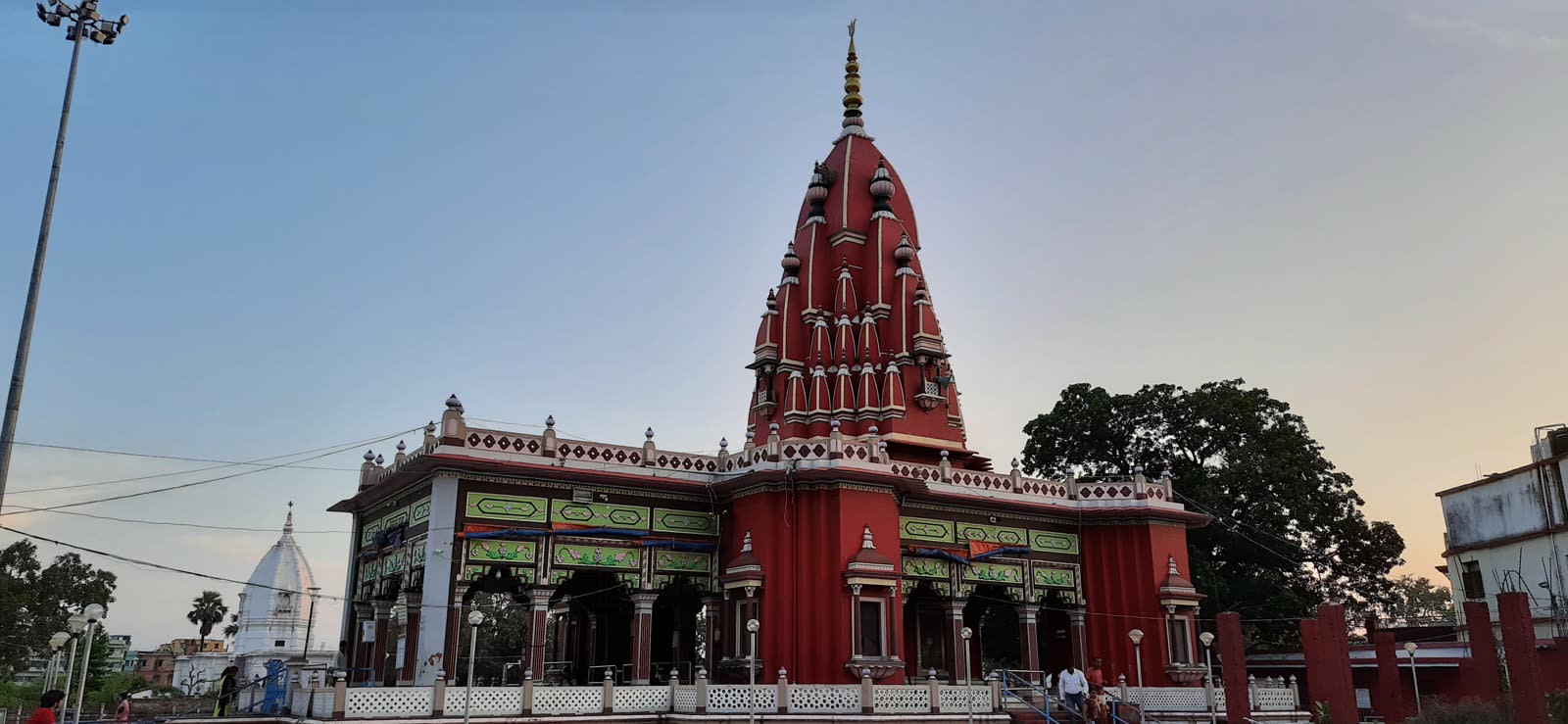
The temple itself is red. Not a subtle red — a deep, unembarrassed brick-red that you can pick out from the road, with a Nagara shikhara rising out of a squat pillared hall and a row of green panels painted along the front like a border on a sari. Around it, on the same ground, are other spires: white ones, smaller red ones, a whole family of shrines standing shoulder to shoulder. In the morning the shopfronts along the pond wall are still shuttered and the loudest sound is the bell.
A pyre, and then a temple
The story here is short and I have never heard anyone in Darbhanga tell it wrong.
Maharaja Rameshwar Singh of the Darbhanga Raj was, among all the things a Maharaja is, a man seriously occupied with worship — a sadhak, people here say, not merely a patron. When he died he was cremated on this ground, as the men of that house were. And his son, Maharaja Kameshwar Singh, did something that is still unusual after ninety years: instead of marking the spot and leaving it to the shmashan, he built a temple on it. That was 1933. The Goddess he installed was Kali, and because the shrine stands on his father's pyre it is still called by his father's name — Maa Rameshwari Shyama Mandir, though everybody in the district shortens it to Shyama Mai.
Understand what that decision means. A shmashan is not a bad place in our tradition; it is a true one. It is where the story a person has been telling about himself finally stops. Tantra has always known this and has always taken its practice to exactly the places householders avoid — the burning ground at night, the ash, the skull, Kali standing on Shiva with her tongue out because there is nothing left to be polite about. What the Raj did in 1933 was take the least domestic site in Darbhanga and put a door on it, and steps, and a bell, and let the town in.
What is inside
The sanctum is dark, as it should be. The image of the Goddess is large and black, four-armed, and — this is the detail worth carrying home — one right hand is raised in blessing. Around her neck hangs a garland that is not flowers. It is letters: the syllables of the alphabet, strung one after another. In the Tantric reading of Kali that garland is the whole created world. Sound comes first, then names, then things; and she is wearing the lot of it, lightly, the way you would wear beads.
She is not alone in there. Mahakal is with her, and to the other side Ganapati and Batuk Bhairav — the boy-form of Bhairav, the guardian you greet before you ask the Goddess for anything. The worship performed here runs on both tracks, Vedic and Tantric, which is less contradictory in practice than it sounds on paper. The Vedic side is the one a visiting family sees: the sankalpa, the offerings, the priest reciting your gotra back to you. The other side belongs to the temple.

The bell has its own building — a small red-and-white pavilion with a shikhara of its own, the brass hung inside behind an iron grille. Children make straight for it. The smell in the hall by mid-morning is coal, marigold, and above all loban: benzoin resin on a live ember, which is the oldest smoke in this part of the country and still the one that tells your body it is in a shrine before your eyes have finished adjusting to the dark.
Why the wedding parties come
Now the part that surprises outsiders.
On a weekday morning, a good share of the people on those steps are there for a marriage. Some are getting married at the temple. Others were married last week and have come, in the clothes, with the elders, to stand in front of her before they begin. Families come for the naming of a child. Families come after a purchase of land. And a steady number come for Manglik matters — the Mars-in-the-chart difficulty that has stalled more Bihari matches than any actual incompatibility ever has — because a Goddess who lives on a cremation ground is understood to outrank a planet.
To a household that keeps the old avoidance, this looks backwards. It is not. The avoidance is about death being contagious to a new beginning. But this ground stopped being ordinary cremation ground the day a temple was consecrated on it — that is precisely what consecration does, and the town has treated it that way for three generations. The bride's grandmother, who would take the long road around any other burning ghat in Mithila, walks up these steps without a flicker.
There is a plainer reading too, and I would not want to be too refined to say it. If you are frightened, you do not go to a gentle deity. You go to the one who is standing on the thing you are afraid of.
The other temples in the compound
Do not leave after the darshan. The Raj built more than one shrine on this ground, and the neighbours are worth the walk: Madhaweshwar, Annapurna, Kameshwari Kali, Laxmishwari Tara, Rudreshwari Kali. Tara, in particular, is not a common sight — she belongs to the same Tantric lineage as Kali and holds her own quiet corner here. Half an hour among these spires tells you more about what the Darbhanga Raj actually believed than any account of its estates will.
Come on a Tuesday
At Navratri the ground disappears under people. There is a fair, there are lines that begin outside the pond wall, and Kali Puja brings its own crowd. Those are the days the district photographs.
But a temple is best understood on a day nobody is photographing it. On an ordinary Tuesday you can hear which parts of the ritual are habit and which are still felt. You can watch a man in a shirt from an office arrive at half past seven, do his rounds in four minutes, ring the bell on the way out and reach work on time — a whole religion running at commuting speed, and none of it insincere.
And you can stand in front of a black image with an alphabet around her neck, on the exact ground where a king's body once burned, and notice that nobody around you finds this strange. That is not indifference. It is the thing Mithila does best: keeping death close enough that it stops being an emergency, and then holding a wedding on top of it.