
Simhachalam Temple: The History Under the Sandalwood
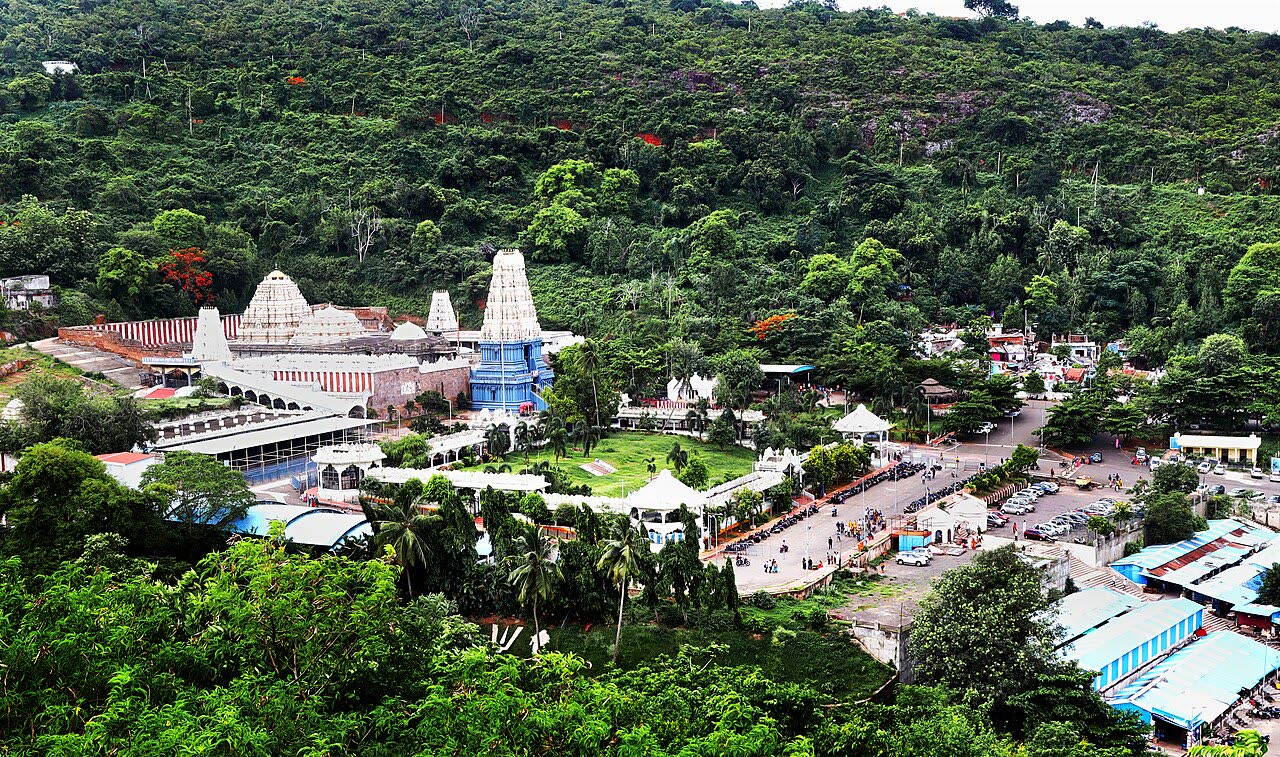
From the coastal plain of Visakhapatnam, the hill does not look like much — a green rise about eight hundred feet up, softened by the haze that comes off the Bay of Bengal on a humid morning. You climb it, or you take the winding road, and somewhere past the mango groves the air changes. Before you see the temple, you smell it: sandalwood, thick and cool, the way it hangs in still air after rain. That smell is the whole story of Simhachalam, and the story is older than most people who climb the hill realise.
A god carved as two avatars at once
The temple belongs to Sri Varaha Lakshmi Narasimha Swamy. The name itself is unusual. Most Vishnu shrines are dedicated to a single avatar; here the presiding form joins two — Varaha, the boar, and Narasimha, the man-lion. Both are avatars the tradition remembers as rescues, forms the god took to set right a world tipped off balance. To fold them into one deity is rare, and it gives the shrine a particular character: this is not a gentle god you visit for comfort, but a protective one you visit for strength.
For most of the year you cannot actually see the carving. It is covered — completely — in sandalwood paste. What a visitor bows to on an ordinary day is a smooth, fragrant mound roughly the shape of a seated figure, four thick layers of chandanam built up over the stone. The true form underneath, the nijaroopa, is shown for only about twelve hours in the entire year. Everything else at Simhachalam sits around that single fact.
What the stones remember
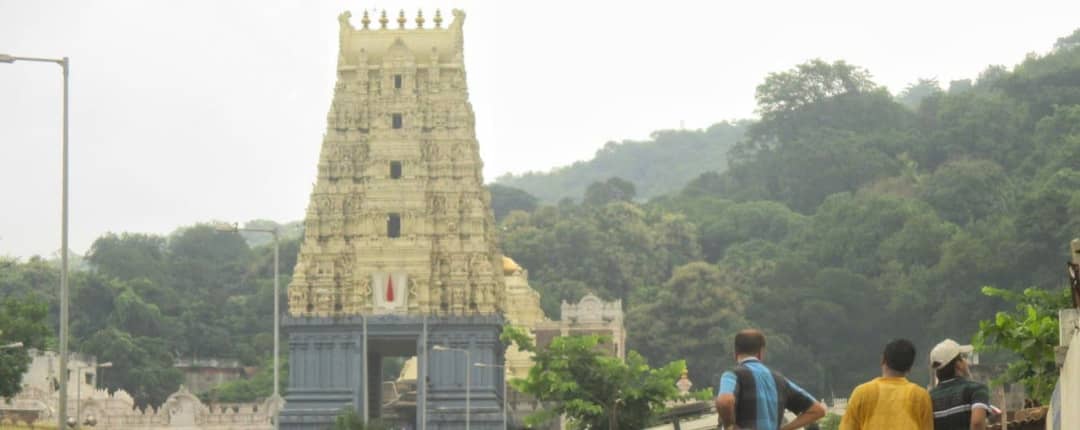
Simhachalam is one of those temples that carries its own history on its walls, if you know how to read it. The oldest inscription here reaches back to around the eleventh century, recording a private gift made during the reign of the Chola king Kulottunga I — a small act of devotion pinned to a date, the kind of thing that outlives the person who paid for it.
But the temple you walk through today is largely a thirteenth-century building, and for that it owes the Eastern Ganga dynasty. Under Narasimha Deva I — a king the Kalinga country remembers for grand stone-building — the shrine was substantially rebuilt in the Kalinga style, the same architectural tradition that shaped the great temples of coastal Odisha to the north. The consecration is placed in 1268, in the reign of his successor. If the tower and the layout feel more Odishan than Andhran, that is why: the hill sat at the meeting point of two cultures, and the building took after both.
The Gangas did not just build and leave. Over the following centuries, kings and queens kept endowing the temple, and the record of it survives in more than two hundred and fifty inscriptions cut into its stone, in Odia and in Telugu — a bilingual archive that is itself a map of who held this coast and when. One of them records a queen of the line arranging for the daily offerings, the sada seva, so that the god would be served every single day without fail. Later, the temple drew patronage from further south as well; the Vijayanagara emperor Krishnadevaraya is remembered among the rulers who honoured it after his campaigns along the eastern coast. Chola, Ganga, Gajapati, Vijayanagara — the hill outlasted all of them, and quietly kept a piece of each.
The sandalwood that hides the god
The paste is not decoration. The tradition around it holds that the stone form of the deity radiates an intense heat, and that the sandalwood is applied to cool it — sandalwood being, in the old reckoning of substances, one of the great coolants. Whether you take that literally or as the language of devotion, the practice is unbroken: layer upon layer of chandanam, renewed through the year, until the figure disappears entirely under it.
Once a year the covering comes off. On Akshaya Tritiya, the third day of the bright fortnight of Vaishakha — usually falling in April or May, in the hot dry weeks before the monsoon reaches this coast — the priests remove the sandalwood in the festival called Chandanotsavam, or Chandana Yatra. For those few hours the deity stands in its true carved form, and the crowds that come for that single darshan of the year are enormous. Then the paste goes back on, and the god returns to its long fragrant sleep.
There is something honest in that rhythm. The sandalwood is worked onto the stone by hand, in a warm shrine, the resinous scent filling the enclosed space until it settles into your clothes. Anyone who has spent time around real sandalwood — the way we do when we blend it into our sandalwood incense back in Bihar — knows how it behaves in humid air: it does not shout, it deepens. It gets rounder and cooler the longer it sits. At Simhachalam that quality is not a fragrance note; it is the point of the whole ritual. The god is kept cool, and the hill is kept fragrant, and the two things are the same act.
Why the hill still fills up
Vizag is a working port city now — shipyards, steel, the long grey line of the harbour. The hill sits above all of it, and on an ordinary weekday the temple is busy but not overwhelmed: families climbing after work, the sea breeze coming up the slope in the late afternoon, the light going soft and orange over the water below. It does not feel like a monument. It feels like a place people still use.
That is the quiet achievement of a temple like this. It has survived nine hundred years of changing rulers not by being preserved behind glass but by being kept in daily service — the sada seva the Ganga queen arranged for is, in spirit, still being performed. The dynasties that built it are gone. The inscriptions they left have to be decoded by specialists now. But the sandalwood is applied again every morning, the same as it has been for centuries, and the smell reaches you before the temple does.
If you ever find yourself in Visakhapatnam, go up in the late afternoon rather than the midday heat. Let the climb do its work. And when the sandalwood reaches you on the slope, remember that you are smelling the oldest continuous thing on that hill — older than the tower, older than the inscriptions, older than the kings. The stone changes hands. The fragrance stays.


