
Somnath at Dawn: Morning Darshan by the Arabian Sea
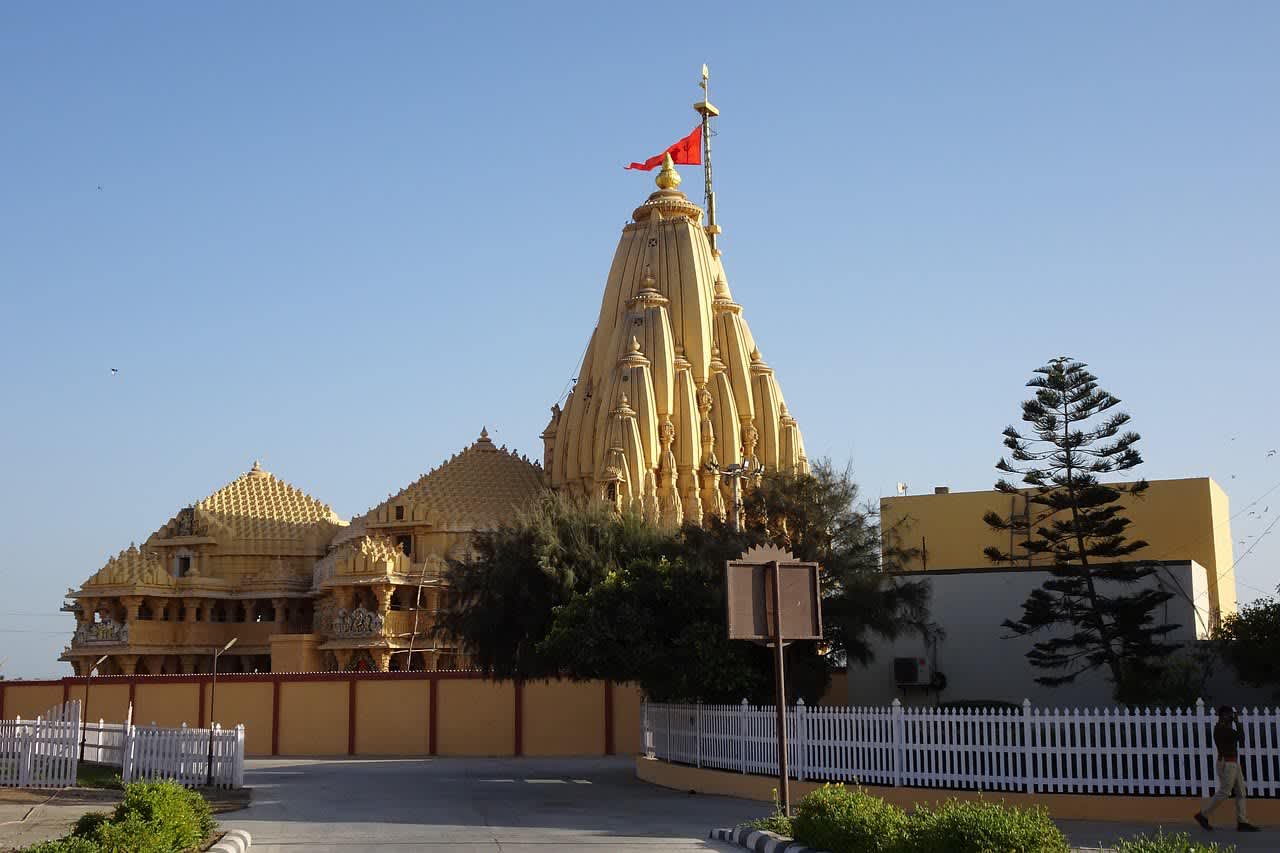
You hear the sea before you see the temple. It is still dark when the bus from Veraval drops you at the edge of Prabhas Patan, and the first thing that reaches you is not the spire or the lights but a sound — the long, even breathing of the Arabian Sea against the shore, close and constant, the way traffic sounds in a city that never fully sleeps. You walk toward it with your slippers in your hand and the cold of the paving under your feet, and somewhere ahead of you, past the barricades and the shoe stalls not yet open, is the temple you have come for.
There is a particular kind of tiredness that belongs to a pilgrimage — the tiredness of a night train, of a bus that left too early, of standing in a line before your body has decided it is morning. It is not a complaint. It is part of what you came for. You do not arrive at Somnath rested. You arrive worn down to the point where the place can actually reach you.
The queue in the dark
The line for the first darshan forms while it is still night. By the time you join it, there are already a few hundred people ahead of you — families with sleeping children over their shoulders, old couples holding each other's sleeves, a group of men from somewhere in the Deccan speaking a language you don't know, all of them quiet in the way people are quiet when they are cold and waiting.
You leave your phone and your shoes and your bag in the lockers, because you cannot carry them in. This is its own small lesson. You walk toward the sanctum with nothing in your hands. The security is thorough — Somnath has reason to be careful, given its history — and you move through it slowly, shuffling forward a few feet at a time, the sea getting louder as the line curves toward the water.
And then the sky begins to change. Not sunrise yet, but the first grey loosening of the dark, and against it you finally see the temple properly: the tall cream-coloured spire, the shikhara, rising straight up against a sky that is turning from black to the colour of ash to a thin, cold blue. The temple faces the open sea. There is nothing between it and the horizon. That is the thing photographs never quite carry — how exposed it is, how it stands at the very lip of the land with the whole Arabian Sea in front of it, taking the wind full in the face.
What the first aarti feels like
Somnath keeps three aartis through the day, and the morning one is worth the sleep you gave up for it. When it begins, the bell starts, and then more bells, and then the whole crowd that has been silent in the cold finds its voice at once. The sound moves through the sanctum and out toward the sea and you feel it in your chest before you understand it in your head.
Inside, at the centre, is the lingam — Shiva worshipped here not as a figure with a face but as a column, a form without form. Somnath is counted first among the twelve jyotirlingas, the shrines where Shiva is held to be present as light rather than image. Standing in front of it, pressed forward by the line behind you, you get only a few seconds. The priest's hand moves, the flame goes up, and you are already being carried past by the crowd. That brevity is deliberate and it is right. You do not get to linger. You get one clean look, and you carry it out with you.
Back in the courtyard, with the aarti still going on behind you, the light comes up over the sea. If you have ever wondered why our people built a shrine to Shiva right here, on this particular exposed shoulder of the Gujarat coast, the sunrise answers it better than any book. The temple stands where the land ends. Beyond the Baan Stambh — the old arrow-pillar on the grounds, with its ancient boast that an unbroken sea-line runs south from this point all the way to the pole — there is only water, and the sun comes up out of it, and the wet stone of the temple turns gold for a few minutes before the day flattens it back to cream.
Around the temple, when the crowd thins
The mistake most first-time visitors make is to leave once they have had darshan. But Somnath sits inside a whole landscape of sacred ground, and the hour after sunrise, when the big morning crowd has thinned, is the time to walk it.
A short way off is the Triveni Sangam, where three rivers — the Hiran, the Kapila, and the vanished Saraswati — are said to meet the sea. Pilgrims come here to offer for their ancestors, and in the early light the ghats are busy in a quieter way than the temple, with priests and small fires and the low sound of names being remembered. Nearby is Bhalka Tirth, the spot tradition ties to the last hours of Krishna, struck by a hunter's arrow while resting in the forest. The Somnath temple itself is dramatic; these places around it are humbler, and they are where the pilgrimage settles into you.
This coast has a long memory of incense — the sea trade that made Somnath rich for centuries carried resins and aromatics along this very shore, and the smell of a temple has always been part of how it is remembered. It is the reason a shrine's fragrance stays with a pilgrim longer than its architecture; we make an incense named for Somnath among the jyotirlingas for exactly that reason — not to sell you the temple, but because the scent is how the place travels home with you. That is all. Then back to the walking.
Staying for the evening
If you can, do not do Somnath as a morning stop between two other places. Stay the day. The light on the temple changes hour by hour, and by late afternoon the sea wind picks up and the spire stands against a sky going orange behind it.
And stay for the evening. After dark there is a sound-and-light show on the temple grounds — the story of Somnath told against the lit-up shrine, the destructions and the rebuildings, the raid of 1026 and the reconstruction finished in 1951, all of it narrated while the sea keeps up its own commentary in the background. It is unashamedly a spectacle. It is also, oddly, the right way to end the day, because it says out loud the thing the morning darshan only hinted at: that this temple has been knocked down and built back more times than almost any shrine in India, and that the cream-coloured spire you stood under at dawn is the latest answer to a very old question.
You leave the way you came, past the shoe stalls now closing, the sea still louder than the town. You are more tired than when you arrived. But you carry the morning out with you — the bells, the cold stone, the sun coming up out of the water behind a temple that has refused, again and again, to stay down.


