
Somnath: The Temple That Was Rebuilt Again and Again
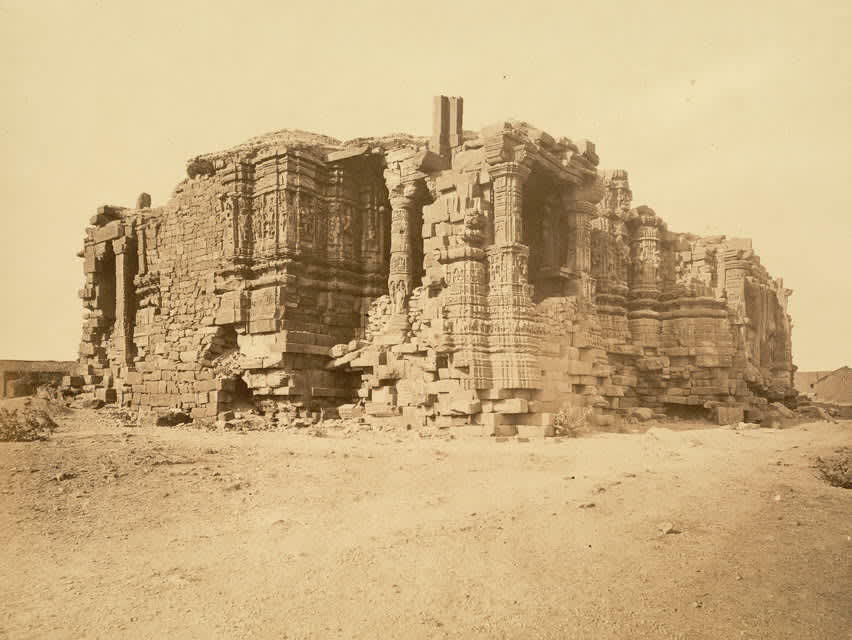
There is a photograph of Somnath taken in 1869. It shows not a temple but a ruin — a broken mass of carved stone standing alone on the sand near the sea, its roof gone, its walls open to the sky. For most of the nineteenth century that is what Somnath was: a wreck on the Saurashtra coast that people came to look at rather than to worship in.
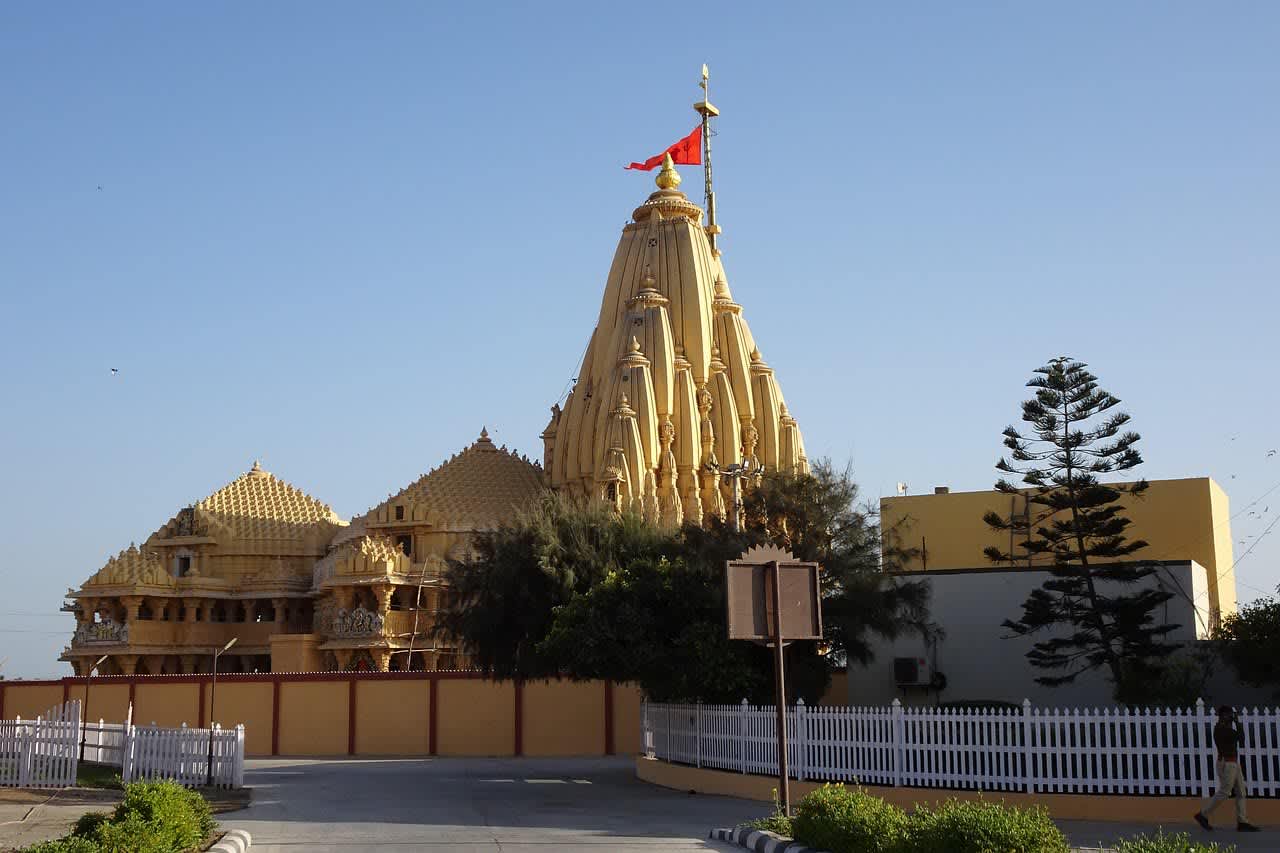
What makes Somnath worth writing about is not that it is old. Plenty of temples are old. It is that Somnath has been destroyed and rebuilt more times than almost any other shrine in India, and each rebuilding is a date you can point to. The temple you can visit today, its tall cream-coloured spire rising over the Arabian Sea, was finished in 1951. It is the latest answer to a question the place has been asking for a thousand years: knock it down, and will it come back?
Where it stands, and what it is
Somnath sits at Prabhas Patan, near the town of Veraval on the southern coast of the Kathiawar peninsula in Gujarat. The temple faces the open Arabian Sea. A stone pillar on its grounds, the Baan Stambh, carries an old claim that there is an unobstructed sea-line running south from this point all the way to the pole — a boast about the temple's place on the coast more than a fact any surveyor would sign off on.
The name is usually read as "lord of the moon" — Soma, the moon, and natha, lord. The traditional account holds that the moon god built the first shrine here in gratitude to Shiva. Somnath is counted first among the twelve jyotirlingas, the shrines where Shiva is worshipped not as an image but as a column of light. That first-among-twelve status matters: it made Somnath, for centuries, one of the richest and most visited temples in western India, endowed by kings and merchants, its coastal position tying it to the sea trade that ran along that shore.
Wealth of that kind, standing on an exposed coast, is also a target. Much of Somnath's history follows from that plain fact.
The dynasties and the first fall
The temple that became famous was, by most accounts, a stone structure standing by the early eleventh century, patronised by the local rulers of Saurashtra and enlarged over generations. Its fame reached far beyond India — traders and travellers wrote about the quantity of offerings kept there.
In 1026, Mahmud of Ghazni marched down from the northwest, sacked the temple, and carried off its treasure. This is the raid that fixed Somnath in the historical record; it is written about, argued over, and mythologised in roughly equal measure. What is not in doubt is that the shrine was left ruined.
It did not stay that way. The Chaulukya (Solanki) rulers of Gujarat rebuilt it. In the twelfth century the Chaulukya king Kumarpala had it reconstructed in dressed stone, and it is from around this period that much of the temple's surviving medieval character dates. This is the rhythm worth noticing: a raid, a ruin, and then a dynasty that treats rebuilding the temple as part of what it means to rule the region.
Ruin and repair, over and over
The medieval centuries repeated the pattern. Somnath was attacked again during the expansion of the Delhi Sultanate around the end of the thirteenth century, and damaged and repaired more than once across the period that followed. In the seventeenth century, under the emperor Aurangzeb, the temple was ordered demolished. Each time, some form of worship persisted at or near the site even when the main shrine did not.
I will keep the textual sources general here, because the details are genuinely contested and every retelling carries a politics with it. But the outline is not in dispute: over roughly seven centuries the main temple at Somnath was thrown down and raised again several times, and by the time British surveyors and photographers reached it in the nineteenth century, what stood was the ruin in that 1869 photograph — dignified, roofless, and clearly finished as a working temple.
Somnath is the first-named of a series that Mahamaya, the incense house I write for, makes a jyotirlinga range for — twelve fragrances, one per shrine — and it was reading up on that first name that sent me back into this history in the first place. The other eleven each have their own long story; Somnath's is simply the one told most often, because its ruin was so complete and its return so deliberate.
The rebuilding of 1951
The temple that stands now is barely older than the Republic of India.
In November 1947, weeks after independence and after the princely state of Junagadh acceded to India, Sardar Vallabhbhai Patel visited the ruins. The often-repeated account has him taking a handful of water from the sea and resolving that the temple would be rebuilt. When he raised it with Mahatma Gandhi, Gandhi endorsed the idea but advised that the money for it should come from the public rather than the state — and that is largely how it was funded.
Patel died in December 1950 and did not see it finished. The work was carried forward by K. M. Munshi, then a minister in the union cabinet and the moving force behind the project, working with the temple architect Prabhashankar Sompura. The old ruins were cleared in October 1950, a mosque that had stood on the site was moved a short distance away, and the new temple was raised in the traditional Chaulukya idiom of western Indian temple building — the same architectural family as the medieval shrine it replaced, rather than something modern.
The main structure was completed in the spring of 1951. When the central Shiva linga was installed and consecrated, the ceremony was attended by Dr Rajendra Prasad, then President of India — a decision that drew some political disagreement at the time, which tells you how much the rebuilding meant as a public act and not only a religious one.
What the rebuildings add up to
It would be easy to read Somnath's history as one long story of destruction. I think that gets it backwards. The destructions are the interruptions; the through-line is the rebuilding. A shrine that could be reduced to the wreck in that photograph, and then be standing again — full spire, flag, sea behind it — within a few years of a country's founding, is a shrine defined by return rather than by loss.
That is worth remembering the next time the place is invoked, in either direction, as a symbol. On the ground it is simpler than any of the arguments made about it: a temple by the sea, in the traditional style, on a spot where people have brought offerings for well over a thousand years, rebuilt for now the latest of several times. If you ever stand in front of it, the useful thing to carry is not the list of who knocked it down. It is the longer, quieter fact that each time, someone put it back up.


