
Swarna Gauri Vrata at Home: A Step-by-Step Guide
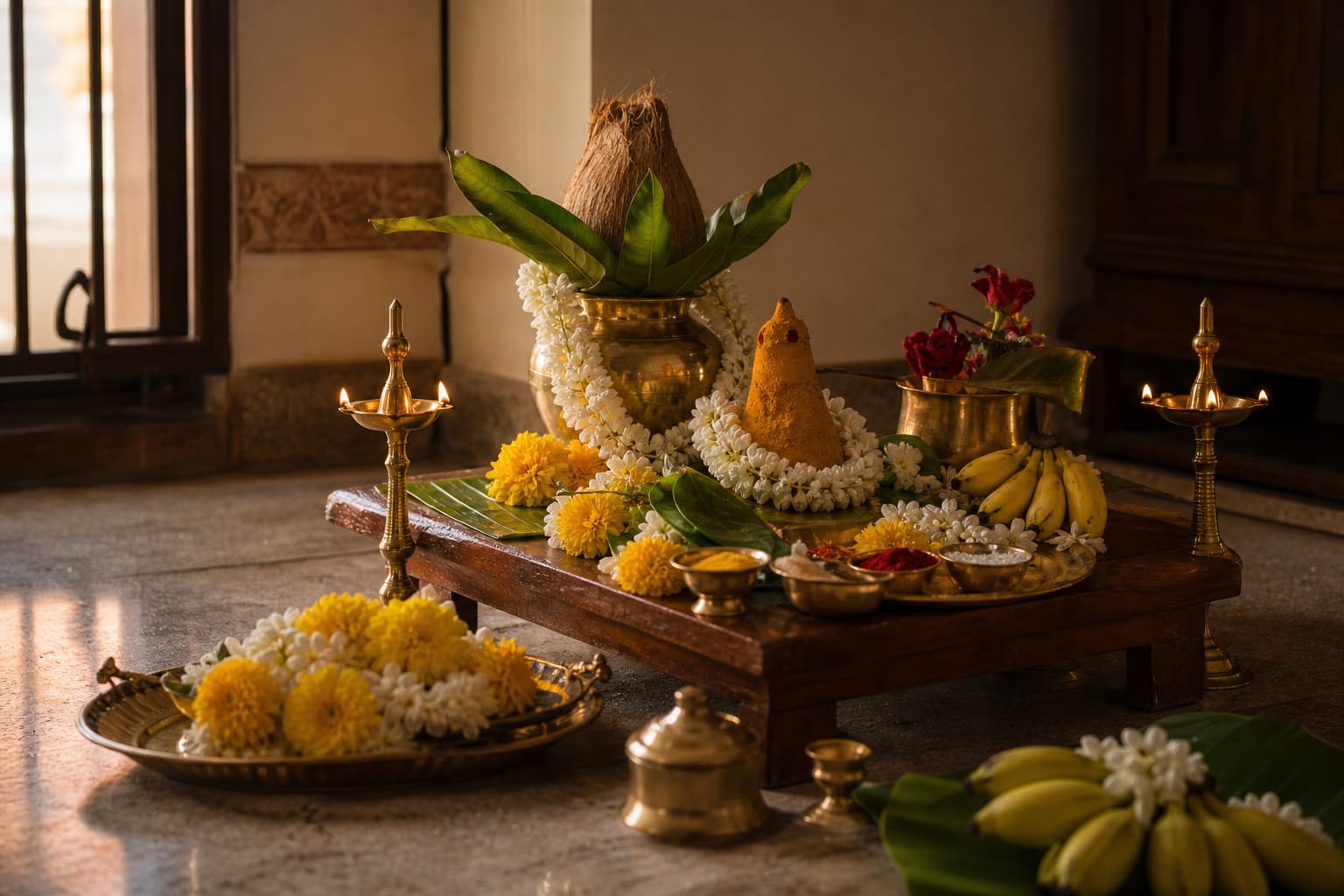
In Mysuru, the day before Ganesha arrives belongs entirely to his mother. It is a quieter day than the one that follows — no drums, no processions, no clay elephant-headed god being carried through the street. Just Gauri, invited into the house the evening before her son, welcomed the way you would welcome a daughter home. Growing up, I understood the sequence before I understood the theology: first the mother, then the child. You do not seat the guest of honour and forget the person who raised him.
Swarna Gauri Vrata is kept most seriously in Karnataka, and in pockets of Andhra and Tamil Nadu, on the Tritiya of Bhadrapada — the third day of the waxing moon. Swarna is gold, Gauri is Parvati in her fair, unmarried form, and vrata is a vow kept with fasting. In 2026 it falls on Monday, 14 September, one day before Ganesh Chaturthi. If your family panchanga marks a different tithi, follow your family. What follows is not the only correct way — every household has its own turns — but it is a clean version you can complete properly, on your own, far from the aunts who usually run the show.
I have written this the way I was taught to practise music: not as inspiration, but as a sequence you can trust. Learn the order, and the feeling arrives on its own.
What the vrata is, in one line
You invite Gauri into a small idol, treat that idol as her living presence for the day, offer her everything a beloved guest is owed, and tie a sacred thread that carries the vow on your wrist. Married women keep it most often, praying for the wellbeing of the household, but anyone who wishes to honour the goddess may observe it.
1. Prepare the space, the evening before
Choose the cleanest corner of the house — the puja room, or a low table against an east or north wall. Wipe it down the night before. Traditionally a small mantapa is raised: an arch of banana stem on either side, strung with mango leaves across the top. If a banana stem is out of reach, and in most flats it is, a clean wooden platform with a torana of mango leaves above it is enough. Draw a rangoli where the idol will sit. Gauri is being received as a guest of the highest order; the room should look like it knows that.
2. Gather everything first, so you never break the puja to fetch
Set all of this out the night before, so that once you begin you do not stand up:
- The Gauri idol — a turmeric-paste figure (arishina gauri), a clay or metal one, or a framed picture.
- Turmeric, kumkum, sandal paste, and akshate (rice mixed with a little turmeric).
- A small kalasha — a brass or silver pot with water, a coin, and a coconut set on mango leaves at the mouth.
- The sixteen-knot yellow thread — the gauri dara — one for each person who will keep the vow.
- Milk, curd, ghee, honey and sugar for the abhisheka.
- Flowers, a new blouse-piece or length of cloth, bangles, a comb, a small mirror, kajal.
- A coconut, jaggery, fruit, betel leaves and areca nut, a lamp with ghee and cotton wicks, camphor, and incense.
- Cooked offering — usually kadubu, payasa, or chakli, whatever your household makes for Gauri.
3. Begin with yourself, then the lamp
Bathe and wear clean, preferably new or festival clothes. Sit facing the idol. Light the ghee lamp first — nothing in a puja happens before the lamp. Do three slow achamana sips of water, and a short prayer to Ganesha to remove obstacles, even though it is his mother's day; he is invoked first out of courtesy in almost every rite.
4. Invoke Gauri and give her the bath
Place the idol on the mantapa. With folded hands, invite the goddess to be present in it — avahana. Then perform the abhisheka: bathe the idol, in order, with water, milk, curd, ghee, honey and sugar, and water again to finish. If the idol is turmeric paste or paper and cannot be bathed, touch each substance to the kalasha instead, and wipe the idol only with a damp cloth. Dry her, dress her in the new cloth, and decorate her with turmeric, kumkum, sandal, flowers, bangles and the small mirror. This dressing of the goddess is the heart of the day — do it slowly.
5. The sixteen offerings, and the incense
Offer the shodashopachara — the sixteen honours — in whatever short form you know: seat, water for the feet, water for the hands, arghya, a sip of water, a bath already done, cloth, sandal, flowers, incense, lamp, food, and salutation. This is where you light the incense. In a Karnataka puja room the smell that settles over everything is usually sandalwood, and it is not decoration; the scent is one of the sixteen offerings in its own right, the way sound and light are. We make a sandalwood incense for exactly this kind of morning, though a stick your family has always used is worth more than any brand. Chant the Gauri or Parvati mantra you know — the Lalita ashtottara, or simply Om Gauryai Namaha — a hundred and eight times if you can, on a tulsi or rudraksha mala.
6. Tie the gauri dara
Take the sixteen-knot thread, offer it briefly to the goddess, and tie it on the right wrist — your own, and those of the other women keeping the vow. The sixteen knots are the vow made visible. It stays on until it wears away or until an elder removes it after the festival. This small yellow thread is, for many women, the whole festival distilled into one act.
7. Aarti, and the reading
Offer the cooked food — place it before her, sprinkle water around it, and invite her to eat. Then do the mangala aarti with camphor, circling the flame, and if your household reads the Gauri vrata katha, read it now while everyone listens. Ring the bell, sing whatever you know. This is the point where a puja stops being a checklist and becomes a gathering.
8. The bagina exchange
The part of Swarna Gauri Vrata that outlives everything else is the bagina. Into a mora — a winnowing tray — you place rice, toor dal, turmeric, kumkum, a comb, a small mirror, bangles, a coconut, jaggery and a blouse-piece: the goddess's own dowry, in symbol. One bagina is offered to Gauri. The others are given to married women — muttaide — as her blessing passing from house to house. In apartment buildings far from home, mothers now do this over a landing or a shared kitchen, and it works exactly as well. The gift is the point, not the geography.
9. Keep the fast, and break it after dusk
Most women fast through the day — no cooked grains until the puja is complete and the sun has gone down. Break it in the evening with the prasada, fruit and milk. It is not a fast of hardship; it is a day of attention, where the appetite is simply turned toward the goddess instead of the kitchen for a few hours.
10. The next morning, Ganesha arrives
Leave Gauri in her place overnight. The next day is Ganesh Chaturthi, and her son joins her on the mantapa — this is why the festival is often called Gowri-Ganesha in one breath. Depending on family custom the Gauri idol is immersed with Ganesha, or kept a further day. Do the visarjana with the same care you did the invocation: a short aarti, a thank-you, and a request that she come again next year.
That is the whole vrata, in the order it happens. If you are keeping it for the first time this year, do not worry about performing every upachara perfectly. Gauri, of all the forms of the mother, is the least interested in flawless procedure and the most interested in whether you set the room with love. Light the lamp, dress her slowly, tie the thread, and the rest will hold together — the way a raga holds together once you have the first few notes true.


