
The Story of Tulsi: The Plant at the Heart of the Home
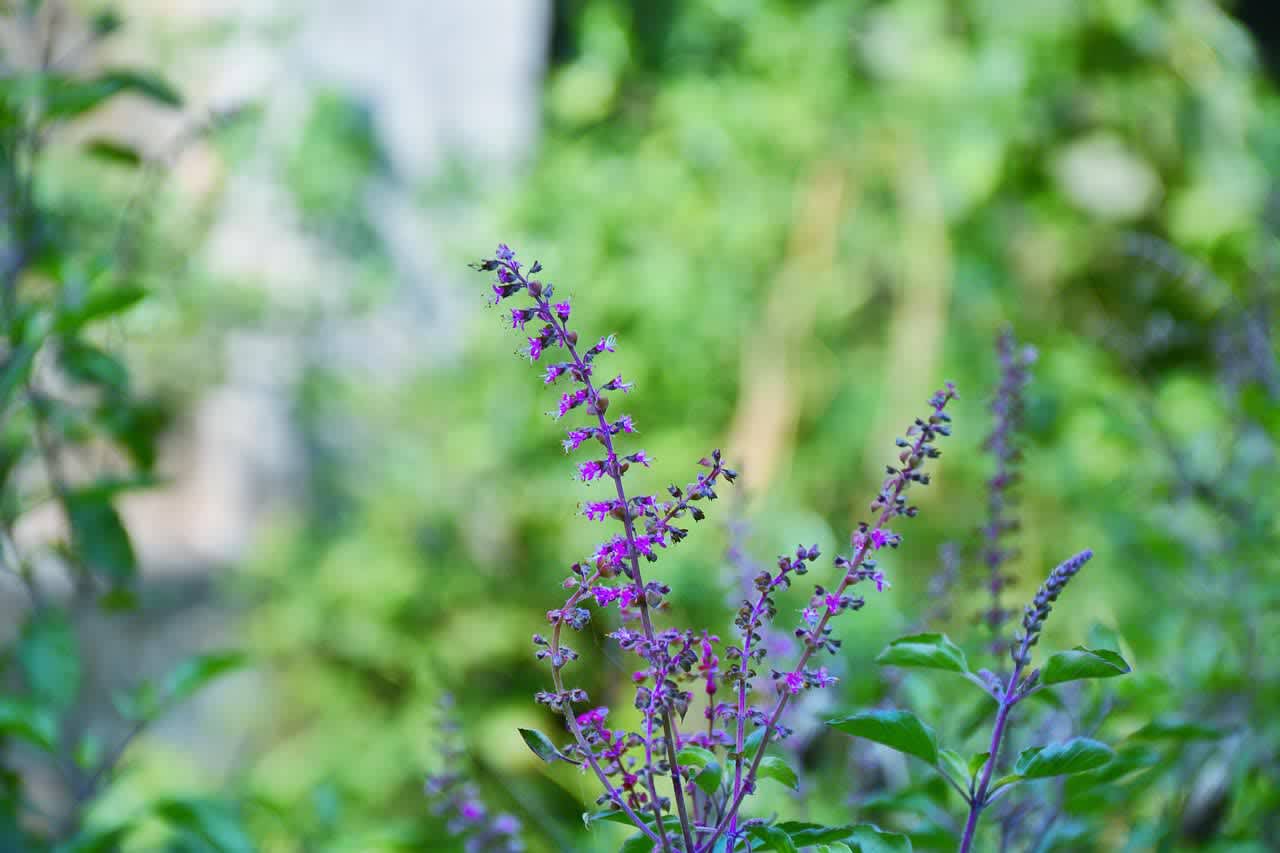
The first time I noticed it, I thought it was decoration. A small, leggy plant with narrow leaves, sitting in a raised pot in the middle of a courtyard in a house I was visiting. Not by the wall with the other plants. Not on a windowsill. In the middle, on its own little platform, as if the house had been built around it.
I am from Lisbon, and I did not grow up with this. So I asked what it was. The woman of the house said the word tulsi, and then, instead of explaining, she told me a story. I have since learned that this is often how the answer comes here — not a fact, but a story you are expected to carry home and think about.
This is that story, told as plainly as I can tell it. I am an outsider to it, so I will not pretend to more certainty than I have. There are several versions, and people who grew up with it will know details I do not.
The story of Vrinda
There was once a woman named Vrinda. In the tellings I have heard, she was extraordinarily devoted — to her husband, and to Vishnu, one of the great gods. Her devotion was not a small, private thing. It was so complete that it became a kind of power in the world.
Her husband was Jalandhar, a mighty and difficult figure, born of fire. He was close to unbeatable in battle, and the reason given for this is unusual: his strength rested on Vrinda's faithfulness. As long as she remained wholly devoted, he could not be defeated. Her constancy was, quite literally, his armour.
So when the gods needed him to fall, the problem was not his sword arm. It was her.
What happens next is the part people tell slowly, because it is not comfortable. While Jalandhar was away at war, Vishnu came to Vrinda in her husband's exact form. She welcomed him as her husband. In that moment her devotion, which had been perfect, was broken — not by her own turning away, but by a deception. And with it broke the shield around Jalandhar, who was killed in the same hour.
When Vrinda understood what had been done, she did not go quietly. In some versions she curses Vishnu — that he too will know separation, that he will be turned to stone. Hindus point to the shaligram, the smooth black river-stone kept in some households and worshipped as a form of Vishnu, as the shape that curse took. Then, holding her grief, she gives up her own life.
And from the place where she died, a plant grew. Vishnu, the story says, was so moved by what she had been that he gave the plant her devotion and her name, and declared he would never accept worship without its leaves.
That plant is tulsi.
Why I have stopped calling it decoration
I want to be careful here. I am not going to tell you what the story means — that belongs to the people who hold it as sacred, not to a visitor from Portugal. But I can tell you what changed in how I saw that courtyard.
The plant in the middle of the house is not decoration and it is not quite a houseplant either. It is a presence. In the tellings, tulsi is not merely dedicated to a god — she was a person, faithful and wronged, and the plant carries that. That is why she gets the raised platform, the little built pedestal called a tulsi vrindavan. That is why, in many homes, someone circles it in the evening, lights a small lamp at its base, gives it water first thing in the morning before anyone drinks. You are not watering a plant. You are keeping company with someone.
There is a whole festival built on this — Tulsi Vivah, in the autumn month of Kartik, where the tulsi plant is dressed and formally married to Vishnu in the form of that shaligram stone. A wedding, in the courtyard, for a plant. Once you know the story, it stops being strange.
I did have to look up when. In 2026 Tulsi Vivah is Saturday 21 November, and the looking up took longer than I expected, because the almanacs disagree with one another about the day before it. That day is Devutthana Ekadashi, when Vishnu is woken from the four months of sleep through which most families will not hold a wedding — which is why a plant's wedding is also, in many places, the first wedding of the season. Some calendars print that Ekadashi on Friday the 20th and others on Saturday the 21st. Neither is a misprint. The tithi opens at 7:15 on Friday morning, after dawn, and closes at 6:31 on Saturday morning, just before it, so in 2026 it never contains a sunrise at all; Smarta households keep the Friday, Vaishnava households the Saturday, and panchang makers simply print it twice under two names. It is the same awkward tithi that moves the five closing days of Kartika in Odisha. The wedding itself is the Saturday either way.
What an outsider can actually take from it
I burn incense and keep a small green thing on my table now — not because I have adopted anyone's faith, which would be dishonest, but because the courtyard taught me something a wellness magazine never managed to. It taught me the value of a centre.
Most of us arrange our homes around function. The sofa faces the screen. The table is where the laptop lives. Nothing in the room is there simply to be tended. The tulsi in that courtyard was the opposite: a fixed point the whole house turned toward, that asked for a small, unglamorous act of care every single day and gave back only its smell and its steadiness.
That daily returning — water in the morning, a lamp at dusk — is, I think, the actual thing underneath a lot of what gets sold to us as self-care. Not a product. A small repeated act at a fixed point in the day and a fixed point in the room. Tulsi leaves, crushed between the fingers, have a sharp, clove-and-pepper green smell that clears the head; it is why holy basil turns up in so many calming rituals. If you keep incense at home for the same reason — a scent that marks the shift from the working day into the evening — you already understand the instinct, even the ones we blend at Mahamaya's fragrance range are really just a portable version of it. Something at the centre. Something you return to.
Holding a story you did not grow up with
I have thought about whether it is my place to write this at all. I decided it was, on one condition: that I tell it as a guest, not an authority. I do not fast for Tulsi Vivah. I cannot read the texts in the original. I have almost certainly flattened details that matter to someone who grew up circling that plant at dusk.
But the woman in that courtyard did not hand me a rulebook. She handed me a story, and stories are made to travel. What travelled home with me was smaller than religion and, I think, allowed: the idea that a home is better with a centre in it. A living thing, or a scent, or a small light — something that is there to be tended rather than used.
So the tulsi stays on its platform in that courtyard in a town I visited once, watered every morning by a woman who knows the story far better than I do. And on my table in Lisbon there is a plant, and in the evenings there is a thread of smoke, and I understand, a little better than I did, why you might build a house around a plant.
If you know a version of Vrinda's story different from the one I was told — and there are many — I would rather hear it than defend mine. That is how it was given to me: passed hand to hand, no two tellings quite the same.


