
Tibetan Incense: The History of a Coreless Stick
On a shelf in a Siliguri shop that sells whatever a hill household needs, I once found two kinds of incense a hand's width apart. One was the packet anybody in India would recognise: thin sticks, a sliver of bamboo up the middle, a single scent named on the front — chandan, mogra, rose. The other was a heavy paper tube tied with string, and the sticks inside were fatter, crooked, dull brown, with nothing running through the centre at all. The label did not name a flower. It listed ingredients, and there were more than two dozen of them.
Those two packets are not variations on one product. They are the end points of two separate histories that happen to meet on a shop shelf in the foothills, because Siliguri is where the plains road runs out and the hill roads to Darjeeling, Kalimpong, Sikkim and Bhutan begin. Understanding why the second stick has no bamboo in it explains most of what is confusing about burning one.
The physical difference comes first
An agarbatti is built around a core. A thin split-bamboo stick is coated with a paste — charcoal or wood powder held together with a natural gum — and that base is then perfumed. The bamboo is structural: it is what your fingers hold, what keeps a very thin stick straight, and what lets the maker use aromatic material sparingly. It also means part of what you smell, always, is burning bamboo.
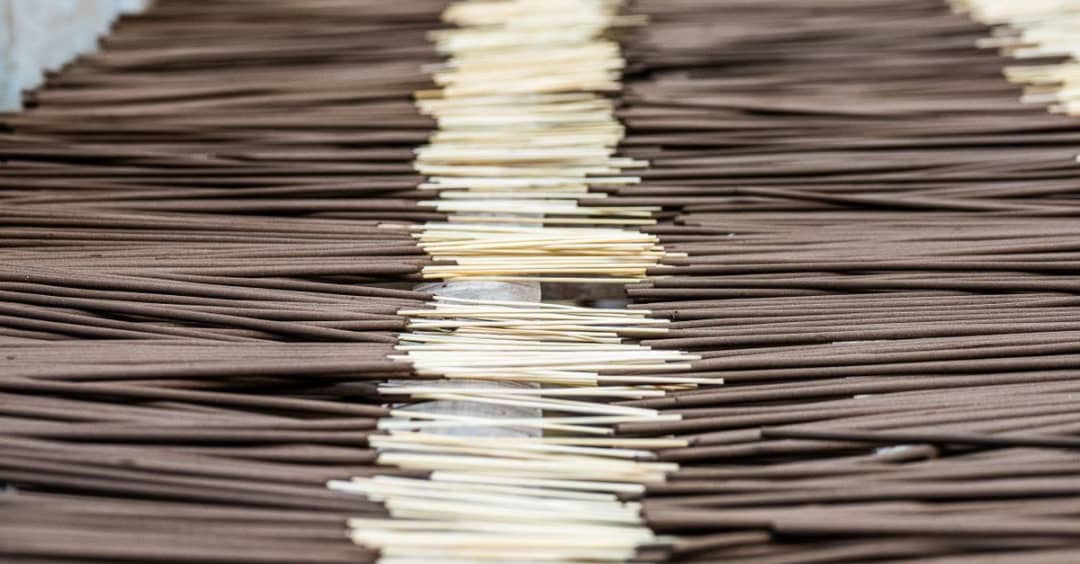
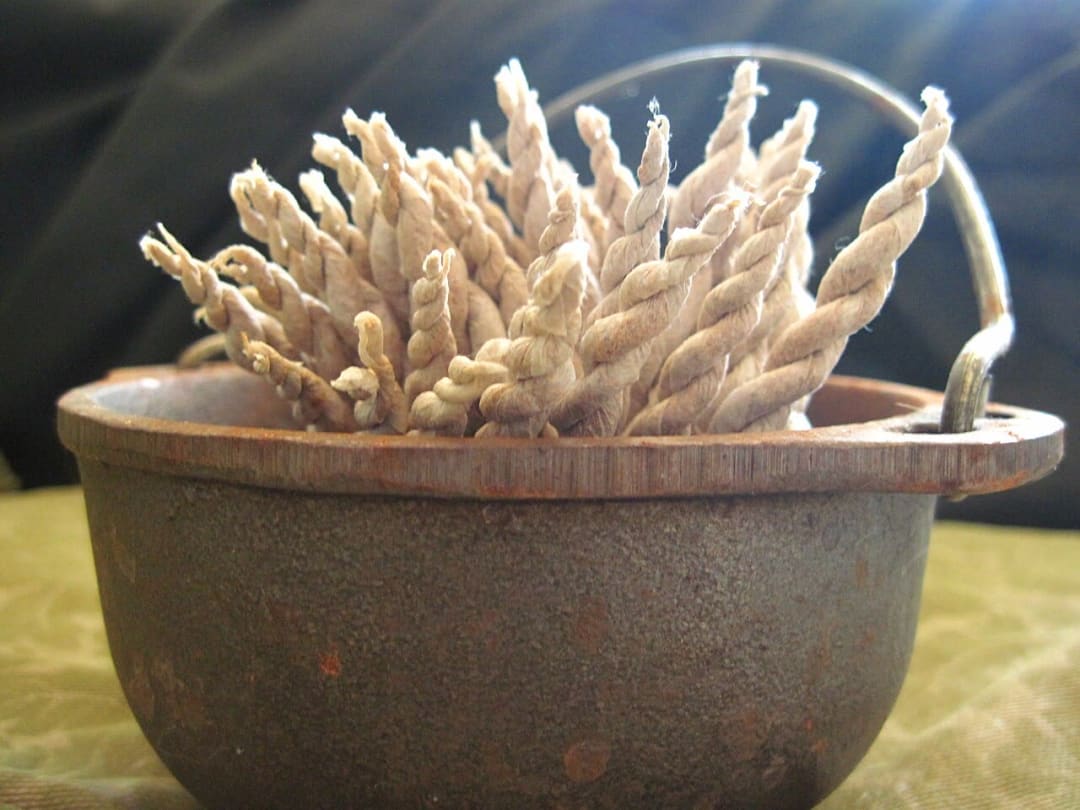
Himalayan and Tibetan incense is made without any core. The aromatic materials are ground to powder, mixed with water and a binder into a stiff dough, kneaded, then pressed out through a die into strands roughly the thickness of thick spaghetti. Those strands are dried on boards in air and sun, and cut by hand into burning lengths. There is no stick to grip and nothing left over at the end: the whole thing is aromatic material, and the whole thing turns to ash.
That single choice explains the rest. The stick has to be fat because nothing is holding it up. It is never perfectly straight because a dried dough strand never is. And it cannot carry one clean perfume note, because it is not perfumed at the end of the process — the smell is the sum of everything ground into it at the start.
A tradition of compounding, not perfuming
Incense arrived in Tibet with Buddhism, in the centuries when the religion was being carried across the Himalaya and translated — the seventh and eighth centuries and after. Sources differ on the details and it is wise not to be too precise about them. What matters is what incense was for: it is one of the standard offerings placed before a shrine, alongside water, flowers and light. It was never primarily a room fragrance.
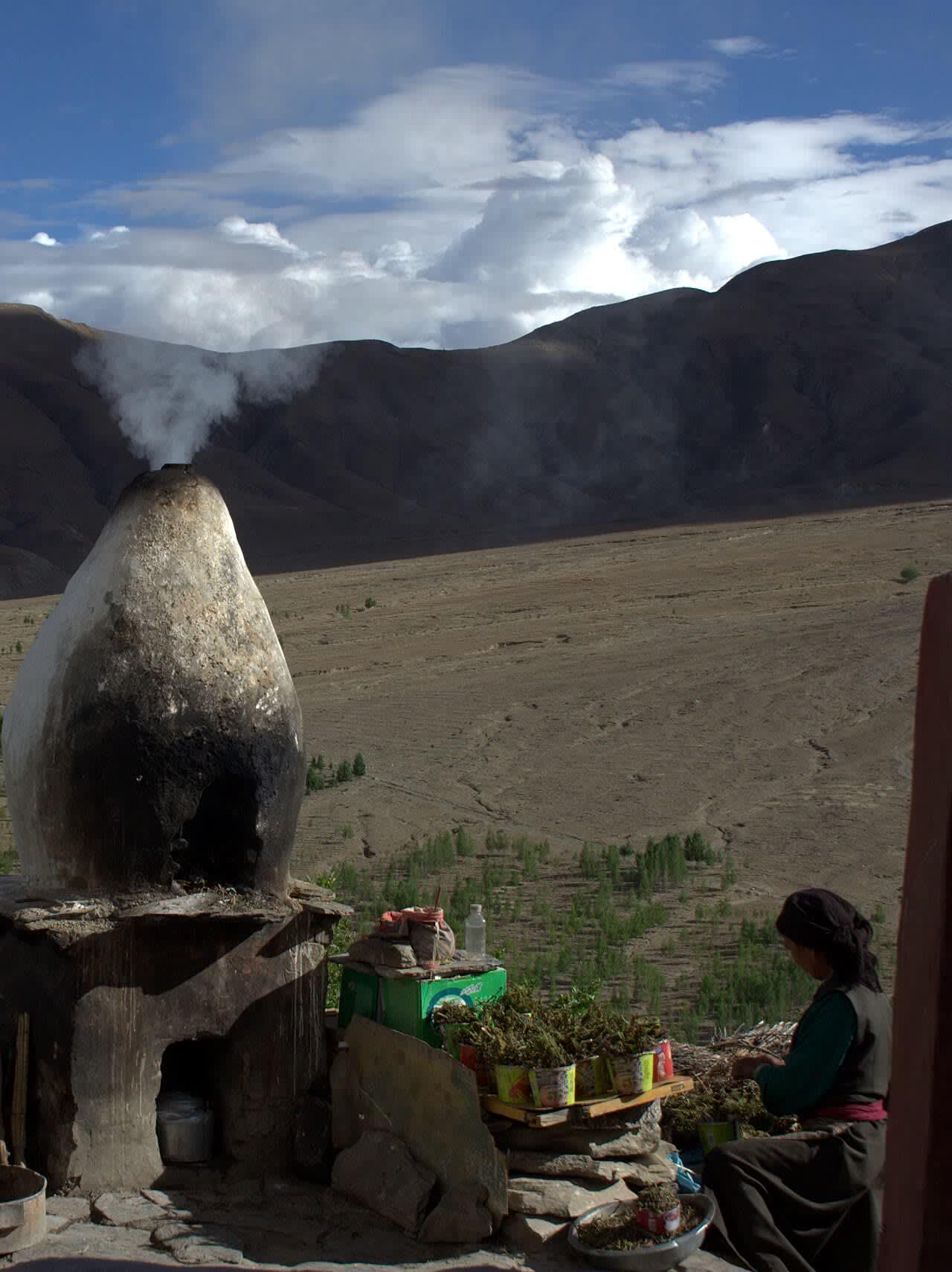
Underneath that Buddhist layer sits something older and, in daily life, more visible. Sang is the smoke offering — an armful of juniper burned in an open hearth or a whitewashed kiln-shaped burner, usually in the morning, sending a column of green smoke up over a village or a monastery courtyard. Juniper, shukpa, is the plant of that ritual. If you have been up in Sikkim or the Bhutan borderlands early enough, you have smelled it before you have seen anything.
The made stick, though, comes out of a third stream: Tibetan medicine. Sowa Rigpa is a formal compounding tradition with a written pharmacopoeia, and incense formulas sit inside it the way any other multi-ingredient preparation does — a named recipe, a fixed list, proportions, a method. Its scholars were physicians who wrote materia medica. Zurkhar Lodrö Gyalpo (1509–1579) produced one of the great commentarial works of that school; Deumar Tenzin Phuntsok (1673–1743) compiled the enormous two-part pharmacopoeia known in short as the Shel Gong Shel Phreng, finished in 1727, which catalogues thousands of substances. This is why a Tibetan incense box reads like a formulary and an agarbatti box reads like a perfume.
Worth saying plainly: that a stick was compounded inside a medical tradition is a fact about its history, not a promise about your health. What the lineage gave the craft was a habit of exactness — fixed lists, weighed proportions, named authors — which is unusual in incense anywhere.
What is actually in one
The recurring materials are high-altitude plants, most of them collected rather than farmed. Juniper. Sunpati, the dwarf rhododendron Rhododendron anthopogon, a shrub of open slopes between roughly 3,300 and 5,100 metres, which turns up in almost every sang mixture. Sandalwood, traded up from the south for centuries. Spikenard — jatamansi — whose root gives the cool, damp, faintly bitter note that reads as "Tibetan" to most people. Then clove, saffron, assorted barks and resins, in quantities that vary by recipe.
Two things follow. The first is that the smell is green, woody and slightly medicinal rather than sweet — closer to a cold hillside than to a flower. People raised on Indian incense often find their first Tibetan stick disappointing for about a week, and then find nothing else has the same weight. The second is a real supply problem: jatamansi is on Appendix II of CITES and assessed as critically endangered on the IUCN Red List, largely because harvesting it means pulling up the whole plant for its root. Any tradition built on wild alpine plants is working against that arithmetic now, and honest producers say so on the box.
The road, and what happened to it
For most of the last century the trade came through here. Kalimpong, an hour and a half up from Siliguri, was the Indian end of the caravan route to Lhasa: goods went by mule over the Jelep La, a pass of just under 14,000 feet, down into the Chumbi valley and on north. In the 1950s the warehouses were full and the mule trains continuous, carrying cloth, oil, cereals, watches, even bicycles reassembled on the other side. Wool, musk and the aromatic material of the plateau came the other way.
That stopped in 1962. The war closed both Jelep La and Nathu La, and the Kalimpong trade did not so much decline as end. Nathu La was reopened for limited border trade on 6 July 2006, forty-four years later; Jelep La stayed shut. The godowns are still there, and the road still goes up, and it goes nowhere.
The making moved instead. After 1959 the tradition was rebuilt outside Tibet by the institutions that carried it: the Men-Tsee-Khang, founded in Lhasa in 1916 under the Thirteenth Dalai Lama, was re-established in Dharamsala on 23 March 1961 and still produces incense to its own formulas. Monasteries and settlements across the Indian Himalaya took up the same work, and in Bhutan, uninterrupted, it grew into an industry.
So the tube on that shop shelf in Siliguri has a route behind it. Not a long one on a map, but a broken one.
Burning one, practically
- It needs a different burner. There is no bamboo tail to push into a holed plate. Stand it upright in a bowl of ash, sand or dry rice, or in a flat burner with a shallow well. Half the complaints about Tibetan incense are really complaints about it falling over.
- It gives more smoke. A fat all-aromatic stick puts out considerably more than a thin cored one, and in a small closed room that is too much. Open a window, or cut the stick in half — it is meant to be cut.
- It burns slower. Reckon on it outlasting an agarbatti of the same length, and light it before you want the room to smell of it rather than during.
- Keep it dry. A dough stick with no core takes up damp badly, and in a Bengal or Assam monsoon an open tube will go soft and burn unevenly. A tin with the lid on is enough.
Two answers to the same question
I have stopped asking which tradition is better made. They were solving different problems. Indian incense grew up around single named aromatics and the habit of offering a specific fragrance — which is why a good sandalwood stick is built to give one clear note and hold it, and why the signature fragrances most Indian houses reach for are named after what they smell of rather than after a recipe. Himalayan incense grew up around compounded formulas in a medical and monastic setting, where the point was the completeness of the mixture, not the legibility of any one note in it.
Burn a Tibetan stick expecting rose and you will be disappointed; burn an agarbatti expecting a formula and you will find it thin. Burn each for what it is. The shop in Siliguri was right to stock both.


