The 12 Jyotirlingas and Their Sacred Temple Fragrances

Few traditions in Hindu worship carry the weight and wonder of the Jyotirlinga — a "linga of light" believed to be a self-manifested form of Lord Shiva. Scattered across the length of India, from Gujarat's coastline to the Himalayan foothills, these twelve shrines have drawn pilgrims for over a thousand years. Each temple carries its own atmosphere, its own legend, and — for many devotees — its own remembered fragrance of sandalwood and camphor drifting through stone corridors.
Where the twelve come from
The story most often told comes from the Shiva Purana. Brahma and Vishnu fell into an argument over which of them was the greater. While they argued, a pillar of light appeared between them — with no visible beginning and no visible end. They agreed to settle the matter by finding its limits: Vishnu would travel downward to find the base, Brahma upward to find the top.
Vishnu went as far as he could and returned to say, honestly, that he had found no end. Brahma also found no end, but came back claiming he had reached the top and produced a witness to support it. Shiva then revealed himself from within the pillar. The lie cost Brahma his share of worship on earth, which is one traditional explanation for why temples to Brahma are so rare in India while temples to Shiva are everywhere.
That pillar of light is the Jyotirlinga — jyoti meaning light, linga meaning the mark or sign. The twelve shrines are the places where it is held to have manifested. They are not twelve copies of one temple; each has its own legend explaining why the light appeared there, and those local stories are often older than the Purana that ties them together.
Devotees traditionally recite the Dwadasa Jyotirlinga Stotram, a short Sanskrit verse that names all twelve in order. Saying the list is itself considered a form of pilgrimage — useful, given how far apart they are.
The twelve shrines
- Somnath, Gujarat — said to be the first among the Jyotirlingas, rebuilt many times through history.
- Mallikarjuna, Andhra Pradesh — perched on the Srisailam hills above the Krishna river.
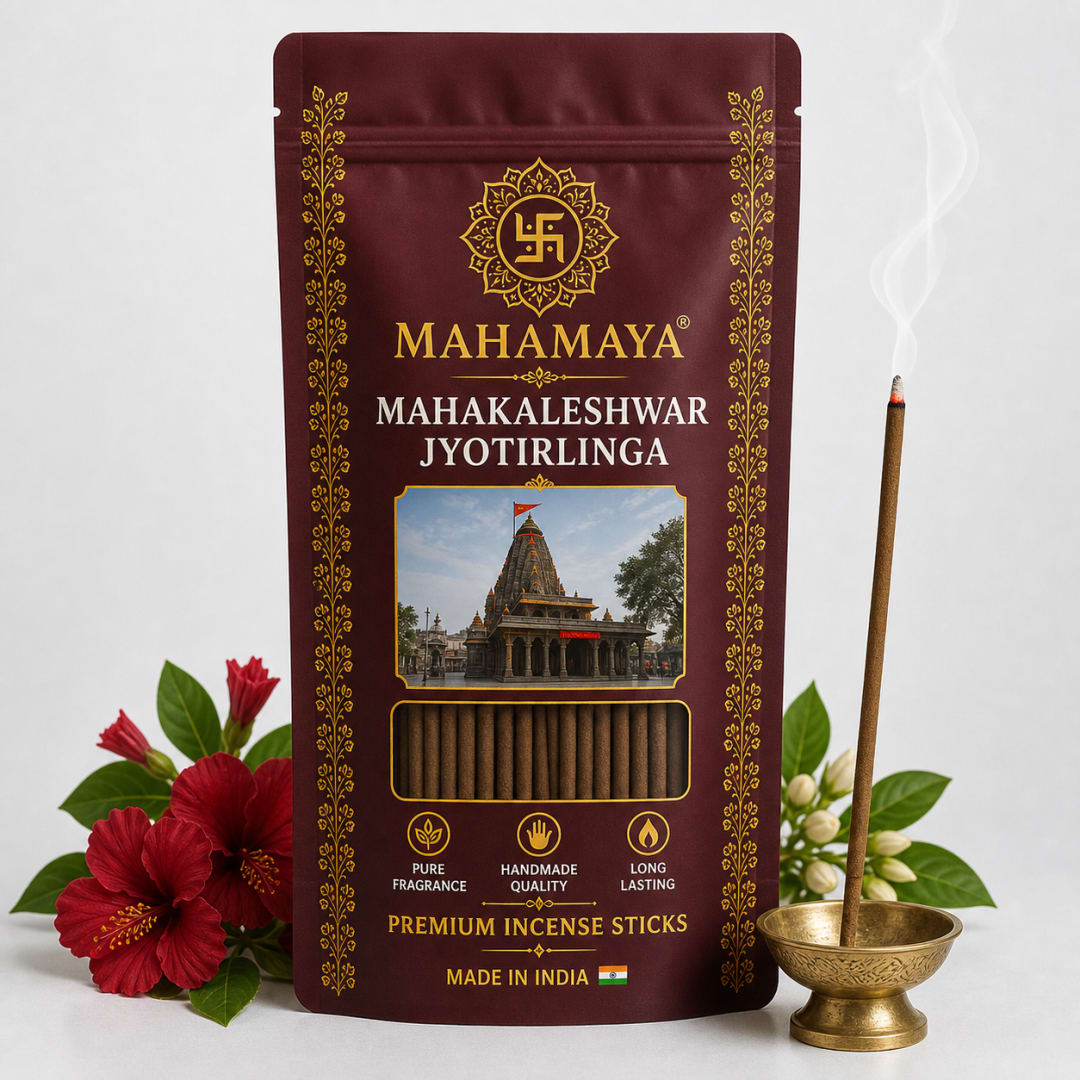
- Mahakaleshwar, Ujjain — the only Jyotirlinga facing south, home to the famous Bhasma Aarti.
- Omkareshwar, Madhya Pradesh — an island shrine shaped, legend says, like the sacred symbol Om.
- Kedarnath, Uttarakhand — the highest and most physically demanding of the twelve, high in the Garhwal Himalayas.
- Bhimashankar, Maharashtra — set deep within the Sahyadri hills near Pune.
- Kashi Vishwanath, Varanasi — on the banks of the Ganga, in India's oldest living city.
- Trimbakeshwar, near Nashik — source of the river Godavari.
- Vaidyanath, Jharkhand — associated with healing and relief from suffering.
- Nageshwar, near Dwarka, Gujarat — linked to protection from poison and harm.
- Ramanathaswamy, Rameswaram — where legend holds Lord Rama himself worshipped Shiva.
- Grishneshwar, near Ellora, Maharashtra — the twelfth and final shrine, close to the Ellora caves.
Twelve shrines, not one trip
It is worth saying plainly: almost nobody does all twelve in one journey. They span roughly the whole country — Somnath on the Arabian Sea, Rameswaram at the southern tip, Kedarnath at around 3,580 metres in the Garhwal Himalayas. Kedarnath itself is closed for about six months of the year, opening around Akshaya Tritiya and closing after Diwali, and the last stretch is a long walk or a pony ride regardless of how you arrive.
What people do instead is collect them slowly, in regional clusters. Ujjain and Omkareshwar sit close enough in Madhya Pradesh to pair over a couple of days. Trimbakeshwar and Bhimashankar are both reachable from Nashik and Pune. Somnath and Nageshwar are both in Saurashtra, near Dwarka. Most devotees we hear from have visited three or four across a lifetime, usually attached to some other reason for being in that part of the country — a wedding, a posting, a family visit.
That slow accumulation is part of why the set matters to people. It is a list you are always partway through.
What people remember is the smell of the place
Ask someone who has stood in the queue at Mahakaleshwar before dawn what they remember, and the answer is rarely architectural. It is the ash and camphor of the Bhasma Aarti. At Kashi Vishwanath it is wet stone, marigold, and sandal paste. At Rameswaram it is the water from the twenty-two wells and the salt in the air behind it.
Temple smell is a real and fairly consistent thing: sandalwood paste on stone, camphor burned in quantity, ghee lamps, crushed flowers, and the damp of a building that gets washed several times a day. It lands in memory harder than sight does, because scent reaches the brain's memory structures more directly than the other senses — which is why a fragrance can return you to a place decades later without warning.
That is the honest reason a fragrance range and a pilgrimage list belong in the same sentence. Not because a stick of incense substitutes for standing in the shrine, but because scent is the part of the experience that can actually travel home with you.
Why we made this range
Our Jyotirlinga range is a set of incense sticks, one for each shrine, meant for the home altar, the meditation corner, or simply a quiet evening. Each stick in the collection is handcrafted using natural ingredients, rolled and dried the traditional way, and finished with a devotional fragrance profile intended for daily puja, meditation, or simply creating a still, sacred atmosphere at home. The packaging carries the name and character of the shrine it honours — a small way to keep the memory of a pilgrimage, or the aspiration for one, present in everyday life.
We deliberately kept the fragrance notes warm and temple-like across the range — sandalwood, resin, and a touch of traditional dhoop character — rather than trying to force each stick into an artificially "unique" scent. The differentiation is in the story and the name, not a gimmick.
Bringing the range home
The full Jyotirlinga collection is available in our collections, individually or as part of a gifting set — a meaningful choice for Diwali, Shivratri, housewarmings, or for anyone who has made the journey to one of these twelve shrines and wants to carry a piece of it home.
For bulk or export enquiries, see our wholesale page.