
Ugna Mahadev: When Shiva Served the Poet Vidyapati
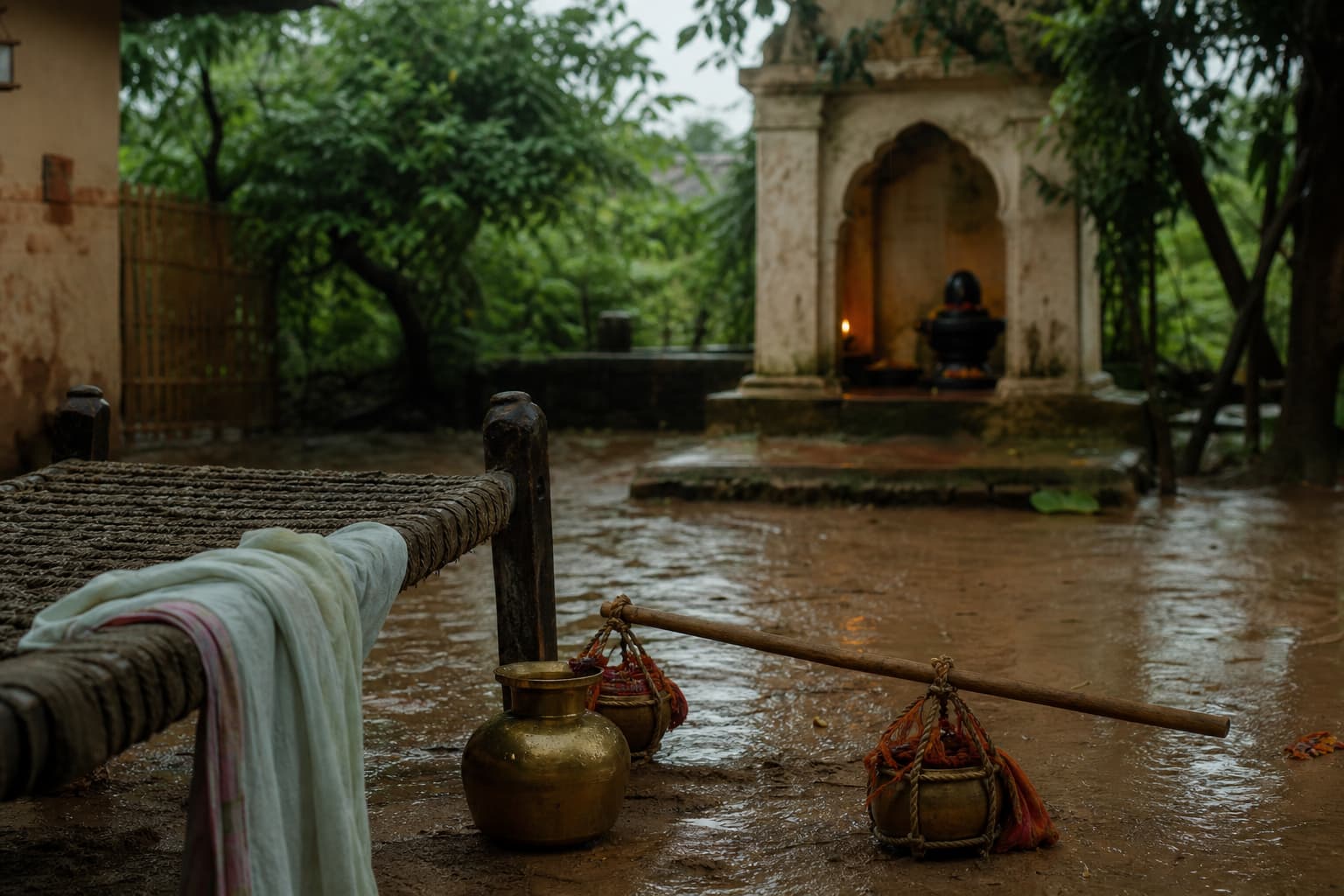
Sit for a minute. I want to tell you a story the way it was told to me — by my grandfather, on a cot in the courtyard in Darbhanga, during Sawan, when the whole of Mithila smells of wet earth and the men are walking to the Shiva shrines with water on their shoulders. This is not a story I read in a book. It is a story you inherit. Every household in Mithila has a version of it, and every version is a little different, and that is exactly how you know it is real.
It is about a poet. And it is about a servant who was not a servant.
The poet everyone in Mithila knows
His name was Vidyapati. If you are from our part of Bihar you grew up hearing that name the way other children grow up hearing about kings. He lived a long time ago — the books say 1352 to 1448, so a very long time — and he was born in a village called Bisfi, near Madhubani. We call him Maithil Kavi Kokil, the koel-bird poet of Maithili, because his verses sing.
Now, most people outside Mithila know Vidyapati for his love songs, the ones about Radha and Krishna. Beautiful, yes. But here at home we know him first as a devotee of Mahadev. He wrote Shiva songs — we call them Nachari and Ugna — and in Sawan you will still hear an old woman humming one over the grinding stone. That devotion is the whole point of the story. Because the story says Shiva loved him back.
Loved him so much that he came to live in his house.
A boy shows up at the door
Here is how the old people tell it. One day a boy arrives at Vidyapati's door. An ordinary-looking boy. He says he is looking for work, he will do the household chores, he only wants two meals a day — nothing more. His name, he says, is Ugna.
And Vidyapati — remember, a poet is never a rich man — thinks about it, and takes him in. Two meals. That is the whole salary. The boy sweeps, fetches, carries, serves. Quiet, willing, always there. Nothing about him seems unusual.
Except.
The water that tasted of Ganga
They are travelling one day — the poet and his boy — through open country, jungle, no village for a long way. The sun is high. Vidyapati is parched, the kind of thirst where you cannot think. He tells Ugna, half an order and half a plea: find me water, anywhere, or I will not make it.
And there is no water. Anyone can see there is no water. But the boy walks a little away, out of sight, and comes back with water in his hands. Cool water. Vidyapati drinks — and stops. Because he knows this taste. Every Maithil knows this taste. It is Ganga jal. Gangajal, out here, miles from any river.
He looks at the boy. The boy says nothing.
Now, the way my grandfather told it, this is the moment the poet understood and the moment he chose not to say it out loud — because to name it would be to lose it. There had been a condition, you see. The boy had come with one rule: never tell anyone who I really am. And so Vidyapati carried the secret, and served the boy his two meals, and let Mahadev of all the fourteen worlds go on sweeping his floor.
Sit with that a moment. That is the whole tenderness of the thing. God does the dishes, and the only price of keeping him is your silence.
The burning stick
But a house is a house, and secrets are heavy, and here is where every version breaks your heart the same way.
One day the boy makes some small mistake in the kitchen — nothing, the sort of thing servants are scolded for every day in every house. And the lady of the house, Vidyapati's wife, loses her temper and picks up a piece of burning firewood from the chulha to strike him.
Vidyapati walks in at exactly that moment. And he sees his wife raising a burning stick at — and the truth flies out of his mouth before he can stop it. Stop! Do you know who you are beating? That is Mahadev himself.
And that was the end of it. The word was spoken. The condition was broken.
They say Ugna simply — went. Not died, not left down the road. Vanished, the way a reflection goes when the water is disturbed. One breath there, the next breath gone, and a poet standing in his own courtyard calling a name into empty air. Ugna. Ugna. The old women, when they get to this part, they lower their voices.
The shrine at Bhawanipur
Now, is that history? I am an old man from Darbhanga, not a scholar — I will not stand here and swear to you which parts happened and which parts grew in the telling. What I can tell you is where you can go and stand.
There is a temple in a village called Bhawanipur, in Madhubani district — about fourteen kilometres out from Madhubani town, roughly a hundred and eighty from Patna. The Shivling there is called Ugna Mahadev, and the place is called Ugnasthan, the place of Ugna. People from all over Mithila go there, and they go in the heaviest numbers in Sawan, this very month, when a whole state turns toward Shiva. It is not a grand temple like the ones the tourist buses stop at. It is a Mithila temple. That is its own kind of thing.
If you are the sort who likes to trace the thread — the same Sawan devotion that fills this little shrine is what carries the great walking pilgrimages to the big Shiva dhams, and it is why, in our own workshop here in Bihar, the incense we roll and name for the twelve Jyotirlingas exists at all. A house that keeps Mahadev keeps his smell in the air. That is all I will say about that.
Why we keep telling it
I have thought about why this story lasts, why my grandfather bothered to tell it to a restless boy on a hot night.
I think it is because most of our religion teaches you to look up — to the peak, the flood, the fire, the god who is bigger than everything. And then here is this one story that turns it the other way. It says: he came down. He came to a poor poet's door and asked for a job. He carried water. He swept a floor. He let himself be scolded. The greatness of Mahadev, in this one Mithila story, is that he was willing to be small for someone who loved him.
And the warning inside it is just as sharp. What broke it was not sin, not pride, not anything wicked. It was a word said in a good cause — stop, you're hurting him. Sometimes what you love the most is kept only by holding your tongue.
So. Before I let you go, the three things to carry from this — because a story should leave you with something in your hand:
- Vidyapati was Mithila's koel-poet, a true devotee of Shiva, and his Ugna and Nachari songs are still sung here in Sawan.
- Ugna was Shiva himself, come as a servant for two meals a day — and the water he drew tasted of the Ganga.
- Bhawanipur, near Madhubani, is where you go to stand at the shrine that remembers all of it.
Next time you light a lamp for Mahadev, in whatever country you are reading this, remember that in one old story he was glad to fetch and carry for a man who simply loved him. Now go — the lamp is waiting.


