
Vidyarambham in Kerala — A Letter to a Cousin Abroad
Meenu,
Your voice note came in at four in the morning my time, which is how I know you recorded it on the way to work, and I have let it sit two days because it deserved more than a reply typed at a traffic light.
You said Ammu turns three in November. You said Valyammai has begun asking, on every call, whether you are "doing her Vidyarambham," in the tone that means the answer had better be yes. And you said — this is the part I keep turning over — that you do not actually know what you are being asked to arrange, that you have never watched one performed, and that it feels dishonest to hold a Malayalam ceremony for a child whose first full sentence was in English.
So: what the day is, when it falls this year, and what in it is essential as against what is only Kerala's local dress. Then you can decide.
The date, and why you will be given two of them
Vidyarambham is kept on Vijayadashami, the morning after Navratri closes. In Kerala this year that morning is Wednesday, 21 October 2026.
Somebody will tell you the twentieth. They are not wrong; they are answering a different question. Dashami tithi opens in the afternoon of the twentieth and runs to the afternoon of the twenty-first, and much of India keeps Vijayadashami on the day the tithi begins. Kerala's rite happens at first light, so what governs here is which morning has Dashami standing at sunrise — and that is the twenty-first. One tithi, two reckonings, both households keeping the day correctly.
If you can reach a temple, go by the notice on its own board rather than by any calendar, this letter included. Where a committee has fixed a time, that is the time the community will be sitting at.
The days before it matter too. On the Ashtami evening the books go in — Pooja Vaypp, the placing. Schoolbooks, ledgers, a carpenter's tools, a musician's instrument, whatever a person works with, all set down before the goddess and left alone. Nobody reads for two days. Then on the Dashami morning comes Pooja Eduppu, the taking back, and the books come out into a room that has been waiting for them. Vidyarambham sits inside that second moment. The child's first letters are the first work done after the pause.
I have always thought those two shut days are the cleverest part of the festival, and the part that travels worst. Everyone can picture a small child writing in rice. Fewer people notice that the tradition asks a whole household to stop reading first.
What actually happens
A child of about three is carried to a temple before the sun is properly up, or to whoever in the family or the neighbourhood is standing as Ezhuthachan — the one who writes, the one who starts you off. There will be queues at Thiruvullakkavu, at Panachikkadu, at the Dakshina Mookambika temple in Paravur, and at a hundred smaller shrines with nobody outside them but the four families who live on that road.
The child sits in the guru's lap. Then the same line is written three times, on three surfaces.
First on the tongue, with gold — a ring dipped in honey, the letters traced where nothing can be seen and nothing stays. Then in a shallow tray of raw rice, the child's finger guided, the shapes holding for a second in the grain. Only last on paper or a palm leaf, where writing behaves the way it will behave for the rest of her life.
The line is Hari Sree Ganapataye Namah, and it is not chosen for its meaning alone. Its Malayalam syllables carry most of the sounds a beginner has to get her mouth around, so it works as a first exercise too — a prayer that is also a scale.
I like what the sequence says about learning without ever saying it. Sweetness first, and invisible. Then something you can see that will not outlast the morning. Then the permanent record, last, once the other two have happened. Nobody explains this to the child. Nobody needs to.
Why three
Three is old, and it is practical: a child of three has enough hand to be guided and not yet enough opinion to refuse. But do not let anyone tell you the day carries an upper limit. Adults sit for Vidyarambham as well — someone learning to read late, someone taking up an instrument at fifty, someone beginning again after a long stop. Newspaper offices hold it for their staff. It is a beginning-of-learning day, not a toddler's day, and it has never really been about school admission, whatever the photographs suggest.
Doing it where you are
Here is the part you actually wrote to me about.
Malayali associations in the Gulf run group Vidyarambham mornings, and if one is within reach of you, go. Ammu will take something from a room full of other three-year-olds that she cannot take from her parents. Ask around before assuming there is nothing — these are organised quietly and announced late.
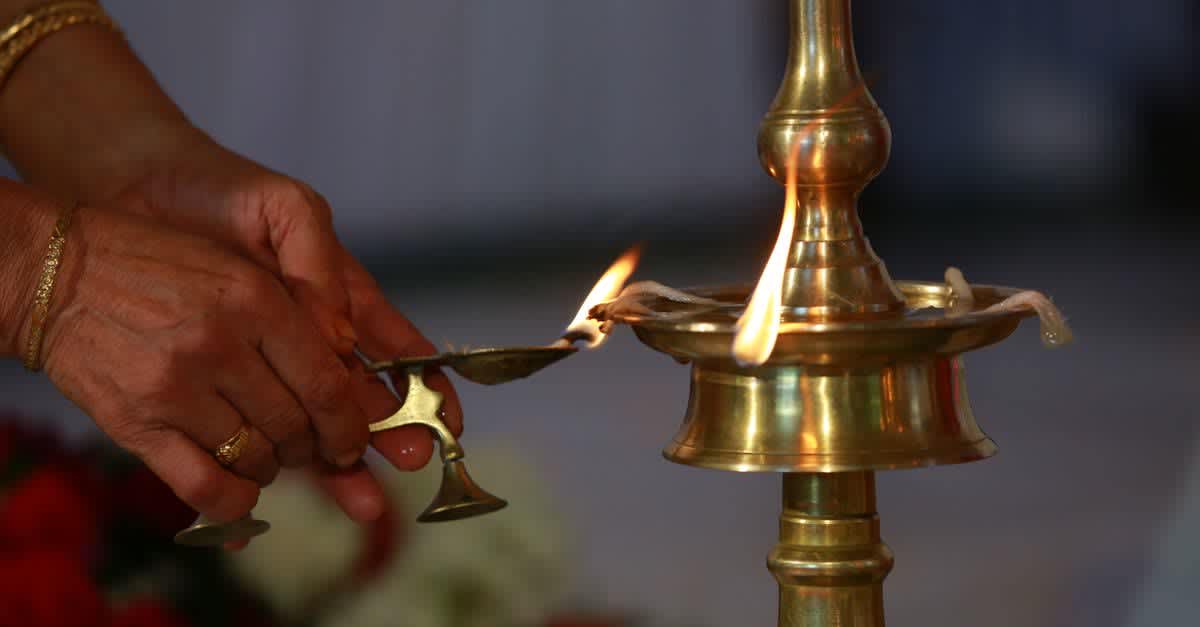
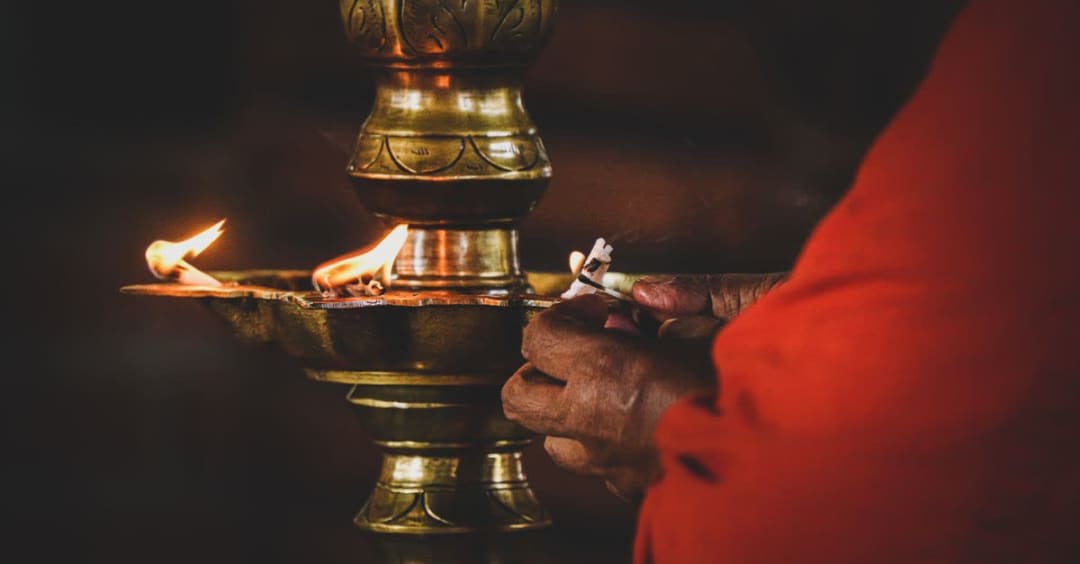
But if the nearest is four hours away, or the twenty-first is a working Wednesday and it simply cannot be done, then do it at home, and do it without apology. The rite has never required a temple. It requires a clean corner, a lamp, a person willing to be the one who starts her off, and a child sat down in front of them.
For the rest: a small tray of raw rice, a gold ring if there is one in the house and a clean coin if there is not, a little honey. A lamp lit before you begin, and something to scent the room, because smell does more than any decoration to tell a child that this corner is not the corner where breakfast happens. In our house it was always chandan, and the hand-rolled sandalwood agarbatti made in the small Bihar workshops is the same thing — slow enough to still be going when the whole business is over. The scent is not the rite. It is only what makes the floor feel like the right floor.
As for who writes the letters: the tradition names a guru, and in practice it is whoever in the family carries the standing. A grandmother on a video call cannot hold her hand, so let Valyammai watch and let one of you do the writing. There is nothing improper in that. Fathers and mothers and elder cousins have always stood in.
And write Malayalam. Yes, even though she will grow up thinking in English. The letters are not a promise that she will become a Malayalam reader; they are a record of the alphabet her family started her on. Write it in Malayalam and let her learn her English letters at nursery in January. The two have never been in competition except in the minds of the adults who are anxious about it.
The one thing I would ask
Do not turn it into a shoot.
The photographs are lovely and you should take some. But I have watched mornings where the phone came out before the lamp did, where a child was made to do the rice three times over because the first two frames were blurred, and where the only adult fully present was the one holding the camera. A three-year-old can tell the difference between being celebrated and being staged, even if she has no words for it.
Let one person film from where they are already sitting. Let everybody else simply be there.
Ammu will not remember it
She will not. That is fine — it was never for her memory. It is for yours, and for Valyammai's, and for whatever Ammu does with the photograph at nineteen when she comes across it.
What she may keep is smaller and stranger than a memory: a grain of rice under a fingernail, a sweetness at the front of her mouth, a brass lamp too bright to look at straight, a room of adults gone quiet at an hour when adults are usually loud. Children hold on to the sensations and lose the occasion. It is enough.
Light the lamp early, before the room warms. Sit her down. Take her hand and write.
Devesh


