
Vishnupad Temple, Gaya: The History of a Footprint
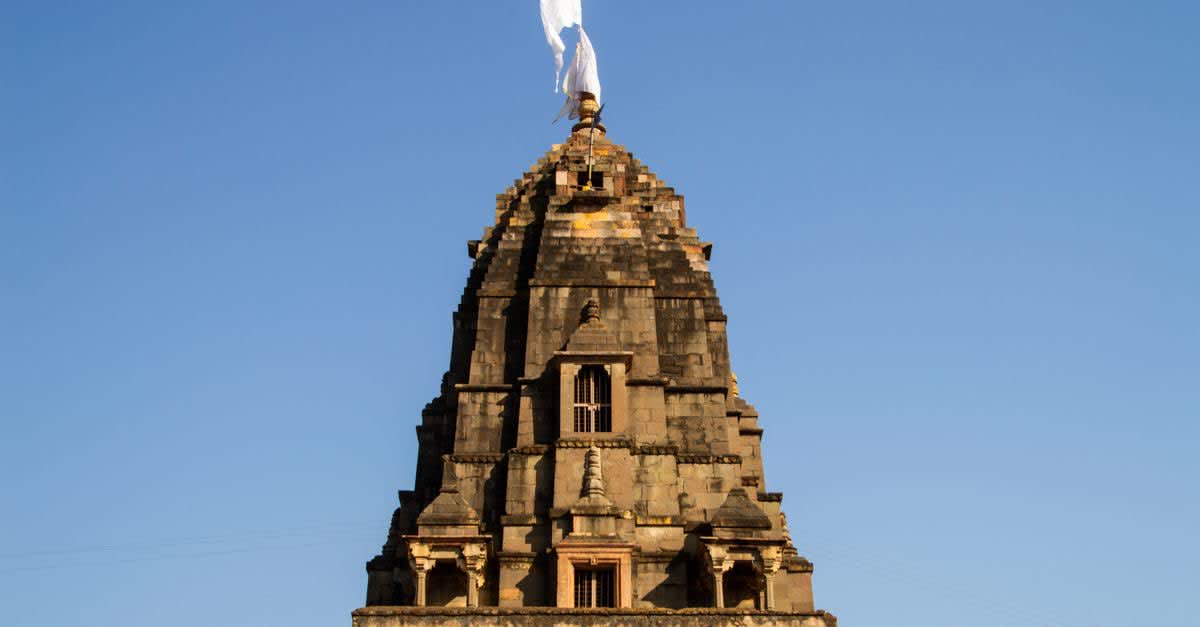
In our part of Bihar we measure the year by the fields — the wheat cut before Holi, the paddy standing tall through the rains, the short dry weeks after Bhadrapada when the ponds shrink and the rivers thin to a walking path. It is in exactly those weeks after the monsoon, when the Falgu river at Gaya runs low enough that you can cross it on foot, that families from every corner of the country start arriving. They come to a temple built around a footprint pressed into black stone. They come to feed their dead.
I have stood in that courtyard. The stone underfoot is cool even at noon, worn smooth by generations of bare feet. What people have come to see is small — a mark in the rock no longer than a forearm — but the weight of what surrounds it is old beyond easy counting.
The footprint and the demon
The temple takes its name plainly: Vishnu-pad, the foot of Vishnu. At its heart is the Dharmashila, a block of basalt carrying a footprint about forty centimetres long, said to be the print of Vishnu's own foot.
The tradition attached to it is one of the oldest Gaya stories. There was a demon, Gayasura, whose penance had made him so pure that anyone who so much as looked upon him was freed of their sins and released from the cycle of birth and death. This, the story goes, threw the order of things into chaos — hell emptied, the machinery of consequence stalled. To settle it, Vishnu pressed his foot down upon Gayasura to hold him in the earth, and the demon, dying, asked one thing: that the place bearing that footprint become sacred forever, a ground where the living could act for the dead. The town carries the demon's name to this day — Gaya.
I tell it here the way it has been told, not as something I can prove. What can be said plainly is that by the time the great texts were being compiled, Gaya was already famous. The Ramayana remembers Rama coming here to perform the last rites for his father Dasharatha; the Mahabharata and the Puranas return to Gaya again and again as the pre-eminent place for ancestral offerings. Long before any temple you can see today, the ground itself was the shrine.
What the shraddha at Gaya means
To understand why a footprint in a riverbank town draws such crowds, you have to understand shraddha — the rite a family performs for its ancestors — and pind daan, the offering of rice balls to them.
Across India a family will perform shraddha at home, or on a nearby riverbank, especially during Pitru Paksha, the dark fortnight that falls after the monsoon each year in the month of Bhadrapada rolling into Ashwin. But Gaya holds a particular place. The belief, held for well over a thousand years, is that a pind daan performed here does what no other can — it grants the ancestors a final release, so that the family need not repeat the rite endlessly. People speak of coming to Gaya "to finish" the obligation: to give a father, a grandmother, a whole line of the dead their rest.
This is why, during Pitru Paksha, Gaya fills. The Pitru Paksha Mela brings pilgrims from across India and from the diaspora abroad — families who saved for the journey, sons who flew in from the Gulf or from Canada to sit on the Falgu's sand and let a priest guide their hands through the offering. In the households I grew up around, the smell of that fortnight is unmistakable — sesame and barley, the smoke of loban, the frankincense-and-benzoin resin that our own family workshop in Samastipur still rolls into incense the old way. It is the scent of remembering.
The queen who rebuilt it: Ahilyabai Holkar, 1787
Here the history becomes firmer, and it is a history I am fond of, because it belongs to a ruler who spent her power well.
The shrine as a piece of ground is ancient. The temple you actually walk into, though, is not. The present structure was raised in 1787 by Ahilyabai Holkar, the Maratha queen of Indore — the same remarkable widow-ruler who, in the second half of the eighteenth century, rebuilt or restored Hindu temples and ghats across the whole of northern India, from Kashi Vishwanath in Varanasi to Somnath on the western coast to the ghats of the Narmada.
The account that has come down about the Gaya rebuilding is a builder's account, and I like it for that. Ahilyabai's officers were sent out to find the right stone — not any stone, but the hardest and finest the region could offer. They settled on the dense black basalt quarried near Jaynagar, the dark, ringing rock that Bihar's stonecutters have prized for centuries. From it they raised an octagonal temple, roughly thirty metres tall, with carved pillars supporting the mandapa and a shikhara crowned in later years by a flag of gold. Stand back from it and the thing reads as deliberately plain and immensely solid — no riot of sculpture, just black stone cut clean and stacked to last.
That restraint tells you something about the woman who commissioned it. Ahilyabai was not building a monument to herself. She was returning a ruined and much-plundered pilgrimage site to working order, so that ordinary families could keep doing what families had done here for a thousand years.
The Falgu, the river that hides its water
You cannot separate the temple from its river, and the Falgu is a strange one. For most of the year it looks like a broad bed of pale sand with barely a trickle across it — a river that seems to have gone underground. There is an old story that Sita cursed it to run dry after it gave false testimony during Rama's own shraddha here; the geologists would tell you instead that the water flows beneath the sand, and both explanations sit side by side in Gaya without anyone minding.
What matters to the pilgrim is that the dry bed becomes the ritual ground. During Pitru Paksha the sand fills with families sitting in the open, priests moving among them, the offerings laid out on the very riverbed the texts have named for centuries. The temple stands over it all on the bank, its black shikhara catching the low post-monsoon light.
Going, if you go
Gaya is easy to reach — it sits on the main line in south Bihar, an hour or so from Bodh Gaya, where the Buddha found his enlightenment under the pipal tree, so many travellers see both. The Vishnupad temple's inner sanctum is, by long custom, open to Hindus; the courtyard and the outer temple are there for anyone who comes respectfully.
If you go outside Pitru Paksha you will find it quiet — a working temple, priests unhurried, the footprint waiting in its silver-railed enclosure. If you go during the fortnight, come knowing what you are walking into: not a sightseeing stop but the busiest grief in the country, thousands of people doing the oldest thing families do, which is to refuse to forget.
The wheat will be sown again after this. The Falgu will fill and thin again with the seasons. And each year, when the fields go quiet after the rains, the road to Gaya fills once more — people carrying their dead the last little distance, to a footprint in the rock that a demon asked for, and a queen made sure would still be standing.


