
Vishwakarma Puja in Begusarai — A Letter to My Nephew
Bikash beta,
Your message came through while I was still at the tubewell, so forgive the delay in replying. You asked a small question and I am going to answer it at length, because it is not as small as you think it is.
You wrote that on the seventeenth of next month your office will be open as usual, that nobody there will know what day it is, and that you feel foolish thinking about putting a marigold on a laptop. You asked whether Vishwakarma Puja is a day for people like you at all, or only for us here with our machines.
Here is my answer, and then the reasoning behind it, which is the part worth reading.
The date, and why somebody will tell you a different one
This year Vishwakarma Puja falls on Thursday, the seventeenth of September. It is not counted by the moon like most of our festivals, which is why it lands on nearly the same date every year — the sun crosses into Kanya, the last day of Bhadra by the eastern reckoning, and that is the day. In 2026 the crossing happens a little before eight in the morning.
If somebody in your building tells you the puja is not in September at all, do not argue with them. They are also right. In parts of north India, and in some Bihar households too, a Vishwakarma day is kept later in the year instead — some say the day after Diwali, some place it in Magh. Both observances are old and I am not the man to settle it. The September date is the one this district works to, because this district has factories.
Who he is, in plain words
Vishwakarma is the maker. He is named in the oldest hymns as the one who shapes and fastens and joins — the mind behind a thing being built, rather than the thing itself. Later tellings credit him with palaces and chariots and weapons, and those tellings do not agree with each other, so I will not pretend to more than that.
On the ground it is simpler. He is not the god of one trade only. The carpenter and blacksmith families keep his day most seriously, and it is right that they do, since it has been their day the longest. But on the seventeenth you will also see a tea-stall man garland his stove and a barber garland his chair, and neither of them thinks he is trespassing.
In the pandals in the eastern towns he is shown young, with his elephant standing beside him. The image goes into the water the next morning.
What actually happens here
Let me tell you the shape of the day as it goes in the villages around us, since you were too small the last time you watched it properly.
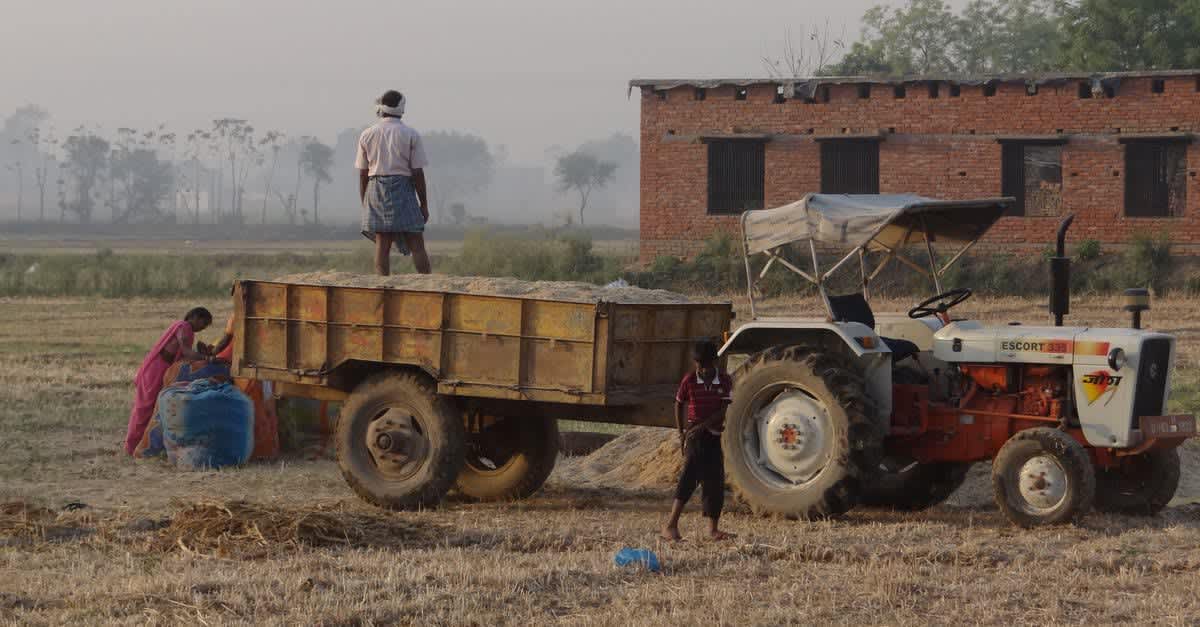
It begins before the field work would have begun. The pump-set is washed first — the diesel engine at the tubewell, the one thing on this land that decides whether we eat. A kerosene rag over the block until the grease lifts, water over the housing, the fuel line wiped down. Then the tractor. Then the thresher, if it is out from under its tarpaulin.
Then the marks. Roli on the nose of the tractor, a small swastika if somebody's hand is steady enough, a garland over the steering column. A banana, a coconut broken, batasha. Somebody's wife will have made something sweet and it goes around the whole yard, including to the mechanic who is not from our village and who has been paid late twice this year.
And then the part that surprises people who have not seen it. Nothing is started. The pump does not run. The tractor does not move. In the middle of a working season, on a working farm, the machines are given the day off, and the men stand around with tea looking at them.
The refinery, and the kites
You know Barauni. The refinery has stood on the bank there since 1964, and a great many families in this belt have somebody who has drawn a wage from that side — the refinery, the thermal plant, the fertiliser works, or one of the small workshops that live off all three.
Inside those gates the seventeenth is a real event. Shrines go up on the shop floor itself. Lathes are cleaned down. Men who spend the whole year being careful about safety spend one day saying the same thing in a different language.
And in the afternoon the sky fills with kites. That confuses visitors, who associate kites with Sankranti in January. Here they go up on Vishwakarma's day — off the roofs of the quarters, off any harvested plot flat enough to run on. By evening there is string in the mango trees.
Why a farmer takes this seriously
Now to your actual question.
You think the puja is about the machine. It is not, quite. Here is what I believe it is about, and you may take it or leave it.
A machine is the only thing on this land that we notice exclusively when it fails. Nobody looks at a pump that is pumping. You look at it at eleven at night in June, when it will not catch, and the field is going dry, and the mechanic's phone is switched off. That is the whole relationship most of us have with the things we depend on — silence, then panic, then relief, then silence again.
One day in the year, we look at it while it is working. We wash a thing that is not dirty enough to need washing. We put a flower on an engine that cannot see it. And in doing that we admit something a farmer does not otherwise say out loud: that the year does not turn on our own strength alone. It turns on a casting somebody poured in a foundry we will never see, and on a repair somebody chose to make properly instead of quickly, and on a design that came out of a mind that was not ours.
That is also why the machine is left still. A day of rest given to a tool is the only way there is of thanking a tool.

And the timing is not accidental. This is maize country — Begusarai is one of a handful of districts that carry most of Bihar's maize between them — and by the middle of September the kharif crop is finishing its business while the ground is already being thought about for what comes next. The puja sits exactly in that gap: after what the machines have just done, before what they are about to be asked to do.
So, your desk
Yes. Do it. And do not make it complicated.
Clean the thing. Properly, not symbolically — the screen, the keyboard, underneath it, the cable you have been meaning to sort out since March. If you have a flower, put it there. If you have a lamp, light it. If you want the smell of the day, one stick of incense is enough — we roll ours a district over in Samastipur, though any honest agarbatti does the same work.
Then, if your office allows it at all, do not work for that half hour.
That last part is the whole thing. Everything before it is decoration.
One more thing
Do not put a tika on somebody else's equipment without asking first, and do not go around telling your colleagues that this is what they ought to be doing. The day travels badly when it is explained loudly. It travels well when one person quietly stops working for half an hour and cleans something he depends on.
Your mother says you have not sent a photograph in four months. The maize is standing well this year, the Burhi Gandak behaved itself through August, and the mechanic's phone is still switched off.
Write when you can.
— your Suresh chacha


