
Yamunotri: The First Dham and the Climb From Janki Chatti
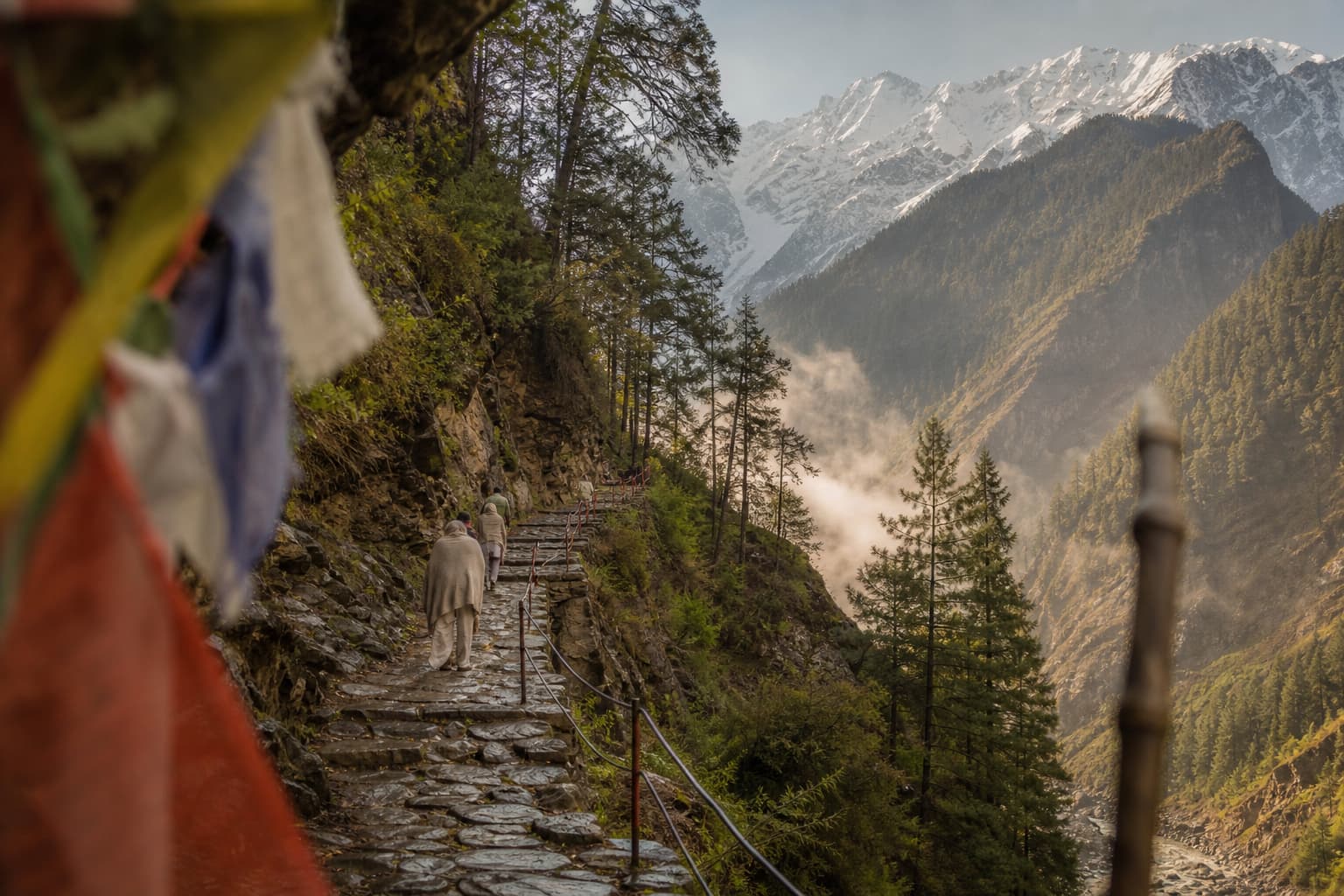
From the ninth floor of an apartment in Dubai, the Himalaya is an idea. You keep it the way people in the Gulf keep a lot of home — as a photograph, a grandmother's story, a plan for a year that keeps moving. Yamunotri, in particular, is one most of us have heard named long before we could place it on a map. It is where the Char Dham begins. The first of the four shrines. The one you are supposed to do first if you are doing them in order, west to east, before Gangotri, before Kedarnath, before Badrinath.
I want to write down what the walk up to it is actually like, because most of what circulates about Yamunotri is either a route map or a photograph of the temple, and both are true and neither prepares you. The shrine sits at 3,293 metres in the Garhwal hills, at the head of a narrow valley. You do not drive to it. The road ends at a small settlement called Janki Chatti, and from there you walk.
Janki Chatti, before six
Everyone who has done it tells you the same thing, and they are right: start early. The last road-head, Janki Chatti, sits at about 2,370 metres, and by the time the sun is properly up the trail is a slow river of people and ponies and it gets hot in the exposed stretches even when the air is cold. So the camp wakes in the dark. Torches move between the guesthouses. Tea is poured from big steel kettles. Somewhere a queue is already forming for the registration check, because since the pandemic years the Uttarakhand government has made online registration compulsory for the whole Char Dham circuit, and no one is meant to start the trail without it.
It is worth saying plainly, before any of the rest: this is a cold-country walk that people arrive for in summer clothes. Bihar and Delhi and Dubai are all thirty-odd degrees in the season the yatra runs, roughly late April to the middle of November, and pilgrims step off the bus in cotton and are genuinely surprised. Carry a layer you would be embarrassed to need. At the top you will be glad of it.
Six kilometres, and what they cost
The trek is about six kilometres one way. On paper that is nothing — an hour on flat ground. On the ground it is three to four hours of climbing, because almost all of it goes up, and it goes up in a valley thin enough that the light comes late and leaves early.
You share the path. There are ponies, hired at the bottom by those who cannot manage the gradient, and there are palanquins — four men carrying one seated pilgrim on poles, usually someone elderly, usually someone who has wanted to come for a very long time. There are pithoo baskets in which small children and, sometimes, very old parents are carried up on a porter's back. Nobody on this trail pretends it is easy. That is part of what it is. The Char Dham has never been a comfortable pilgrimage, and Yamunotri, being the first, is where people learn what their legs are actually going to do for the next two weeks.
The cold at the top is not the dramatic, breathless cold of the higher dhams. Yamunotri is lower than Kedarnath and much lower than Amarnath; you are not really fighting the altitude here. What you are fighting is the gradient and the thinning of the light, and the plain surprise of a place that is snow-fed cold at the exact hour your body expected the plains. Halfway up you stop pretending you will not stop. You stop. You drink water. You look back down the valley at the line of people behind you, and it is a strange, moving thing to see — a thread of the living, walking uphill toward a river's beginning.
The goddess at the source
Yamunotri is the seat of Yamuna — not the polluted river people know from the Delhi bridges, but the goddess at her origin. In the old telling she is a daughter of Surya, the sun, and the sister of Yama, who is death, and of Shani. That family matters to the pilgrims here. Because she is Yama's sister, bathing in her waters is held to soften a hard death, and the small brass image inside the shrine is bathed and dressed and offered to in that spirit — not fear of dying, exactly, but the wish to meet it gently.
The temple you reach is not ancient in its stones. This is high, hard country, and the shrine has been damaged by weather and avalanche and rebuilt more than once over the centuries; what stands now is comparatively recent. The devotion is the old thing, not the masonry. Mahamaya, the incense we roll down in Samastipur, keeps a stick named for each of the four Char Dham shrines, Yamunotri among them, and I mention it only because the naming is the easy part — it is standing in the actual cold at the head of the actual valley that tells you why anyone bothered to name anything after this place.
Divya Shila, and the spring that boils
Before you go in to the goddess, you pay respects to the Divya Shila — the "slab of divine light" — a rock pillar near the temple that pilgrims touch and worship first, in the order the priests will tell you. Then there is the thing almost everyone remembers longest: the Surya Kund.
The Surya Kund is a hot spring, geothermal, water boiling straight out of the mountain a few steps from an ice-fed river. The contrast alone stops people. And the custom is beautiful in its practicality — pilgrims tie raw rice and potatoes into a cloth, lower the bundle into the boiling water on a string, and take it out cooked. That rice, cooked in the spring, is carried home as prasad. There is something in that image that stays with you longer than the darshan: the mountain itself doing the cooking, a whole queue of people waiting for their small tied bundle of rice, steam going up into cold air.
Walking back down
The queue for the sanctum can be long in season, longer on Sundays and around the Shravan weeks when the plains empty themselves toward the hills. You wait. You go in. It is brief, as these things are — a few seconds in front of a small dark image, a hand raised, and then the press of people behind you moves you out again. Nobody I have ever heard describe Yamunotri leads with the darshan. They lead with the walk, and the cold, and the spring.
Then you turn around and walk down the six kilometres you climbed, and the descent teaches its own lesson, which is that going down a mountain is harder on the knees and easier on the lungs and gives you time, at last, to be quiet. That quiet is the part a wellness magazine would try to sell you and cannot. It is not a technique. It is just what is left in a person after a long uphill walk toward a river's beginning, when the wanting is finished and only the walking-home is left.
From a ninth-floor apartment, the mountain will go back to being an idea. But you will have cooked rice in a spring that boils out of a glacier, and that stays real in a way a photograph never manages. The Char Dham is done in order for a reason. You begin at the water. You begin at Yamunotri.


