
Chopda Pujan and Labh Pancham: Gujarat's Merchant Year
Gujarat's trading year does not turn on Diwali night. It turns across three separate days, and each one does a different job — the account books are consecrated on the first, the year-number changes on the second, and the shop actually reopens for trade on the third.
In 2026 those days are Sunday 8 November, Tuesday 10 November and Saturday 14 November.
Key takeaways
- Chopda Pujan (Sun 8 Nov 2026) — the new account books are sanctified on Diwali night, before Lakshmi, Ganesha and Sharda.
- Bestu Varas (Tue 10 Nov 2026) — the Gujarati new year's day, falling on Bali Pratipada. This is when the Samvat number changes.
- Labh Pancham (Sat 14 Nov 2026) — the first working day. The ledger is opened and written in, and trade resumes.
- Almost every English listing compresses these into a single "Gujarati New Year" entry, which loses the sequence that is the whole point.
What is Chopda Pujan?
Chopda — also spelled chopada — is the Gujarati word for a traditional bound accounting book. Chopda Pujan is the worship of those books, performed on Diwali night as part of the household and shop Lakshmi Puja. The rite is also called Muhurat Pujan.
What is placed before the deities is not a symbol of the business. It is the business's actual records: the books that will carry the coming year's figures, new and unwritten, along with incense, kumkum and a lamp.
It is worth saying plainly that this is not a Gujarat-only observance. Panchang sources note it is kept in Rajasthan and Maharashtra as well, by trading communities there. Gujarat is simply where it is most visible and most organised.
The modern form is less of a break than you would expect. Where a business runs on accounting software rather than bound volumes, the laptop goes in front of the deities instead, with swastika, om and shubh-labh marked on it. The object changed; the gesture did not.
When exactly are the three days in 2026?
| Date | Day | What it is | What happens |
|---|---|---|---|
| Sun 8 Nov 2026 | Diwali / Lakshmi Puja | Chopda Pujan, with Sharda Puja | New account books are consecrated |
| Tue 10 Nov 2026 | Bali Pratipada | Bestu Varas — Gujarati New Year | The Samvat number changes |
| Wed 11 Nov 2026 | Bhai Dooj | Chitragupta Puja | A separate pen-and-inkpot rite |
| Sat 14 Nov 2026 | Kartika Shukla Panchami | Labh Pancham | The shop reopens; the ledger is written in |
The gap between the 8th and the 10th is not an error. There is no Pratipada sunrise on Monday the 9th that year, which is why Bestu Varas and Govardhan Puja both land on the Tuesday — the same two-day structure covered in our piece on the five days of Diwali.
Why does the year turn on Bestu Varas and not on Diwali night?
Because Gujarat counts its Samvat from Kartika, and most of north India counts from Chaitra. Gujarat's year therefore begins in autumn rather than in spring, on the first day of the bright fortnight of Kartika — Bali Pratipada.
This is easier to check than to argue about, and the panchang shows it directly. On the day panchang for 2026, the Gujarati Samvat row reads 2082 Pingala through Monday 9 November, and 2083 Kalayukta from Tuesday the 10th. The number and the year-name both change overnight.
Meanwhile the separate Vikram Samvat row on the same page reads 2083 Siddharthi throughout — unchanged across all of those dates, because that reckoning started back in Chaitra. The two rows sit one above the other and disagree, which is exactly the point.
So "Vikram Samvat 2083" on its own does not tell you whether the Gujarati year has turned. Two different years can carry the same number and a different name, and only one of them begins at Diwali. Both rows read identically whether you set the panchang to Delhi or to Ahmedabad, so this is not a regional quirk of one city's calendar.
Why is Saraswati worshipped at a business puja?
The 8 November panchang prints Sharda Puja alongside Chopda Puja. Sharda is a name of Saraswati, and her presence at a merchant's rite confuses people who expect Lakshmi alone.
The reasoning given is direct: wealth without wisdom and learning does not last. Lakshmi is asked for prosperity, Ganesha for the judgement to keep it, and Sharda for the knowledge to grow it. An account book sits naturally under all three, because a ledger is a knowledge object before it is a wealth object — it is a record of what was understood about a year.
Is this the same as Chitragupta Puja?
No, and the two are easy to confuse because both worship the tools of record-keeping.
Chitragupta Puja is kept on Bhai Dooj, Wednesday 11 November 2026, largely in Kayastha households, and what is worshipped there is the pen, the inkpot and the register of a divine accountant. Chopda Pujan is a merchant's rite on Diwali night, and what is worshipped is a working business's own books. Different day, different community, different object. We have written about the Chitragupta side of it in Govardhan Puja and Bhai Dooj.
What actually happens on Labh Pancham?
Labh means benefit or gain, and Labh Pancham — also called Saubhagya Panchami and Gyan Panchami — is the fifth day of the bright fortnight. In Gujarat the Diwali season culminates here rather than at Diwali, and it is treated as the first working day of the new year. Shops that have been shut since the festival open their shutters on this morning.
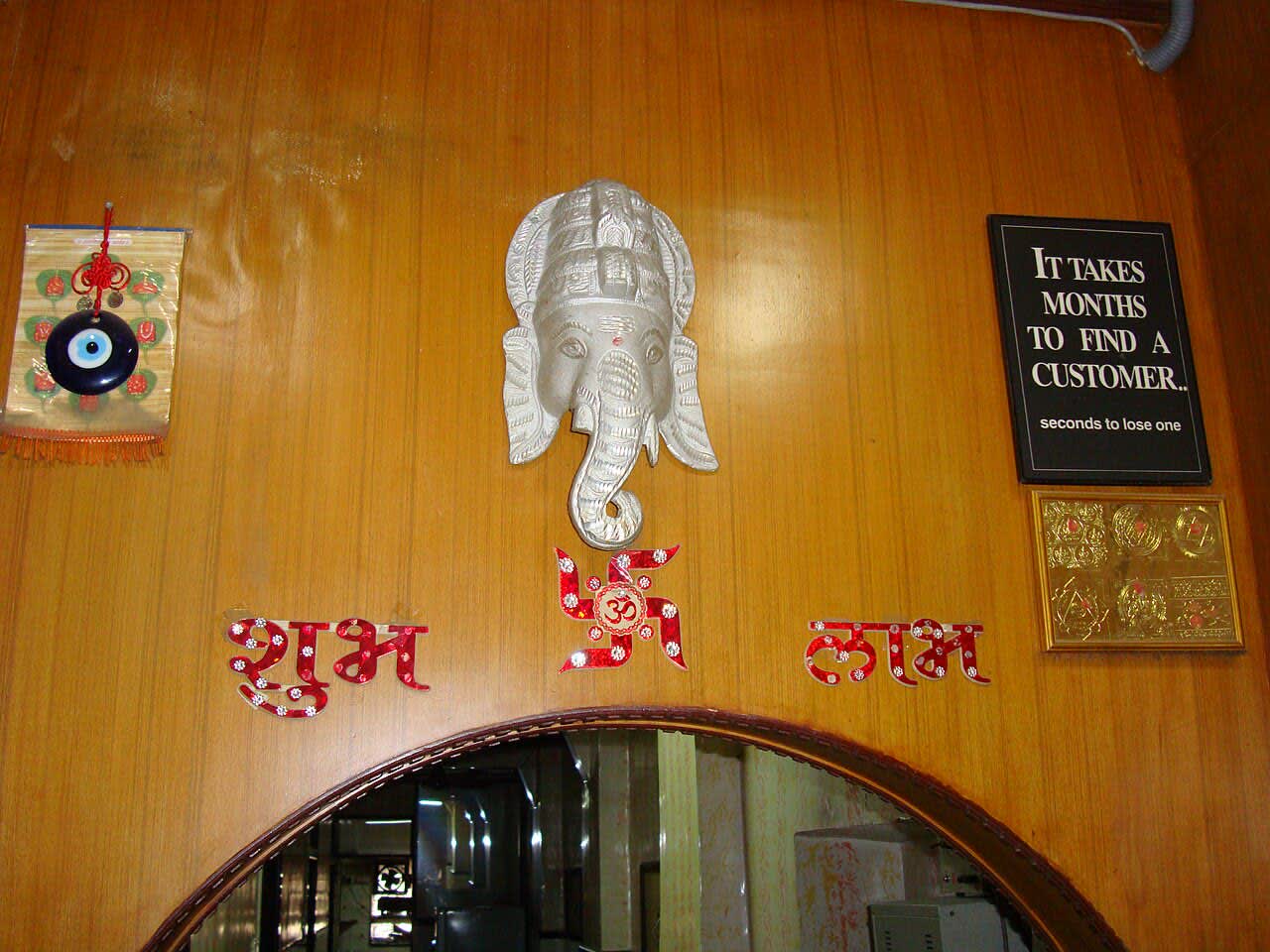
The detail worth knowing is what is done to the book. The new ledger — khatu in Gujarati — is inaugurated by writing शुभ (shubh) on the left of the first page, लाभ (labh) on the right, and drawing a sathiya in the centre between them. Auspiciousness on one side, profit on the other, and the mark of good fortune holding the middle. You can see the same three-part arrangement painted above the doorway of almost any old shop in western India, which is where most people have met it without knowing what it was for.
The books were consecrated six days earlier. This is the day they are finally written in.
What the three days are counting
Read as one festival, this is just a long Diwali. Read as three, it is a precise piece of sequencing — and the sequence says something.
The books are blessed before the year begins. The year then turns on its own day, with nothing asked of it. Only on the fourth day after that does anyone write a figure down. The rite puts three clear days between consecrating the instrument and using it, which is an unusually patient way for a trading culture to behave.
There is a near-opposite version of the same instinct elsewhere. In Kerala households, during Navratri, books and tools are placed before the goddess on the Ashtami evening and deliberately not opened for two days — the pause is the offering. In Gujarat the books go in and come back out to be used. One tradition closes the book to honour it; the other opens it. Both are saying that the thing you work with is not merely equipment.
Questions people ask
What is Chopda Pujan?
It is the worship of a business's account books on Diwali night, before Lakshmi, Ganesha and Sharda. Chopda or chopada is the Gujarati word for the traditional accounting book. The rite is also called Muhurat Pujan and Chopada Pujan.
When is Chopda Pujan in 2026?
Sunday 8 November 2026, the same day as Diwali and Lakshmi Puja. The panchang prints Chopda Puja and Sharda Puja together on that date.
When do Gujarati shops reopen after Diwali?
On Labh Pancham, Saturday 14 November 2026. It is treated as the first working day of the Gujarati new year, and many businesses do not resume trade before it.
Is Bestu Varas the same as Diwali?
No. Bestu Varas is the Gujarati new year's day and falls on Bali Pratipada, Tuesday 10 November 2026 — two days after Diwali night. The Gujarati Samvat number changes on that morning, not on Diwali.
Why is Saraswati worshipped at a Diwali business puja?
Because the account book is treated as an object of knowledge as much as of wealth. Sharda is a name of Saraswati, and the reasoning given is that wealth without wisdom and learning is not sustainable.


